Is that a Cardinal or a Pyrrhuloxia?


A Female Northern Cardinal could be Confused with a Pyrrhuloxia (photo Bob Bowers)

A Female Northern Cardinal could be Confused with a Pyrrhuloxia (photo Bob Bowers)

Whether you collect rocks or photograph wildflowers, it’s always more fun when you know what you are looking at.  Similarly, one of the pleasures of birding is being able to identify the birds you are watching.  A good field guide and a decent pair of binoculars work well for most of our birds.  However, some species are similar to others, juvenile birds often look like they were adopted, females like to be drab (we’re talking birds here) and they all refuse to wear name tags.
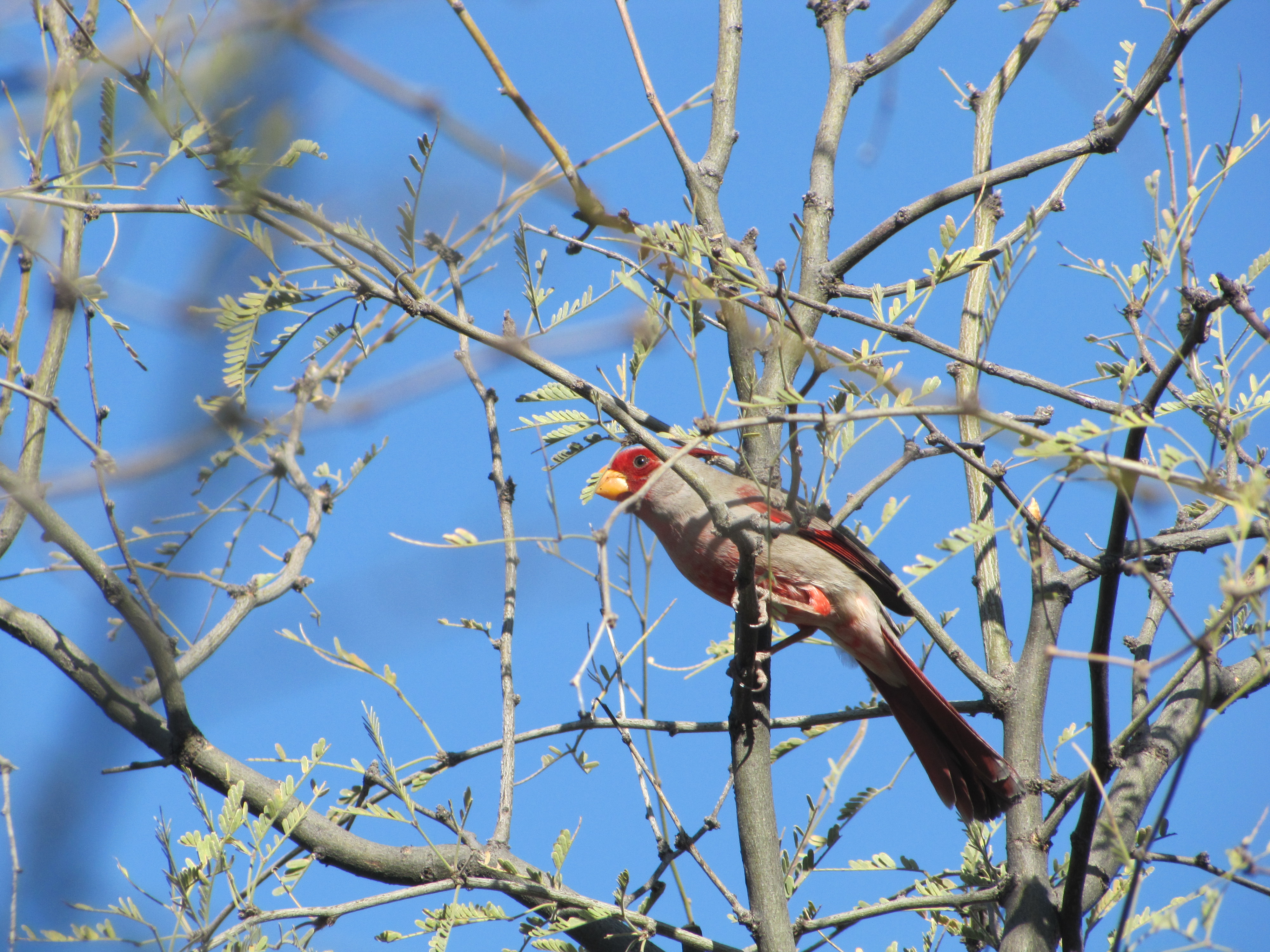
 

A Male Pyrrhuloxia with Bright Red Face and Yellow Bill (photo Bob Bowers)

A Male Pyrrhuloxia with Bright Red Face and Yellow Bill (photo Bob Bowers)

Two of our most colorful birds are the Northern cardinal and the Pyrrhuloxia.  We are quite fortunate to have either of these, let alone both of them, as year-round residents.  Both are common to Mexico, but other than in southern Arizona, Cardinals are found only east of New Mexico and north of Texas.  Pyrrhuloxias are much rarer, just barely ranging into Arizona, New Mexico and Texas.  Differentiating between a Northern cardinal and a Pyrrhuloxia can be perplexing, since both birds have many similarities, and in fact belong to the same genus.   Both have tall crests and red feathers, are the same size, weigh the same and have similar songs. 

Adult Cardinal males are easy to identify (bright red overall with a black face and a tall red crest), but then it gets more challenging.  Here are some tips to help you make the right choice:  If the bill is large, thickly pointed and red or red-orange, it’s a Cardinal.  If the bill is small, rounded, parrot-like and yellow, it’s a Pyrrhuloxia.  If there is any black on the face, around the bill and into the eye, it’s a Cardinal.  If the face is red around the bill and into the eye, it’s a Pyrrhuloxia.  If gray is a predominate color, it’s likely to be a Pyrrhuloxia.  If it’s a juvenile, focus on the bill size and shape (because both have similarly colored gray to black bills), but your best bet is to look around for nearby adults.  Males and females often travel together as well, so look for easier to identify males if you’re having trouble with a female. 


A Curve-billed Thrasher can Sing much like a Northern Mockingbird (photo Bob Bowers)

A Curve-billed Thrasher can Sing much like a Northern Mockingbird (photo Bob Bowers)

Northern mockingbirds and Curve-billed thrashers, both common to SaddleBrooke, present a different kind of identification problem.  They don’t look much alike, but their songs are almost identical.  The Thrasher usually sticks to his call, one or two sharp, high-pitched whistles, but when he decides to sing, he will perch on a cactus or wall and do a perfect imitation of a Mockingbird, who does a perfect imitation of all the other birds.  If the bird takes flight, and you see a large white wing patch, it’s a Northern mockingbird.  If it has a long and curved bill and a yellow eye, it’s a Curve-billed thrasher. 


A Sharp-shinned Hawk, Trying to Look Innocent and Harmless (photo Bob Bowers)

A Sharp-shinned Hawk, Trying to Look Innocent and Harmless (photo Bob Bowers)

Probably the toughest differentiation of common SaddleBrooke birds is between the Cooper’s hawk and the Sharp-shinned hawk.  The two species look virtually identical, with barred tails and streaked breasts (brown and white in juveniles, orange-brown and white in adults).  Cooper’s hawks are larger, but small Cooper’s and large Sharp-shinned overlap.  If you are seeing a small bird with a small head and a square tail, it’s likely to be a Sharp-shinned.  If your bird is closer to 15 inches than 12 in length, with a large head and a rounded tail in flight, it’s a Cooper’s.  If the bird is flying and the wing beats are stiff and shallow, it’s a Cooper’s.  If the wing beats are deep and remind you of a flicking wrist, it’s a Sharp-shinned.  Both of these hawks will come into your yard hunting other birds.  The Cooper’s likes doves while the Sharp-shinned prefers finches.  Finally, take a good look at the bird’s face.  A Cooper’s hawk looks like he wants to kill something soon.  A Sharp-shinned hawk tries to look like an innocent bystander, and wears a ‘Who me?’ expression.

(This article originally appeared in the August, 2009 issue of the Saddlebag Notes newspaper, Tucson, Arizona.)
Posted in Birding Arizona | Tagged , , , , , , | Leave a comment

Monsoon Birding on Mt. Lemmon

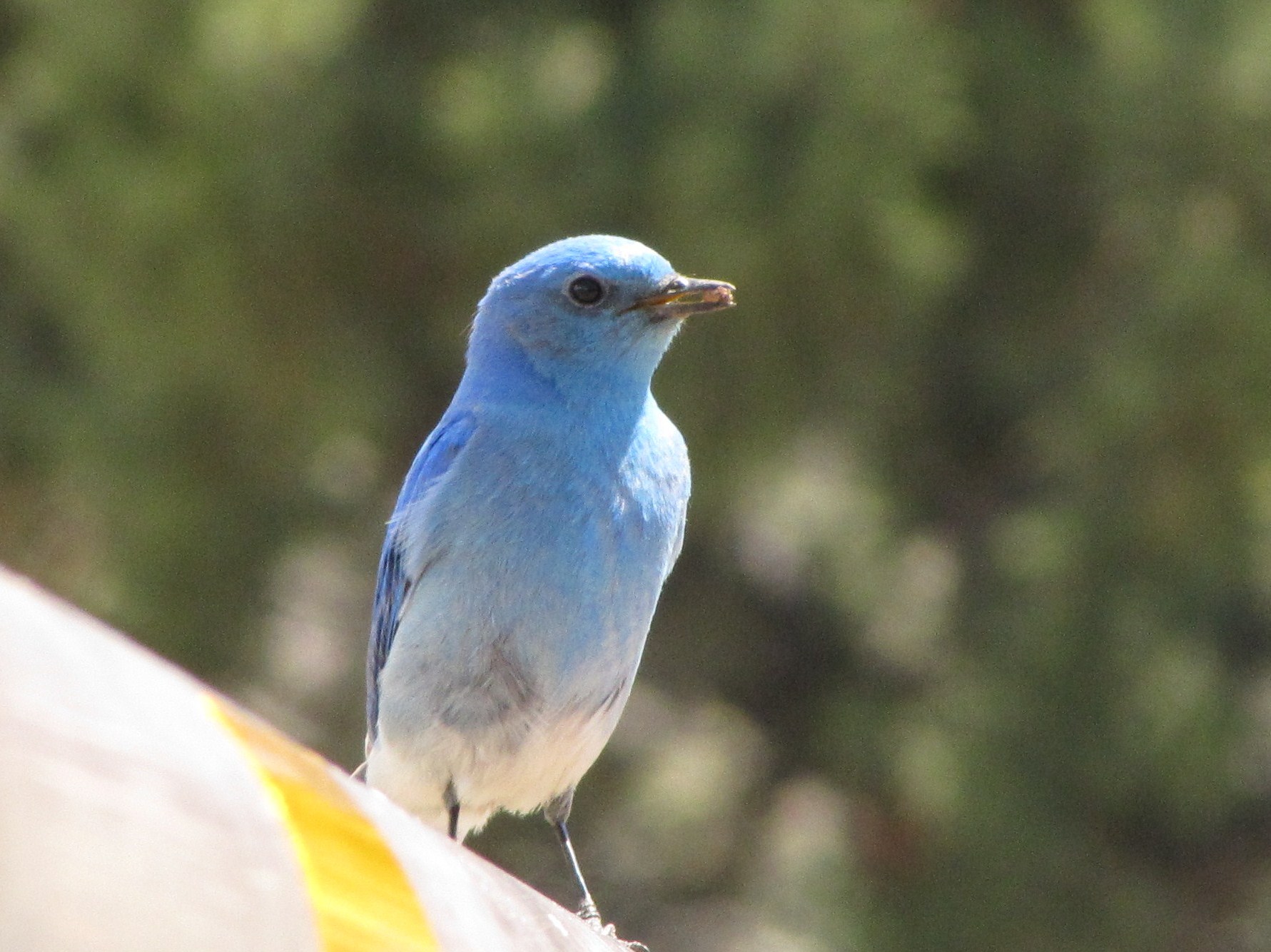
Mountain Bluebird (photo Bob Bowers)

Mountain Bluebird (photo Bob Bowers)

Mt. Lemmon’s summit is just nine short miles from SaddleBrooke, but without wings, it’s a two-hour drive:  an hour to Catalina Highway near the base, and another hour to cover the 25 miles to the summit.  If you’re a birder, however, you’ll spend a lot more than an hour getting to the top.  At mile zero on the Sky Island Scenic Byway, the road climbs some 6,000 feet to reach the summit’s 9,157 feet, taking you through six life zones and a variety of bird species impressive even for southeastern Arizona.  These six life, or vegetative zones include the saguaro-rich Sonoran Desert, Semi-desert Grasslands, Oak Woodland and Chaparral, Pine-oak Woodland, Ponderosa Pine Forest and Mixed Conifer Forest.  Botanically, this 25-mile climb is like driving from Mexico to Canada.

I’ve taken this trip many times, but one last June is most memorable.  The temperature in Tucson was forecast to break 100, but the mountain’s summit beckoned at 30 degrees less.  Conveniently, a Tucson Audubon field trip was scheduled, five hours of professional guiding at no cost.  Tucson Audubon Society (TAS) offers free, guided field trips year-round throughout southeastern Arizona, many of which are led by professional guides who regularly charge a lot more than nothing. You don’t have to be a TAS member to enjoy these free trips, but the cost of membership is reasonable and the benefits substantial.

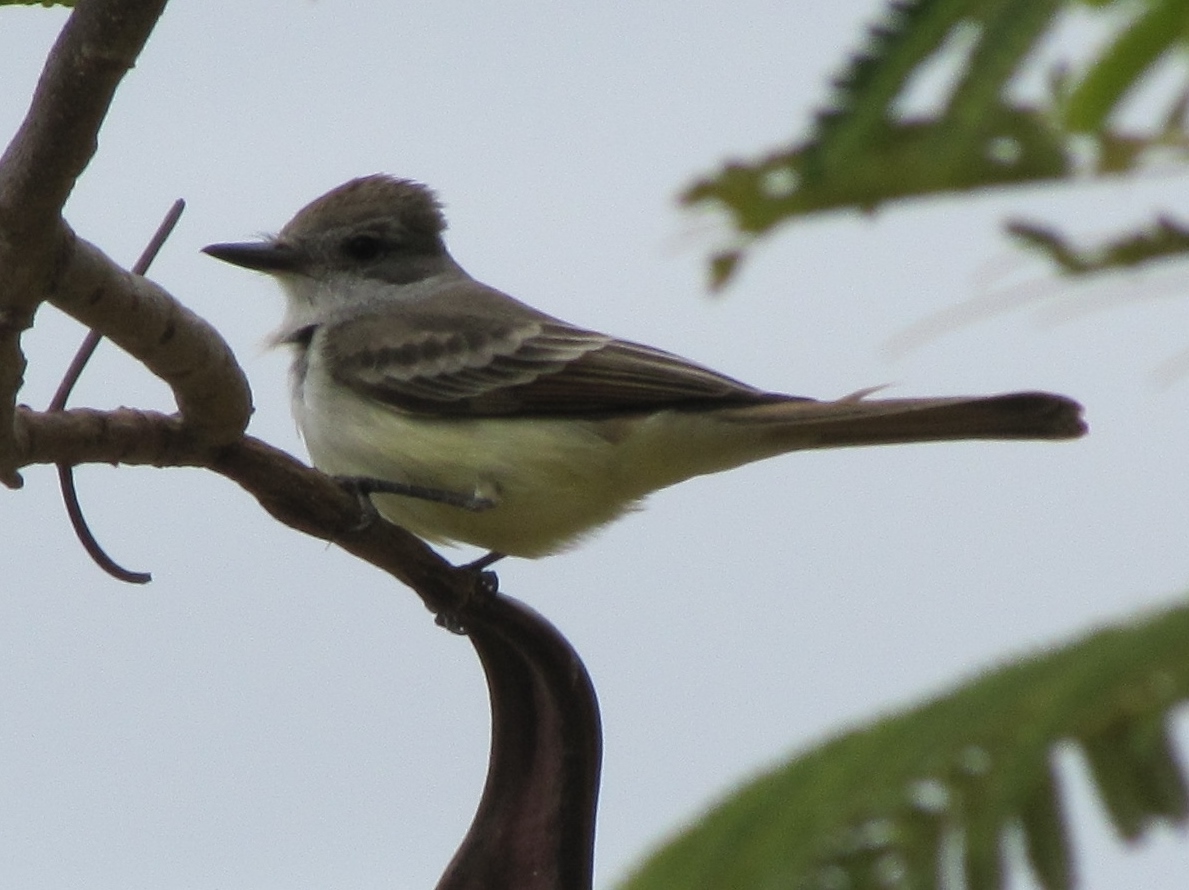
Ash-throated Flycatcher (photo Bob Bowers)

Ash-throated Flycatcher (photo Bob Bowers)

We were particularly lucky that Saturday.  Our trip leader was Melody Kehl, a long-time Tucson resident and professional guide, leading more than 200 trips a year as Melody’s Birding Adventures, and she’s done this for 23 years.  Like other TAS leaders, she birds by ear, taking frequent breaks to simply listen.  She picks up soft, distant or high-frequency songs or calls that elude the less-skilled, accurately identifying unseen birds that invariably show to prove her right.  Her background in music serves her well.

Melody led us to Molino Canyon at 4,000 feet, to Middle Bear picnic area at 6,000 feet, to Rose Canyon campground at 7,000 feet and finally to Ski Valley near the summit.  From there, we turned back, pausing for lunch at Sykes Knob at 8,000 feet.  It was a birding day of color, with Blue and Black-headed Grosbeaks, Indigo Bunting, Black Phoebe, White-breasted Nuthatch, Dusky-capped and Ash-throated Flycatchers, Painted Redstart, Hepatic Tanager, Olive Warbler, Blue-gray Gnatcatcher, Western Bluebird, Plumbeous Vireo, Black-throated Gray Warbler, Rufous-crowned Sparrow, Yellow-eyed Junco and no doubt some colors I’ve forgotten.  Beyond this feathered rainbow, the day’s highlight was close up views of Grace’s Warblers feeding their fluffy young in Rose Canyon.  The slogan painted on Melody’s van proclaims ‘So many birds, So little time’, a perfect description for birding Mt. Lemmon.

Anvil-topped Monsoon at SaddleBrooke, Arizona (photo Bob Bowers)

Anvil-topped Monsoon at SaddleBrooke, Arizona (photo Bob Bowers)

As we drove down the mountain, towering storm clouds built behind us, contradicting the forecast.  The first monsoon is rarely seen before July, and it was only June 16.  Regardless, thunder rumbled as we arrived home, and the wind rose.  I rushed to retrieve tools and cushions from the dry yard, flinching as lightning moved closer.  Wonder trumped fear as I stood at the door and watched the storm explode with horizontal rain, hail and thunder.  Waves of rain washed over my eastern windows like seawater against a ship, measuring an inch in ten minutes and dropping the temperature from 96 to 66.

Free, professionally guided birding in the morning, ranging across 6,000 vertical feet and 6 life zones.  More than 40 species of birds recorded; a spectrum of color in name and feather.  A cataclysmic afternoon monsoon storm that was equally frightening and amazing.  A 30-degree temperature drop that had me looking for a sweater.  And that was just a Saturday.  This is why I live in Arizona.

(This article originally appeared in the July, 2013 issue of the Saddlebag Notes newspaper, Tucson, Arizona.)
Posted in Birding Arizona | Tagged , , , , | 2 Comments

Summertime Birding Getaways in Arizona


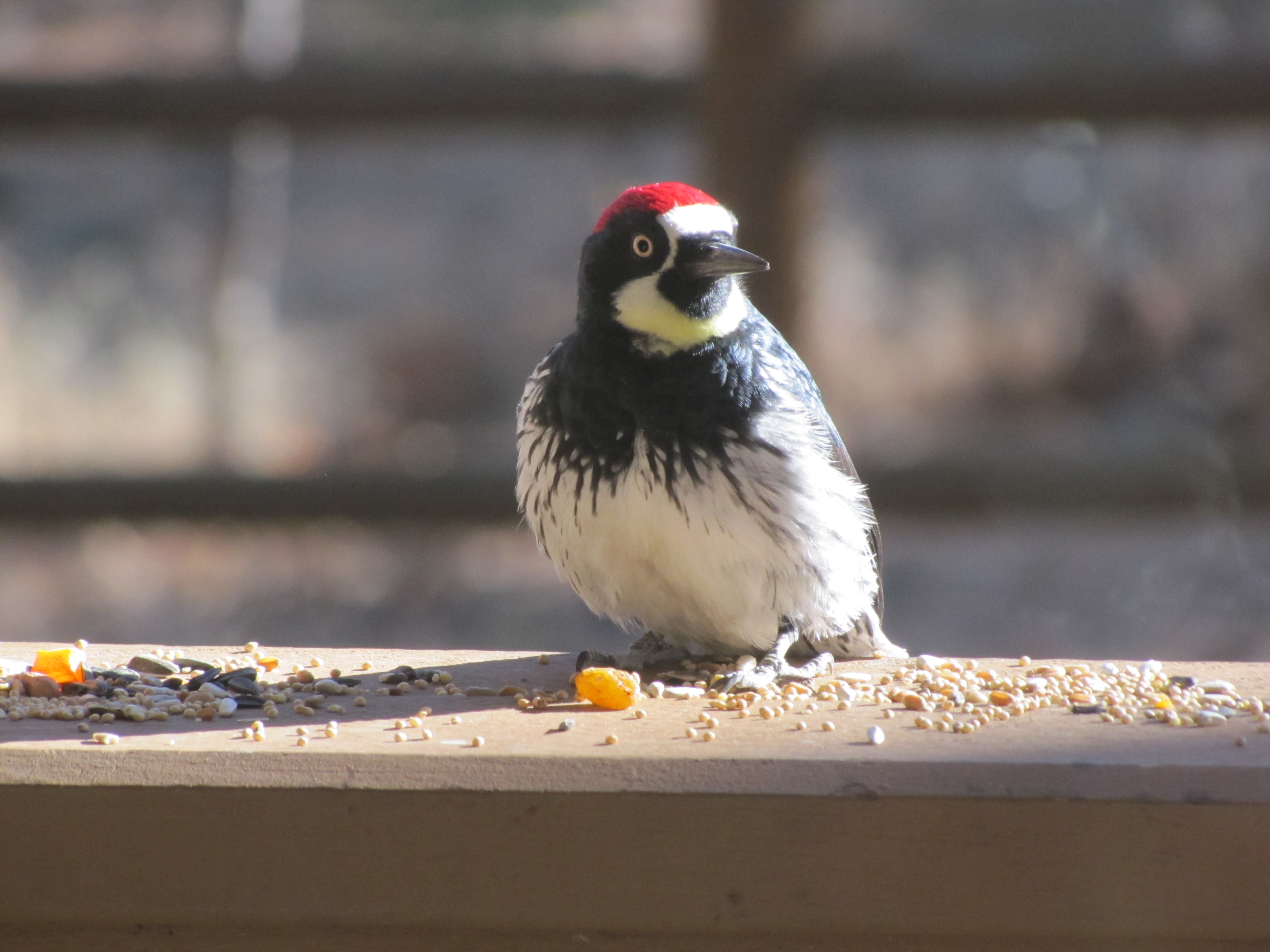
Acorn Woodpecker at Pinetop-Lakeside, Arizona (photo Bob Bowers)

Acorn Woodpecker at Pinetop-Lakeside, Arizona (photo Bob Bowers)

By June, SaddleBrooke’s snowbirds have flown the coop, heading back to their nesting areas in Washington, Michigan, Maine and other northern states.  In order to skip June, they miss the monsoons of July and August, the post-monsoon flowers of September and the glory of October in the desert.  Those of us left behind reap the benefits of fewer cars, shorter lines and resort bargains, but we still have to deal with June.  Summer arrives in June, and if you’re in the middle of the Sonoran Desert, this is not a good thing.  The majesty and plummeting temperatures of a monsoon storm are still a month away, leaving June high and dry.  And hot.  Even Michigan starts looking good to a desert rat in June.

Yellow-eyed Junco on Mt. Lemmon, Arizona (photo Bob Bowers)

Yellow-eyed Junco on Mt. Lemmon, Arizona (photo Bob Bowers)

There are still lots of birds around, of course.  But like us, they start seeking shade and conditioned air as breakfast winds down, and even dedicated birders lose interest in looking when the thermometer hits triple digits.  All is not lost, however, since there is more to the Grand Canyon State than deserts.  Arizona also has more than its share of ponderosa pines and high mountains, and coniferous mountain forests are a heck of a lot cooler than deserts in the summer.  One of the best of these is Mt. Lemmon, just nine miles from SaddleBrooke.

Male Indigo Bunting at Peppersauce Canyon, Mt. Lemmon (photo Bob Bowers)

Male Indigo Bunting at Peppersauce Canyon, Mt. Lemmon (photo Bob Bowers)

OK, that’s nine miles as the raven flies.  For those of us in cars, it takes nearly an hour to get to the Catalina Highway at Tanque Verde, and another hour to drive the 25 miles to the mountain top.  This is time well spent, however.  From the base of the scenic byway at 2,000 feet, the road climbs through six life zones to a parking lot near the mountain’s 9,157-foot peak.  For birders, this relatively short drive produces a variety of birdlife that would otherwise require visits to multiple scattered destinations.  As you transition through each life zone, new habitat and new birds appear, while the elevation increases and the temperature drops.  On a typical summer day, an enervating hundred degrees at the base falls to an energizing seventy at the top.  At lower elevations, summer birders will find Blue Grosbeak, Indigo Bunting, Canyon Wren and Rufous-crowned Sparrow.  Middle elevations produce Yellow-eyed Junco, Plumbeous Vireo, Dusky-capped Flycatcher and Acorn Woodpecker, and higher elevations showcase Western Tanager, Pygmy Nuthatch and Olive Warbler.  Feeders at the Iron Door Restaurant across from the ski lifts are the primary summer hangout for Broad-tailed Hummingbirds.

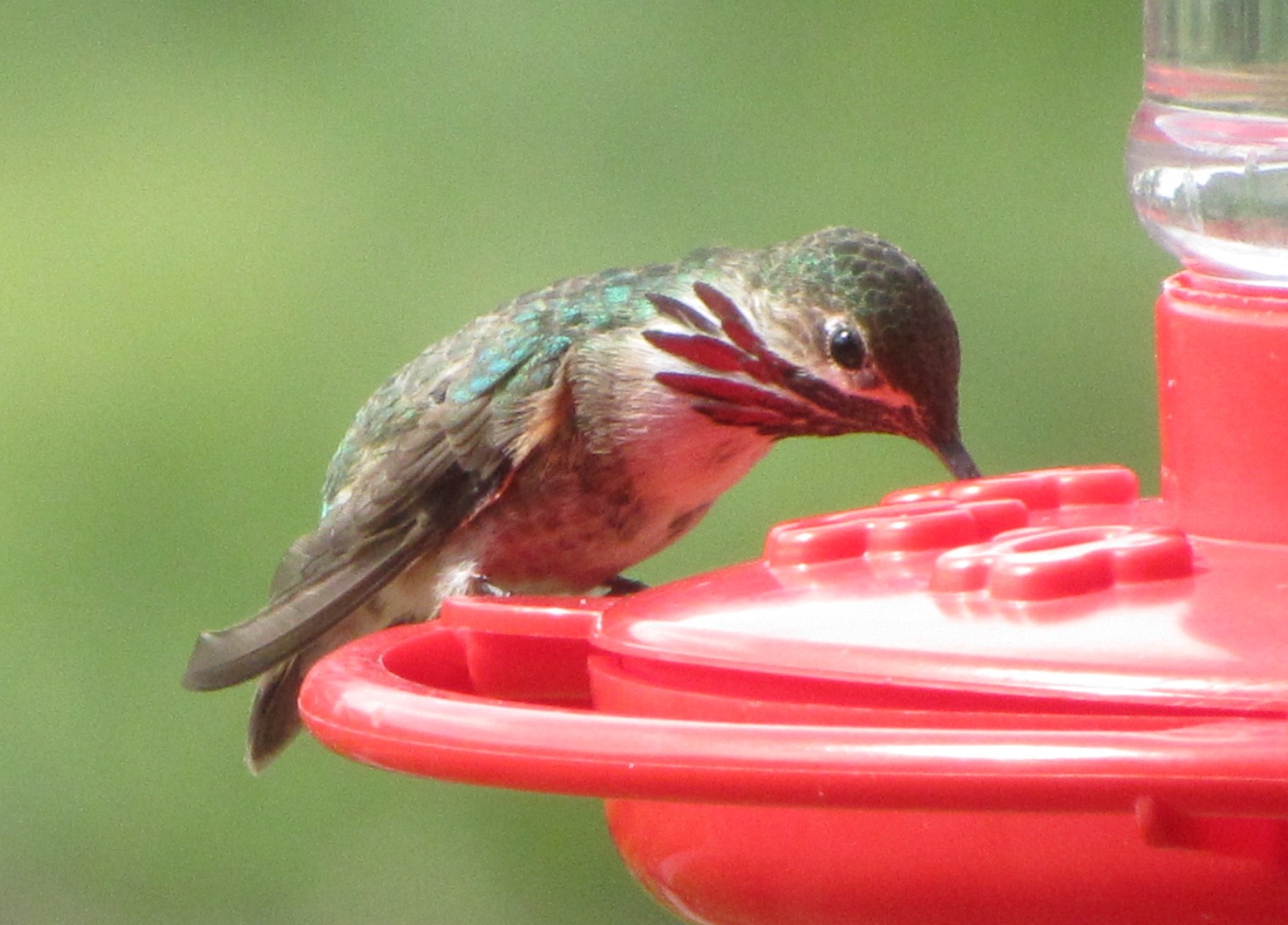
North America's smallest bird, the Calliope Hummingbird (photo Bob Bowers)

North America’s smallest bird, the Calliope Hummingbird (photo Bob Bowers)

Unless you’re camping, however, Mt. Lemmon is a day trip destination, rather than a suitable week-long getaway.  For longer breaks from the heat the White Mountains are a better choice, and from SaddleBrooke you can be in the cool pine forests of Show Low with only an hour’s more driving than what it takes to reach the top of Mt. Lemmon.  Since Show Low, at 6,331 feet, can still be on the warm side, mid-summer birders might want to continue to Pinetop-Lakeside, Greer or other nearby and higher elevations.  Year-round streams, lakes and reservoirs are found across the White Mountains and the Mogollon Rim, and a wide range of overnight accommodations are available throughout.  Greer, which sits on the Little Colorado River at 8,400 feet, is just as birdy as it is cool, and three nearby reservoirs add to the variety of birdlife.  The riparian area is good for Virginia’s, Wilson’s and Red-faced Warblers, Hairy Woodpecker and Clark’s Nutcracker, and the reservoirs are a great place to find Mountain Bluebird, Pine Siskin, Belted Kingfisher and Calliope Hummingbird, North America’s smallest bird.

Instead of dreading June and wishing you had a summer home in Minnesota, look on the bright side.  Go picnicking on Mt. Lemmon and spend a couple of weeks in the White Mountains.  Besides, there are no Calliope Hummingbirds or Red-faced Warblers in Minnesota, and most of the things that look like birds there actually are mosquitoes.  Count your blessings.

(This article originally appeared in the June, 2013 issue of the Saddlebag Notes newspaper, Tucson, Arizona.)

Posted in Birding Arizona | Tagged , , | Leave a comment

Roadrunners and Quail


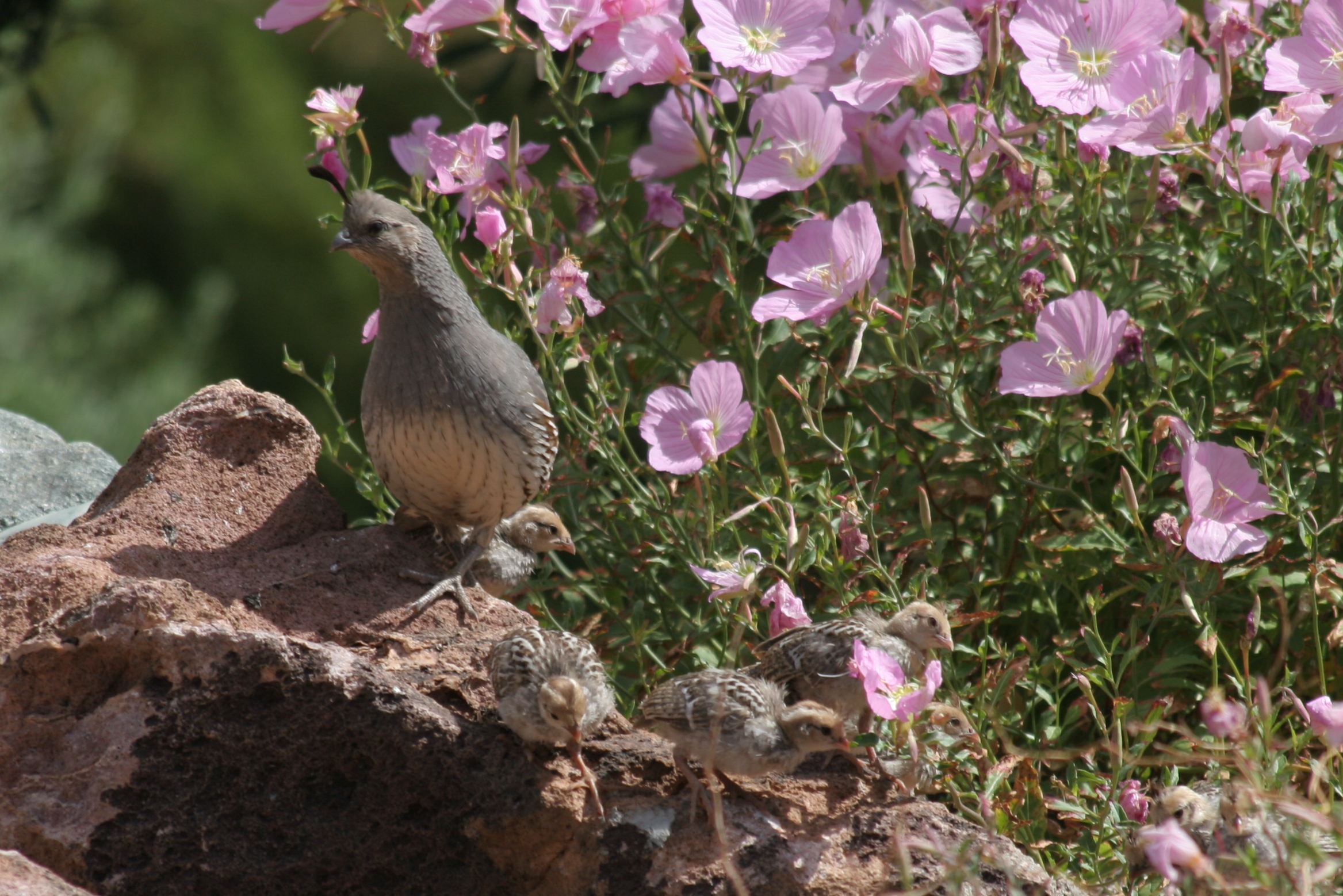
Mother Gambel's Quail and babies in Mexican primrose (photo Bob Bowers)

Mother Gambel’s Quail and babies in Mexican primrose (photo Bob Bowers)

Here in SaddleBrooke, May is when we start seeing baby quail.  We see Greater Roadrunners year-round, but more likely than not, we will see a lot more of them during baby quail season.  Roadrunners are drawn to baby quail like seafood addicts are drawn to popcorn shrimp.

There are three species of quail found in Arizona:  Scaled, Montezuma and the one common to SaddleBrooke, Gambel’s.  Similar to California Quail, Gambel’s Quail (Callipepla gambelii) is a non-migratory bird well adapted to life in the suburbs.  They are beautiful 10-inch birds that prefer walking to flying.  When they do fly, their short, rounded wings produce explosive and noisy takeoffs.

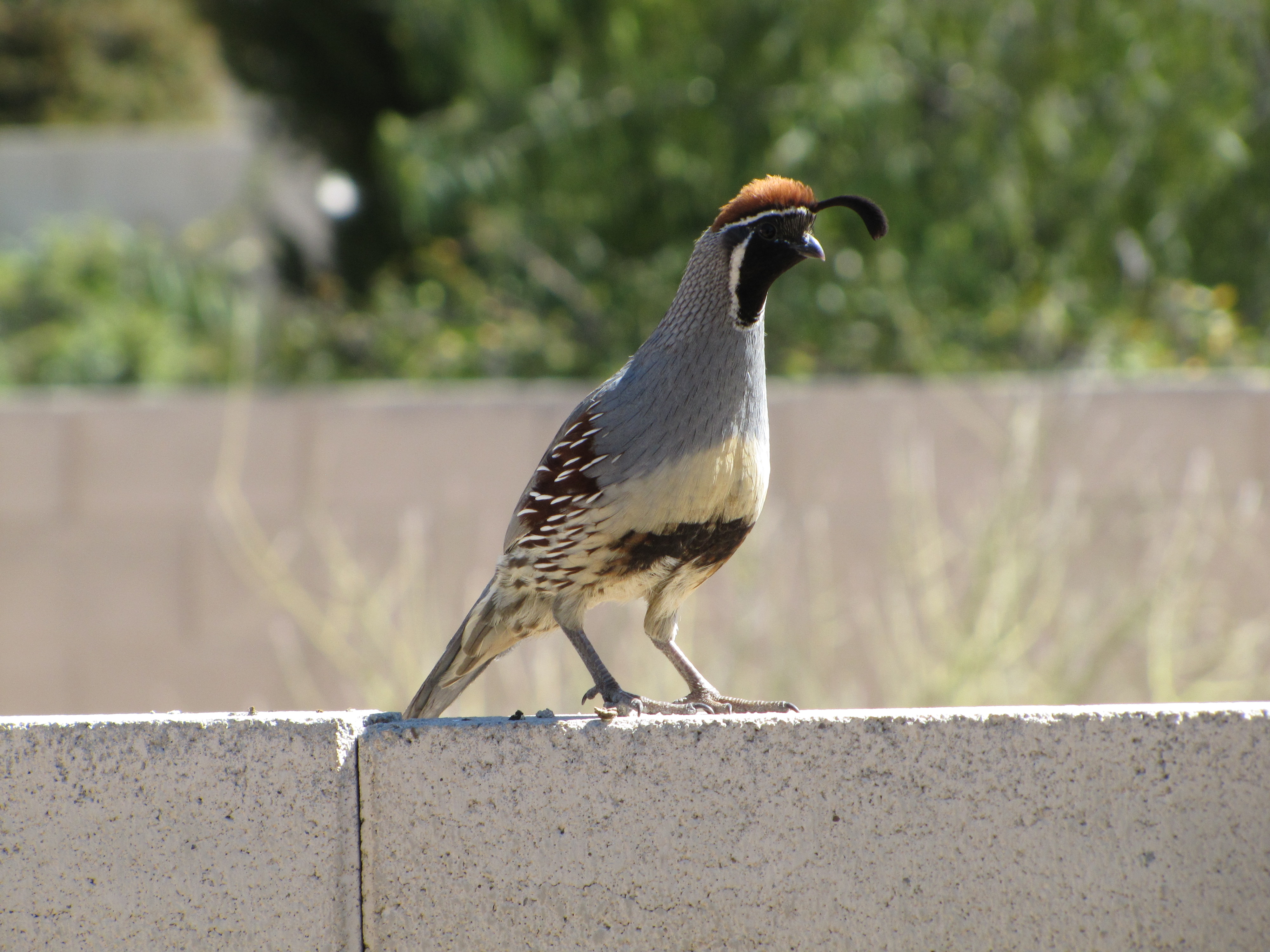
Striking male Gambel's Quail on sentry duty (photo Bob Bowers)

Striking male Gambel’s Quail on sentry duty (photo Bob Bowers)

Both females and males have a distinctive topknot, and the male is particularly striking with his dark face, forehead and abdomen.  The male is often seen perched on a wall or other high point, acting as a sentry while the rest of the entourage forages below.  Their diet is almost exclusively the leaves, seeds, flowers and shoots of plants, and they scratch their way across the terrain like chickens.

Except when breeding, quail are gregarious and often found in groups.  Social coveys form after the young hatch, sometimes consisting of several families.  Normally only one brood is produced annually, with up to 15 eggs, although 2 females may lay in the same nest.

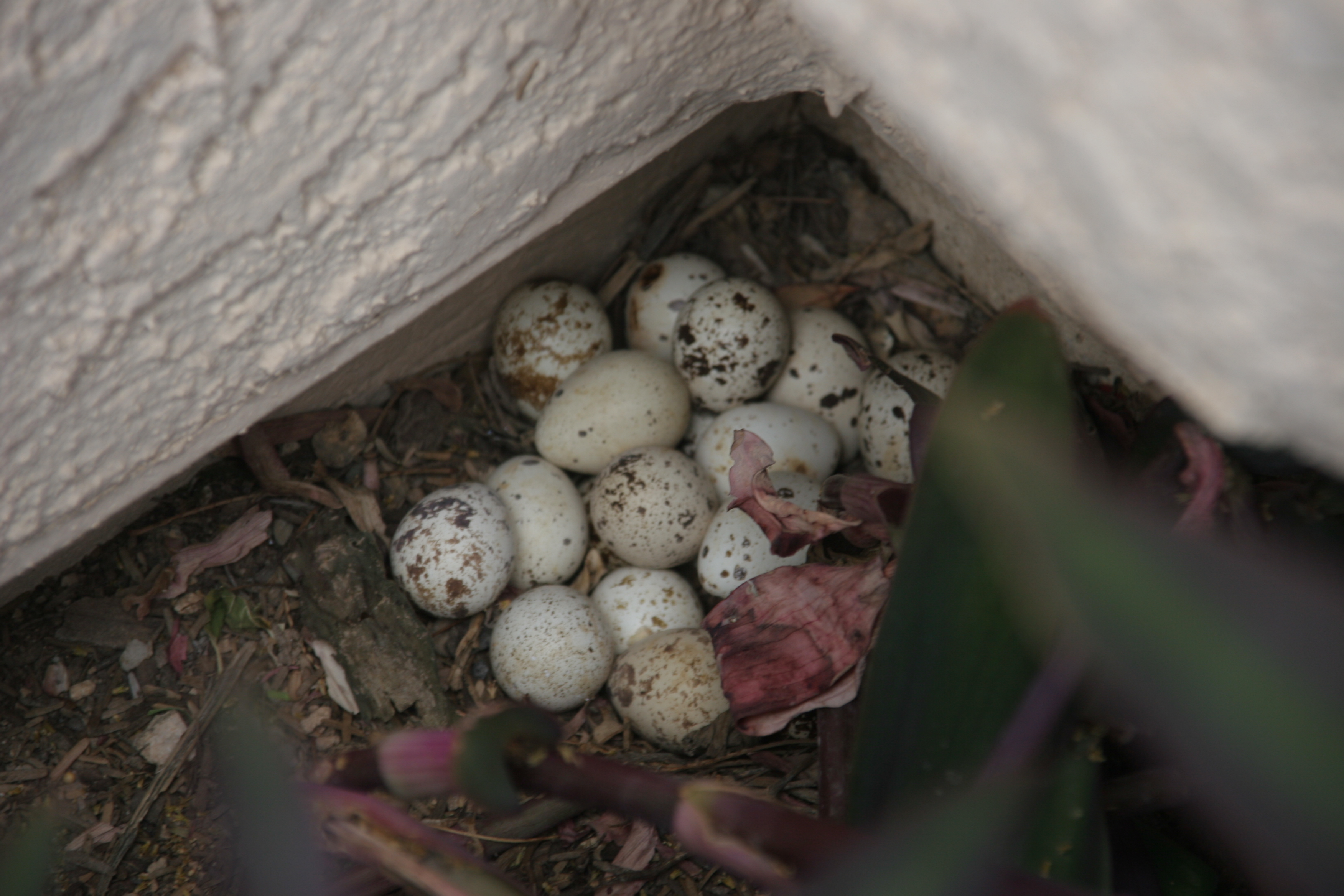
Gambel's Quail eggs 'hidden' in an open house corner (photo Bob Bowers)

Gambel’s Quail eggs ‘hidden’ in an open house corner (photo Bob Bowers)

“Nests” might be an exaggeration, since you are likely to find a bunch of quail eggs under a bush or in a pot.  We found a single egg lying on our patio one day, stuck it in with another 15 eggs under a bush and all 16 eggs later hatched successfully.  The young  hatch synchronously (together) three weeks later, and are precocial, walking out of the nest and foraging within hours.  And a good thing, too, with roadrunners likely salivating in the neighborhood.

Greater Roadrunner (photo Bob Bowers)

Greater Roadrunner (photo Bob Bowers)

The Greater Roadrunner (Geococcyx californianus) is a big bird, 23 inches long and with an equivalent wingspan.  Like quail, roadrunners prefer walking to flying, and, living up to their name, they also like to run.  Almost as fast as their cartoon caricature, roadrunners can reach 15 miles per hour, which is a lot faster than a quail.  The state bird of New Mexico, the Greater Roadrunner is comical (he’s in the Cuckoo family, after all), raising his crest, looking quizzical and slowly raising and lowering his long tail.  Far from being a comedian, however, this is a bird with a mean streak, a necessary trait when you like to eat rattlesnakes.  They aren’t model parents, either, often stopping incubation of their other eggs once the first one or two hatch.  Roadrunners are fearless, as you will know if you have tried to scare one out of your quail-populated yard.  They are non-migratory meat eaters, with an appetite for snakes, lizards, rodents and baby quail.

A roadrunner in waiting (photo Bob Bowers)

A roadrunner in waiting (photo Bob Bowers)

Baby quail have a high mortality rate for lots of reasons.  Anyone who enjoys watching them follow their mother in a single file, like little wind-up toys, knows that the fifteen you counted on Tuesday is likely to be thirteen on Wednesday and into single digits by the weekend.  The roadrunner, with those tiny quail feet sticking out of his bill, is the usual suspect.  Obviously, there is good reason for large quail broods.

(This article originally appeared in the May, 2010 issue of the Saddlebag Notes newspaper, Tucson, Arizona.)
Posted in Birding Arizona | Tagged , , | 1 Comment

Costa Rica: a Paradise for Birders


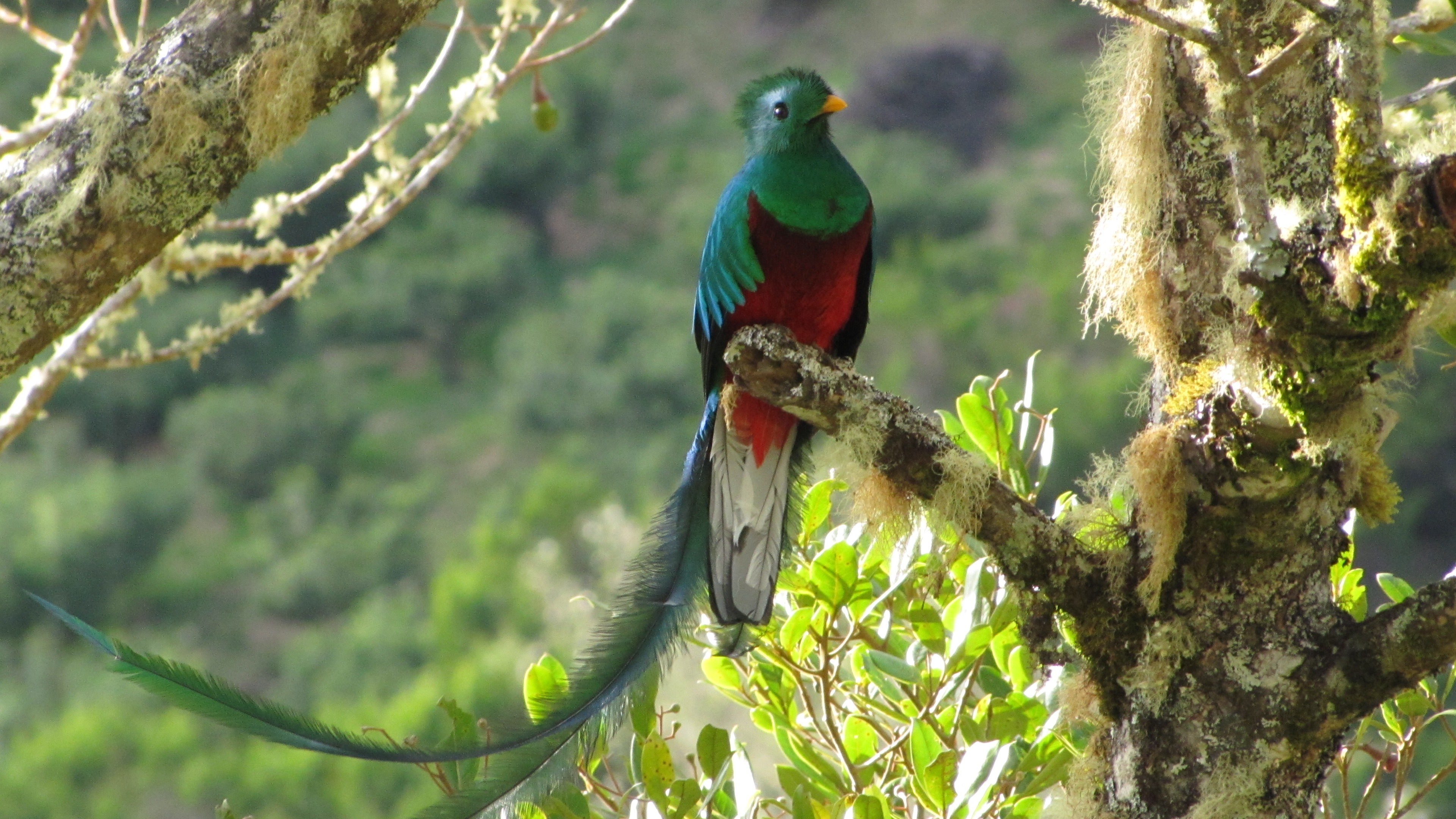
Resplendent Quetzal (photo Bob Bowers)

Resplendent Quetzal (photo Bob Bowers)

Look up information on Costa Rica and you will find it compared with the state of West Virginia in size.  This is a bit of a stretch, since West Virginia is nearly a fourth larger than the Central American country, but I guess it’s important to think in terms of the familiar when you plan a trip to the unfamiliar.  However, even if they were exactly the same size, they would have nothing else in common.  The highest point in landlocked West Virginia is 4,863 feet, while Costa Rica ranges from sea level to 12,530 feet.  And speaking of sea level, Costa Rica is bordered by 801 miles of the Pacific Ocean on one side and 132 miles of the Caribbean on the other.  That high mountain range that runs down the center of Costa Rica is also home to several active volcanos, something else you won’t find in the ‘Mountaineer’ state.  This wild mix of elevations, ocean frontage, tropical jungle and location (Costa Rica is just one country distant from South America) is also responsible for one of the richest bird habitats in the world, making this nearby travel destination a paradise for birders.  Nearly three times as many species are found in Costa Rica as in West Virginia, but we shouldn’t pick on John Denver’s ‘almost heaven’.  Costa Rica’s near 900 bird species outnumbers those of the entire U.S. and Canada combined.  This many birds packed into less than 20,000 square miles gives Costa Rica the record for most bird species per square mile of any country in North, Central or South America.

Blue-crowned Motmot (photo Bob Bowers)

Blue-crowned Motmot (photo Bob Bowers)

These include plenty of familiar birds, since many of our warblers, orioles and vireos winter there.  For example, this is where we saw our first Baltimore Oriole.  But it’s the exotics that are the real draw, and the colorful names match the colorful birds.  Here you’ll find aracaris, toucans, leaftossers, foliage-gleaners, flowerpiercers, tityras, motmots, puffbirds and quetzals.  There are also 52 species of hummingbirds, with evocative names like White-tipped Sicklebill, Garden Emerald, Violet Sabrewing and Purple-crowned Fairy.   Those who named our birds could have learned something here.

With the densest avian population in the Americas, you would think finding birds in Costa Rica an easy task, and you would be right.  Scarlet Macaws perched over our cabin at Cerros Lodge, and Fiery-billed Aracaris came to the banana feeders every morning.  Blue-throated Goldentails visited the heliconias that grew in our open air bathroom, making it difficult to concentrate on shaving.  Wherever you venture in Costa Rica, you will find birds.  Even in the streets and parks of the capital, San Jose, parrots chatter in the treetops.  One of the most interesting surprises for a visiting birder is that a short drive from one location to another often creates a dramatic change in species.

Fiery-billed Aracaris (Photo Prudy Bowers)

Fiery-billed Aracaris (Photo Prudy Bowers)

Costa Rica is possibly the safest country south of Arizona to visit, as well.  This may be because more money is spent on education than on the military.  In fact, no money is spent on the military, because there isn’t one.  Consequently, there are no military coup d’etats, and a guerilla uprising has no army to rise up against.  This has spared Costa Rica from the bloodshed in neighboring countries, and has generated a climate favorable to tourism and investment.  If you have a chance to visit Costa Rica, don’t hesitate.  If you’re a birder, start packing.  If you need any other encouragement, consider this:  the shortest flight from Phoenix to Morgantown, West Virginia involves two stops and takes 8 hours and 24 minutes.  Phoenix to San Jose, Costa Rica is just 5 hours and 5 minutes, and there are no stops.

(This article originally appeared in the May, 2013 issue of the Saddlebag Notes newspaper, Tucson, Arizona.)

Posted in Birding Costa Rica | Tagged , , | Leave a comment

Birds Do It: a Short Guide to the Sex Life of Birds

Enraptured Roadrunners (photo copyright Bill George)

Enraptured Roadrunners (photo copyright Bill George)

Most of us can quote the most memorable lyrics from Cole Porter’s song, Let’s Fall in Love:  ‘Birds do it, Bees do it.  Even educated fleas do it.’  I’m not sure about the fleas, educated or not, but now that spring has sprung, bees are buzzing, birds are singing and it’s all about sex.  Or, as the owl in Bambi put it, ‘twitterpation.’

As it turns out, the sex life of birds is practically as complex and varied as that of humans, with strikingly similar, and equally aberrant, behavior.  There are happily monogamous birds, deadbeat dads, trashy moms, polygamous males, ménages a trois, male and female harems, prostitution and just about every other quirk and kink found among humans.  The difference, though, is that birds are driven by a single motivator, reproduction.

Monogamous Mates, the Curve-billed Thrasher (photo Bob Bowers)

Monogamous Mates, the Curve-billed Thrasher (photo Bob Bowers)

Most of our year-round resident birds are the faithful type, monogamous couples that share parental responsibilities and stick together long term.  Hummingbirds, on the other hand, are at the other end of the spectrum, whether resident or migratory, and the males epitomize irresponsibility.  Like self-centered jocks they hang out at nectar bars, pick fights with intruders and probably would watch football, given the chance.  But when their juices move, they make room for the ladies, flashing their iridescent feathers like a roll of c-notes.  They’ll share a nectar cocktail or two, and then make their move, which takes less time to consummate than to read about.  And no fond farewells, either.  The expectant mother is kicked out and left alone to build a nest, incubate the eggs, feed and raise the young, while deadbeat dad is bedding down everyone else in town.

The Greater Roadrunner also belongs to the ‘wine and dine’ club, but unlike the hummingbird, the roadrunner actually cares about his mate.  While the female is preparing her nest, the male goes hunting for a desert dinner gift.  Returning with a mouse or lizard clamped in his bill, he proudly shows it off.  This is dinner at the Ritz-Carlton to Mrs. Roadrunner.  She jumps in front of her mate, raises her tail and trades her innocence for a 5-star mouse.  Her mate settles for take-out.

Male birds aren’t the only opportunists.  Consider the cowbird.  In spring, the arrival of Hooded Orioles from Mexico is coincidental with the arrival of Bronzed Cowbirds, but this is no coincidence.  The female cowbird may lay many eggs in a season while never building a nest of her own.  Cowbirds are brood parasites, laying their eggs only in the nests of other species, and the Bronzed Cowbird has a thing about orioles.  Not only are these females nymphomaniacal, they stop at nothing to give their young every advantage.  They spread their eggs around as many nests as possible, and will pierce host eggs as well as those from competing cowbirds in the process, murdering the unborn of both species.  If a host bird recognizes and disposes of the foreign egg, the female cowbird has been found to return to the nest and trash it, sending a Mafia-like message to the host.  Surprisingly, once the cowbird’s eggs hatch, the host birds typically feed and raise the foster kids like their own, even when the interlopers are bigger, look funny and sing a different tune.

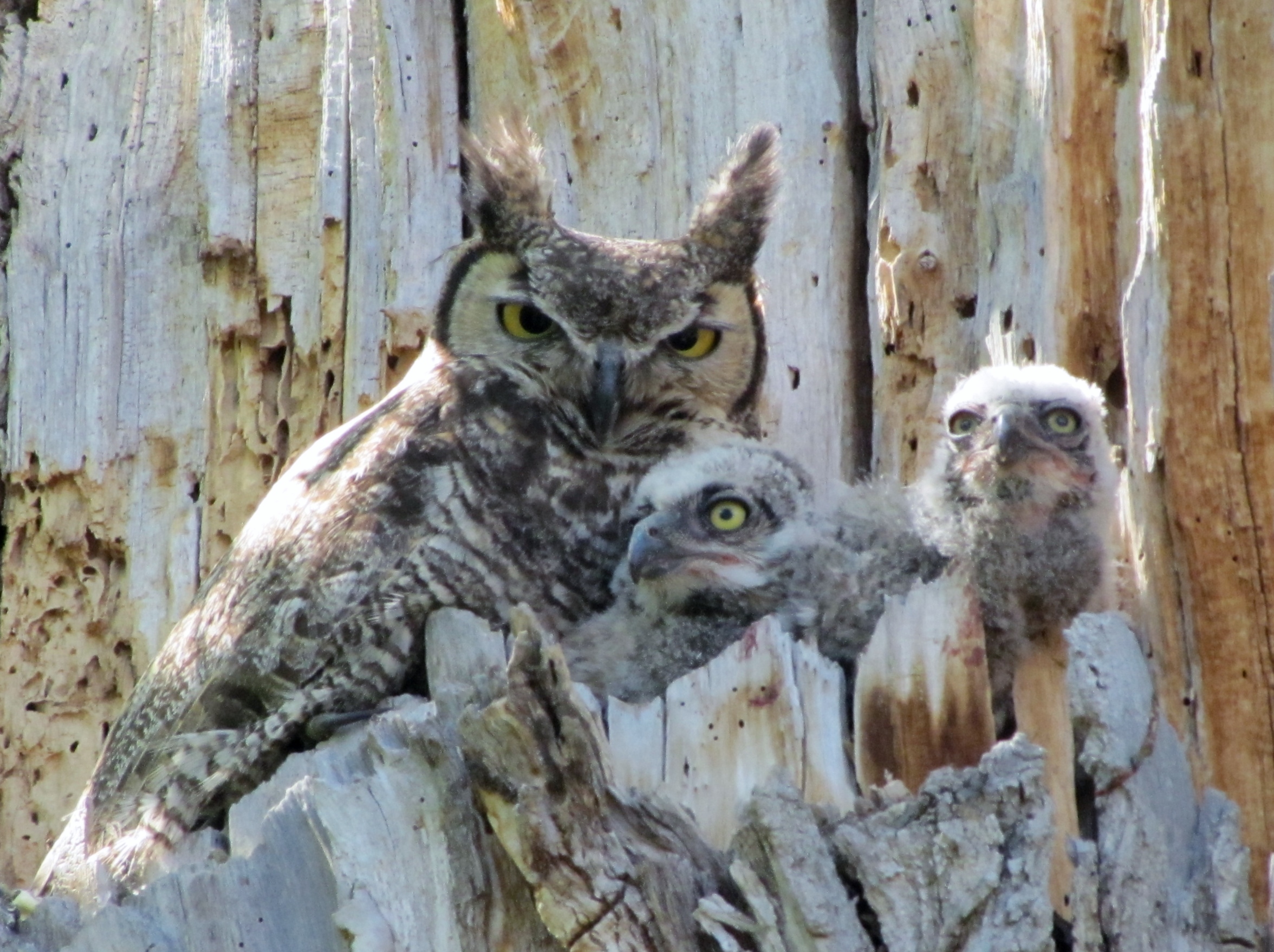
In the end, it's all about babies, as shown by these Great Horned Owls (photo Bob Bowers)

In the end, it’s all about babies, as shown by these Great Horned Owls (photo Bob
Bowers)

Shunning single-parenting, widowed females of some species with a nest full of eggs will find an unattached guy and tempt him into sex.  She’ll then return to her nest, incubate the eggs and lay parental responsibility on the unsuspecting male.  Deceitful for sure, but effective, and the otherwise doomed young survive.  Male Red-winged Blackbirds, on the other hand, are into harems, often maintaining a territory of three or more females through the breeding season, sometimes helping with the young, sometimes not.  Red Phalaropes are more into role reversal than harems, and female phalaropes, supercharged with male hormones, have the bright breeding plumage and aggressive behavior normally found in males.  These liberated feminists choose their mates and lay his eggs, but then turn over incubation duties to the hen-pecked male while she goes looking for a second (and sometimes third) mister mom before migrating south on her own.

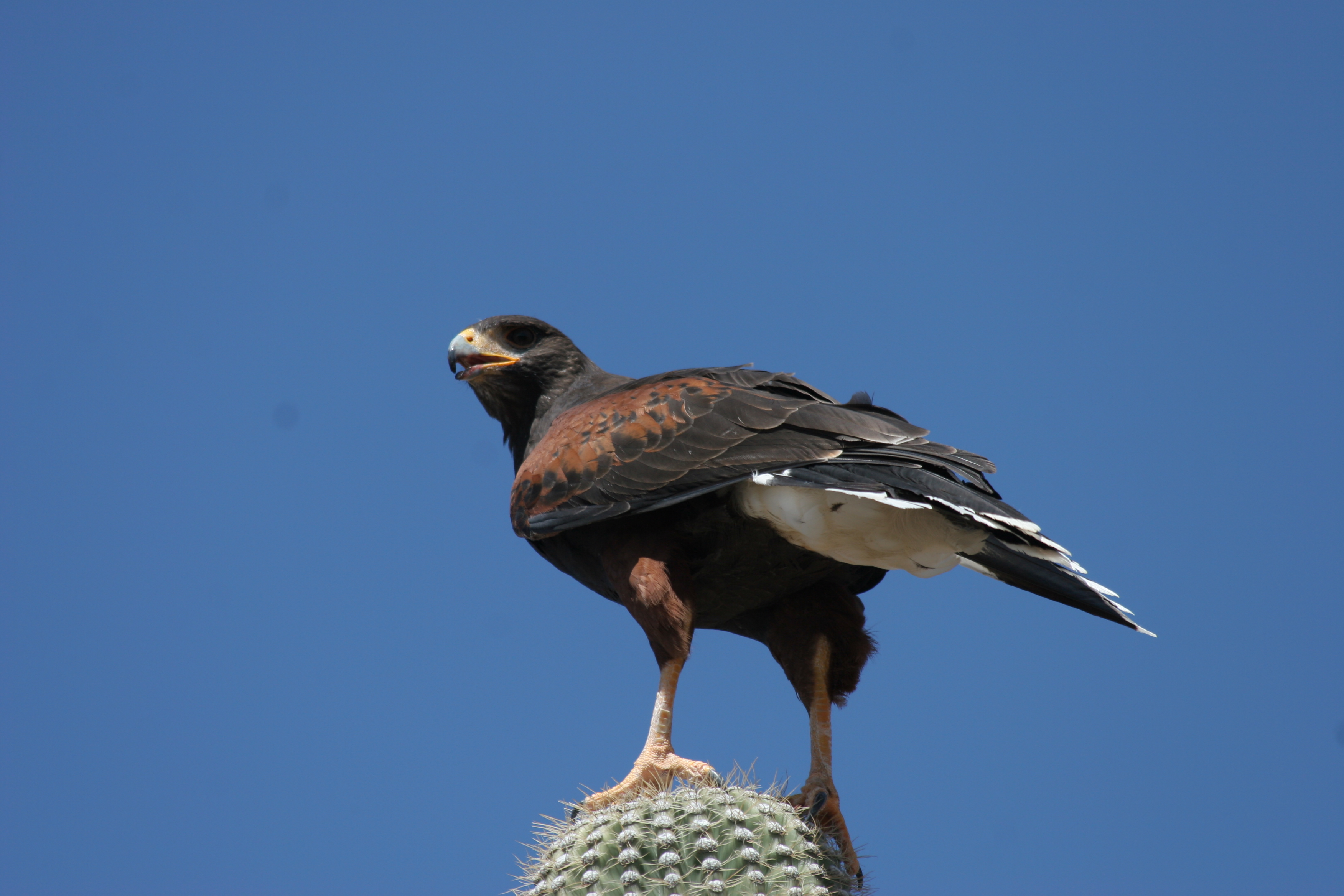
The Harris's Hawk goes for menage a trois (photo Bob Bowers)

The Harris’s Hawk goes for menage a trois (photo Bob Bowers)

The ménage a trois is found in bird land, too.  Female Galapagos Hawks will live with two males, all three sharing familial duties.  This two-lover relationship can be life-long for the lucky lady.  Here in southeastern Arizona, we have a similar ménage with Harris’s Hawks.  The reason you often see three Harris’s Hawks hanging out together is because it’s a two male, one female liaison, with the alpha female often perched above the others.

This being a family newspaper, I decided to steer clear of the explicit mechanics of bird sex.  Suffice it to say that we’re talking quick and painless, like a kiss on the cheek.

(This article originally appeared in the April, 2013 issue of the Saddlebag Notes newspaper, Tucson, Arizona.)

Posted in Wild Birds | Tagged , , , , , | 2 Comments

Do Bird Feeders Attract ‘Pack’ Rats and Spread Disease?


Female Lawrence's Goldfinch and two Lesser Goldfinches below on thistle feeder (photo Bob Bowers)

Female Lawrence’s Goldfinch and two Lesser Goldfinches below on thistle feeder (photo Bob
Bowers)

A ‘Letter to the Editor’ published in February’s TWO’S NEWS, the monthly newsletter for SaddleBrooke’s homeowner’s association HOA 2, claims that “unknowing homeowners” have created a problem for all of us by placing bird feeders in their yards.  The writer states that feeding birds, though popular in other places, is not appropriate in a “desert environment” because pack rats, attracted to bird seed, wreak havoc on wiring, BBQs, hot tubs, fountains, cars, attics, roofs and furniture.  The letter writer then suggests that the HOA 2 Architecture and Landscaping Committee (ALC) provide all new residents with a copy of a proposal to the ALC written by one or more HOA 1 residents in 2006.  The proposal, which is included in its entirety in the letter, calls for a total ban on bird feeders. It goes to considerable length to justify this, based mostly on the risk of disease, but also claiming that feeders attract pack rats, snakes and neighborhood cats, and lead to costly broken windows from flying birds.  The proposal was not supported by any sources or cited references, and was not adopted.

Why would someone suggest official distribution to all new residents of a five-year old un-adopted proposal that contradicts SaddleBrooke’s ALC Guidelines and Requirements?  Most of the claims made in the proposal are false, probably why it was rejected in 2006.  Nevertheless, some people remain misinformed about bird feeders and rats, and others might be frightened by warnings of infectious diseases contained in the reprinted proposal, suggesting the need for some clarification.

Are Pack Rats Drawn to Bird Feeders?

White-winged Doves on seed block (photo Bob Bowers)

White-winged Doves on seed block (photo Bob Bowers)

The simple answer is no.  I have bird feeders, and, from time to time, I have rats.  If you and your surrounding neighbors have no bird feeders, in all likelihood you will see at least as many rats as I do.  The rat found in SaddleBrooke is the white-throated woodrat (Neotoma albigula), which is common to the Southwest, where it has lived long before any human moved in.  Woodrats dine almost exclusively on cactus and woody vegetation.  They get their water from cactus, as well, and typically make their home among cholla or prickly pear in order to be close to their food and water.  They also seek out dark hiding places, such as beneath a BBQ cover, in an attic or a car.  You can easily recognize these hideouts, because the rats hoard food in them.  If you discover one, you will find pieces of cactus, cholla and prickly pear fruit, acorns, mesquite and bird of paradise seed pods, sticks and newspaper.  I’ve found all of the above in the dens I discovered, but I have never found birdseed.

The 'Pack' Rat's favorite food, cholla cactus (photo Bob Bowers)

The ‘Pack’ Rat’s favorite food, cholla cactus (photo Bob Bowers)

Woodrats are certainly annoying, and they can indeed do damage to insulated wiring.  Since we share their habitat, we’re not likely to get rid of them, but there are steps we can take to minimize their presence.  Cholla and prickly pear provide both food and shelter to woodrats, while oak, mesquite and other seed pod producing plants are additional food sources. Planting fewer of these plants will make your yard less attractive to rats.  You could also reduce hiding spots and clutter, and get rid of your BBQ cover.  Insure that your roof eve openings are impassable, and keep your car inside the garage.

These steps will reduce your contact with woodrats, but nothing is going to eliminate them.  Rodent poisons are a terrible idea, because they are slow-acting, and are very likely to kill rat predators like Great-horned Owls.  Dead, decomposing rats in your attic aren’t pleasant either.  The best solution is to use a spring-loaded or live trap, which are effective and available for about $40 at local hardware and do-it-yourself pest control stores.  Bait live traps with a single Reese’s peanut butter cup, and release captured rats on state land outside of SaddleBrooke.  The owls will love you for it.  I keep one set year-round, although I rarely see any rats except in spring, when they are most active. If you don’t want to get involved personally, hire an exterminator, but insist that he use live or spring-loaded traps instead of poison.

What about Snakes and Mice?

Snakes do like to eat woodrats, as do owls, bobcats, coyotes and ringtails.  For the most part, this is good, not bad.  If you see a gopher snake in your yard, it most likely means that the one or two woodrats you had are gone or going soon, and the snake will then move on.

The grasshopper mouse, common in our area, is a carnivore that doesn’t eat seed of any kind, bird or otherwise.  He’s a vicious predator that craves grasshoppers and scorpions, the kind of rodent you might want to keep around.

Do Bird Feeders Spread Disease?

The 2006 proposal went to great lengths suggesting that bird feeders contribute to the spread of multiple diseases, especially salmonellosis and Avian influenza, and claimed that humans, dogs and cats were at significant risk.  Salmonellosis, or salmonella, is a bacteria-based disease that affects animals, including birds and humans.  According to the National Institute of Allergy and Infectious Diseases (NIAID) and other comparable sources, human infections of salmonella are tied to food products, such as raw poultry, eggs, beef and unwashed fruit, as well as through contact with pets, particularly pet reptiles, such as snakes, turtles and lizards.  Birds are not listed as an infection source.

However, birds are also susceptible to salmonella infection, which can be spread through contact with other infected birds or feces-contaminated food or water. Salmonella infection in birds is characterized by large numbers of dead and dying birds.  I’ve not seen that here, but you should protect birds against salmonella by keeping bird feeders dry and cleaning them regularly with a 10 percent bleach solution.  Cats should not be allowed to run free to eat a possibly-contaminated bird, but free-running cats in SaddleBrooke have much more to worry about than sick birds.

Avian influenza also was emphasized in the 2006 proposal as a threat to humans, although this virus has not been found in humans or wild or domestic birds in North America.

Bird Feeders Should not be a Concern to SaddleBrooke Residents

Birds are a natural part of our environment, and we are fortunate to live in southeast Arizona, one of the country’s most highly-regarded birding destinations.  Suburban developments like SaddleBrooke encroach on wild habitat, and can negatively impact native populations of birds and other animals.  By setting out bird feeders, keeping them clean and dry and replacing food every week or two, you can supplement diminished natural food sources and attract some of our special birds to your yard without being a nuisance to your neighbors.  Woodrats are far more interested in cactus and clutter than birdseed.

(This article originally appeared in the April, 2011 issue of the Saddlebag Notes newspaper, Tucson, Arizona.)
Posted in Wildlife Arizona | Tagged , , , | Leave a comment

Wild Bird Pets and Birds as Threats to Pets

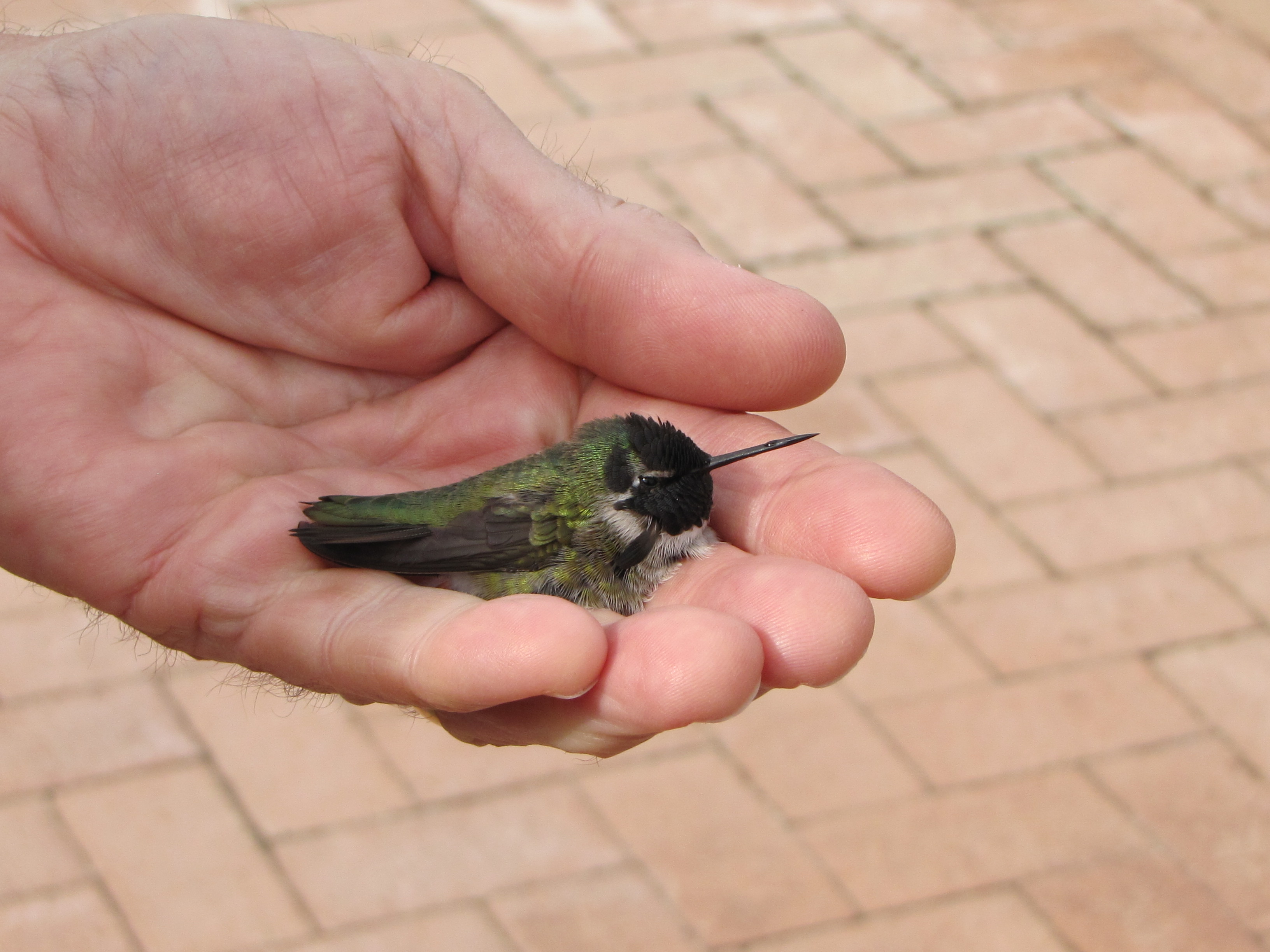
Lazarus, a temporary 'pet' Costa's Hummingbird (photo Prudy Bowers)

Lazarus, a temporary ‘pet’ Costa’s Hummingbird (photo Prudy Bowers)

This month we’re looking at two aspects of birds and pets:  can the wild birds of your yard become familiar enough to be considered ‘pets’, and are any of your real pets, dogs and cats, at risk around SaddleBrooke’s wild birds?

If you provide food for birds, hang hummingbird feeders or set out seed, eventually you will probably recognize individual birds through an errant feather or other distinguishing mark.  Those birds probably recognize you as well, and although they’re never likely to play ‘fetch’, you may well establish some level of relationship.  In the fascinating book, Wesley the Owl, biologist Stacey O’Brien adopted an infant, injured Barn Owl that became her pet for 19 years.  Wesley’s injury prevented his return to the wild, and Stacey’s dedication to the owl included purchasing and providing him with 28,000 mice over his lifetime.  Think about that the next time you shop for dog food.  Other books of interest about wild birds as ‘pets’, include Hummingbirds:  My Winter Guests, Providence of a Sparrow and Quail in My Bed.

Gray Head, an over-wintering Hooded Oriole (photo Bob Bowers)

Gray Head, an over-wintering Hooded Oriole (photo Bob Bowers)

In our case, we have had multiple ‘relationships’ with some of our yard birds.  Gray Head, so-called because of his unique gray head feathers, is a male Hooded Oriole that visits us each September on his southbound migration back to Mexico.  In 2010, he forgot to leave or maybe was worried about reports of violence south of the border.  In any case, he came to our hummingbird feeders daily from September into the following March, when other Hooded Orioles began showing up on their northern migration.  An over-wintering oriole is not unheard of in Arizona, but it is extremely unusual, particularly considering that the winter of 2010-2011 was one of the coldest on record.

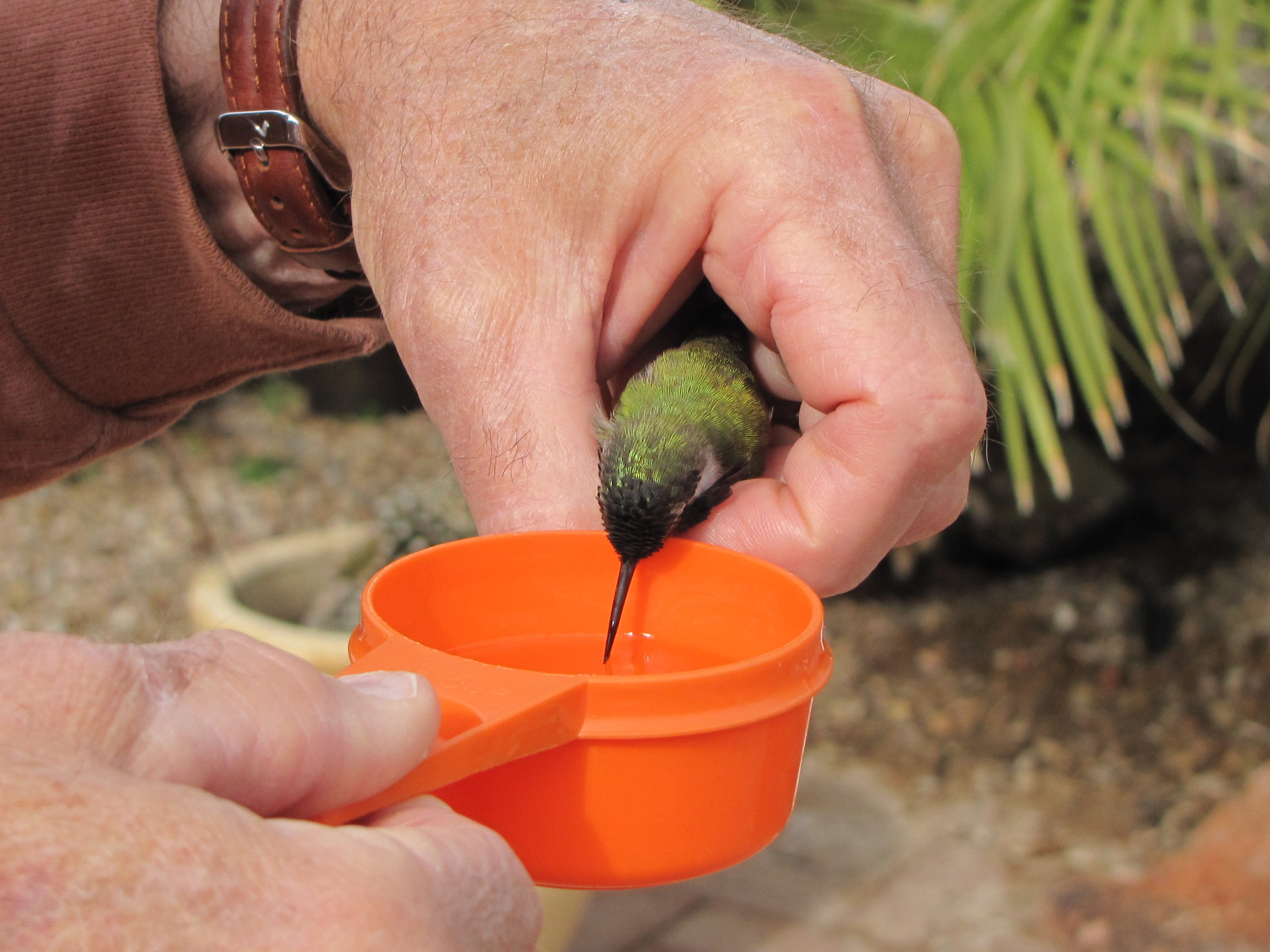
Lazarus feeding from a cup of sugar water (photo Prudy Bowers)

Lazarus feeding from a cup of sugar water (photo Prudy Bowers)

One of our all-time favorite wild bird ‘pets’ is Lazarus, a male Costa’s Hummingbird that we found on our back patio one December morning, an apparent victim of a brutally cold night.  As I carried him to a suitable final resting place, I noticed a leg quiver on his still warm body.  We swaddled him in a heated shoe box and watched him gradually return to the living.  Three days later, after hourly feedings of sugar water, Lazarus left my hand and flew away.  That evening, while we sipped wine on our upper patio, a male Costa’s buzzed in and hovered in front of us for a full minute.  A recognizable cockeyed gorget feather proved it was Lazarus.  We weren’t sure if he was thanking us for the sugar water or asking for a slug of Chardonnay, but we’re certain he’s still a regular visitor.

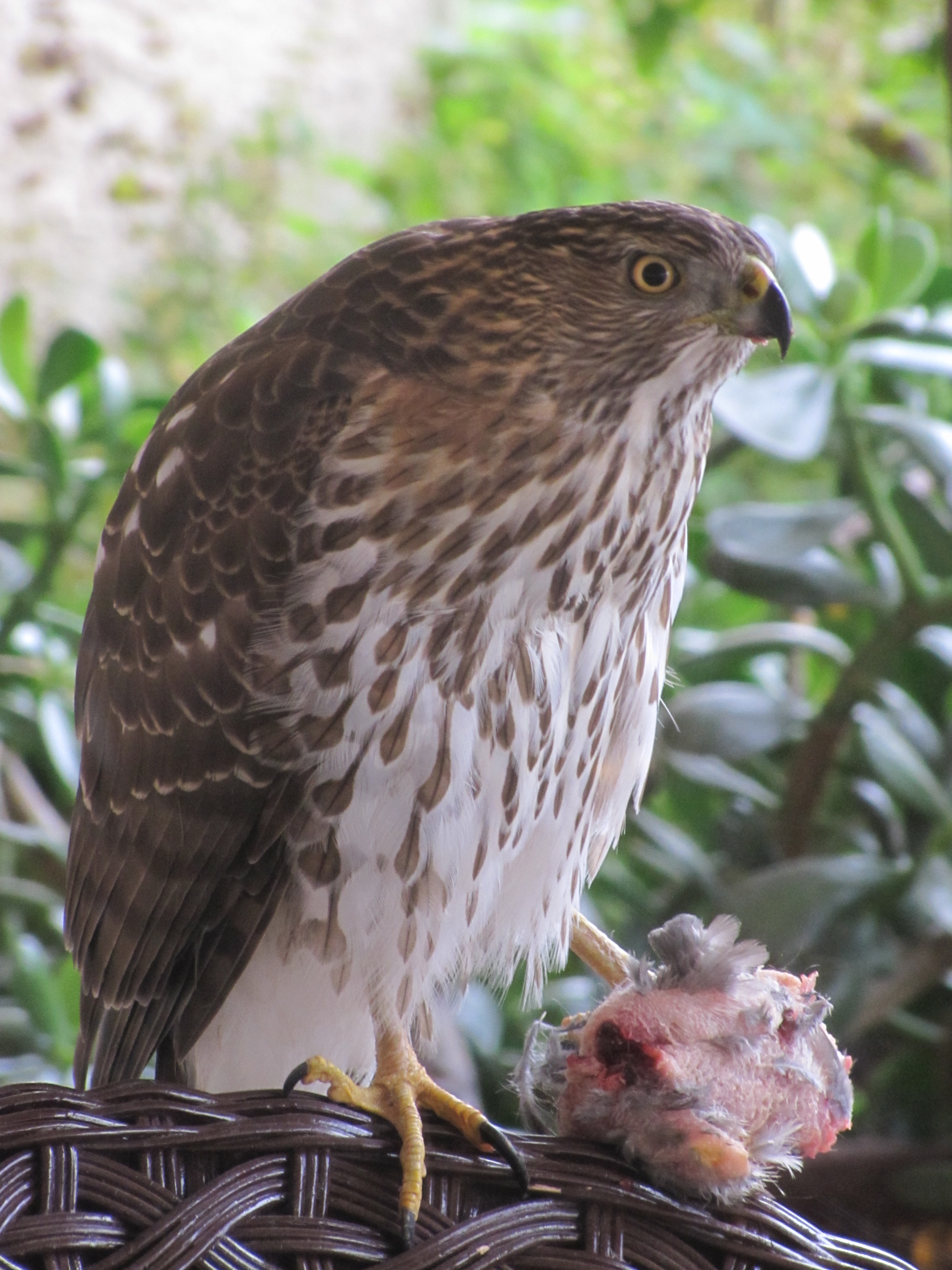
Juvenile Cooper's Hawk with Mourning Dove (photo Bob Bowers)

Juvenile Cooper’s Hawk with Mourning Dove (photo Bob Bowers)

None of our countless quail or doves has ever become a ‘pet’, but this is probably because they see Gary and James Fennimore as pet-like regulars at our house.  Gary and James Fennimore are a pair of Cooper’s Hawks that view our bird-rich feeders as their own private smorgasbord.  They are particularly fond of plump Mourning Doves, not the brightest bird on the block, and love to drive them into windows.  After retrieving the stunned doves, the Cooper’s take a leisurely meal on our stucco walls or patio furniture.  No wonder the doves refuse to fetch the paper.

Which brings me to the question, are birds a threat to real pets?  Those Cooper’s Hawks and their smaller cousins, the Sharp-shinned Hawks have an appetite for birds, but even small cats and dogs are just too much for them.

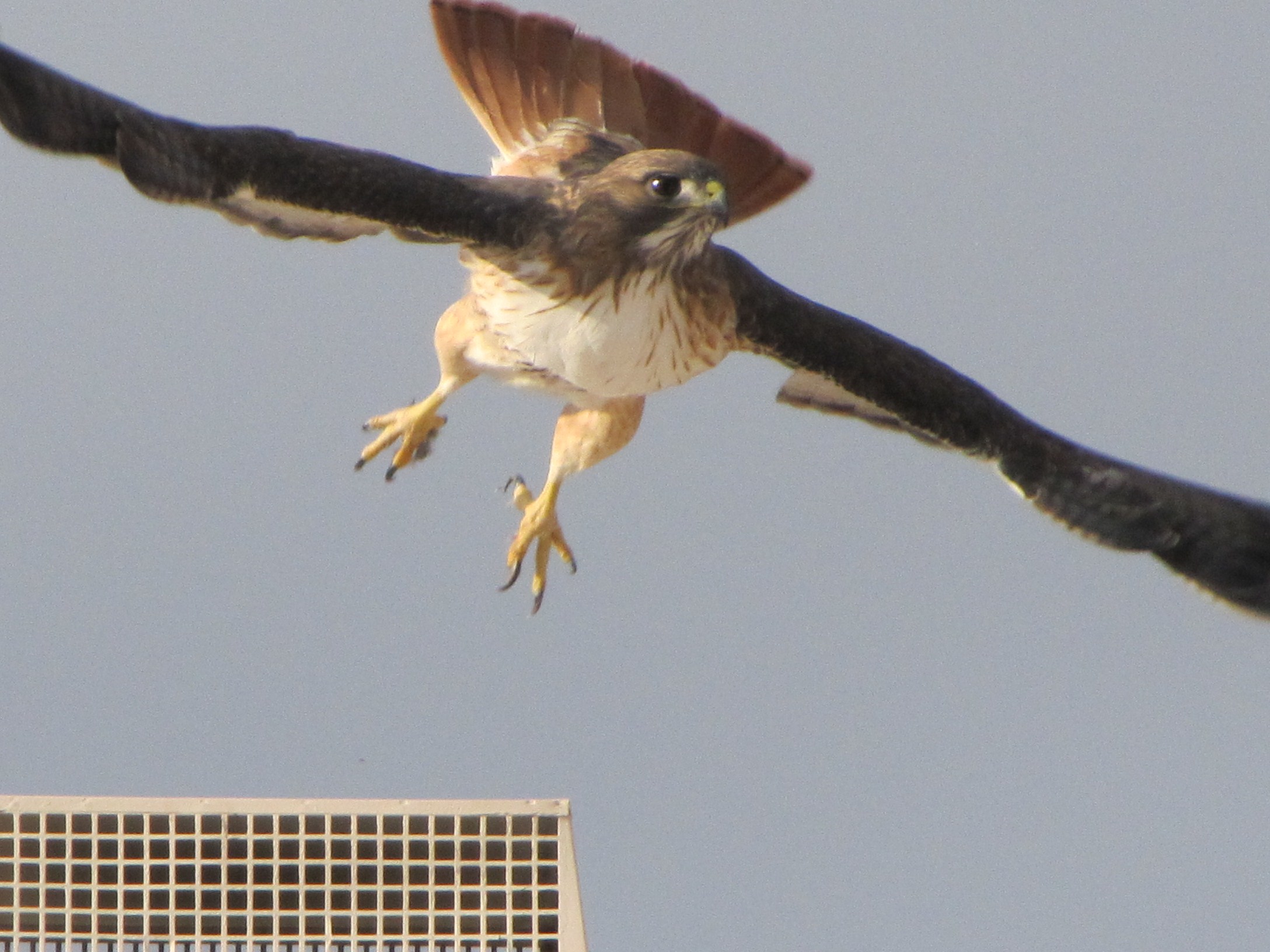
Red-tailed Hawk with Chihuahua-sized talons (photo Bob Bowers)

Red-tailed Hawk with Chihuahua-sized talons (photo Bob Bowers)

On the other hand, larger raptors like Red-tailed and Harris’s Hawks and Great Horned Owls are meat-eaters with bigger appetites and talons to match.  All three of these birds will eat mammals as large as rabbits.  Your German Shepard has nothing to fear, but if your Chihuahua weighs less than 10 pounds, I would keep him on a short leash.  And if your pet likes carrots and has a fluffy white tail, you might want to carry him on his daily walk.

(This article originally appeared in the March, 2013 issue of the Saddlebag Notes newspaper, Tucson, Arizona.)
Posted in Birding Arizona | Tagged , , , , , | Leave a comment

Birding Peppersauce Canyon near Oracle, Arizona

Male Summer Tanager, Peppersauce Campground, Arizona  (photo Bob Bowers)

Male Summer Tanager, Peppersauce Campground, Arizona (photo Bob Bowers)

For a birder, one of the joys of living in SaddleBrooke is the incredible diversity of nearby birding sites. Sweetwater, a waste water reclamation area practically in downtown Tucson, is rich with ducks, shorebirds, migrants and Yellow-headed Blackbirds. Just fifteen minutes from SaddleBrooke, Catalina State Park covers 5,500 acres of Sonoran Desert saguaros, and has a bird list of 200 species including sought-after ‘lifers’ like the Rufous-winged Sparrow and Crissal Thrasher. The national record for most hummingbird species recorded in a single day (14) was set at Beatty’s Guest Ranch in Sierra Vista, and a day on Mt. Lemmon takes one through six different life zones, each one showcasing unique birds. Although touring Mt. Lemmon is an all-day commitment, many of the mountain’s lower elevation birds can be found much closer, in Peppersauce Canyon.

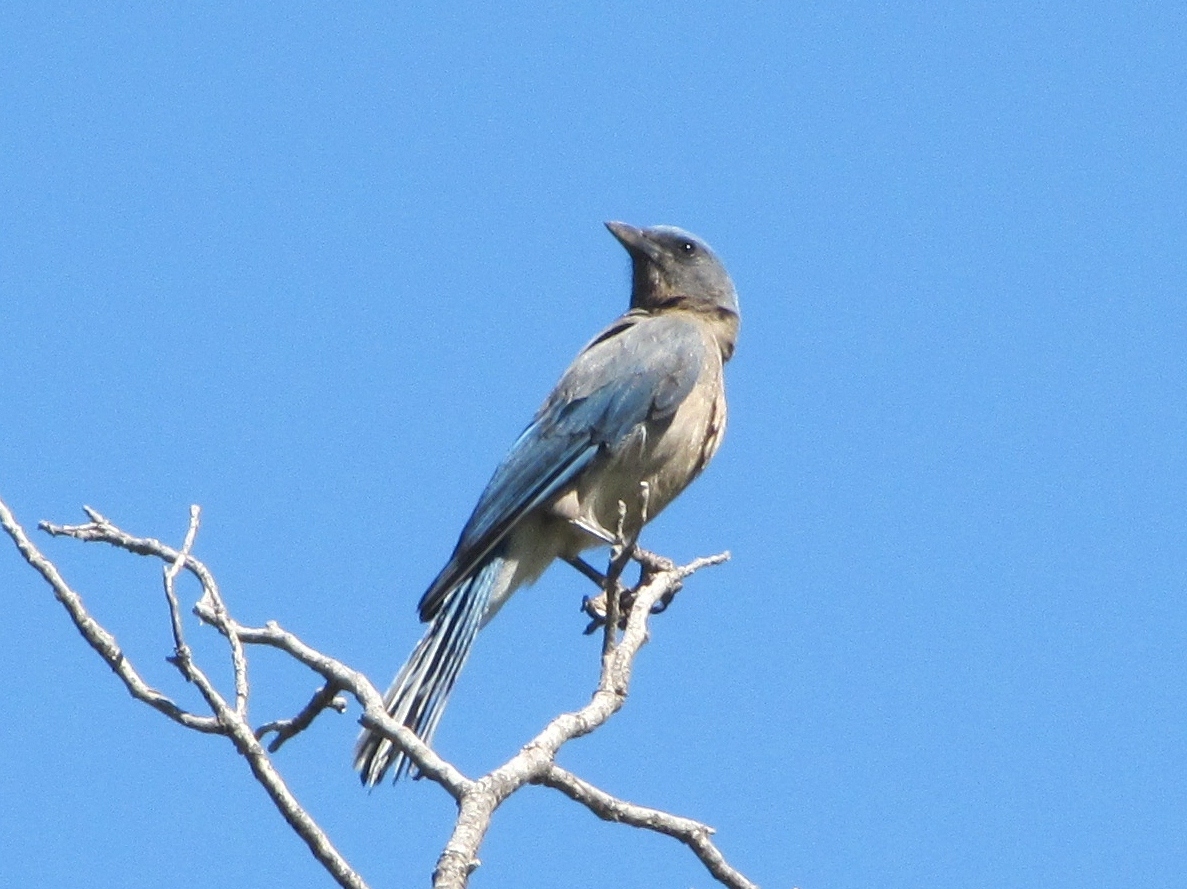
Mexican Jay  (photo Bob Bowers)

Mexican Jay (photo Bob Bowers)

Peppersauce Canyon is an oasis on the backside of Mt. Lemmon, just seven miles beyond Oracle State Park, which is currently closed except for weekends from February 2, 2013 through April 27, 2013, and again in the fall. A National Forest Campground sits in this treed oasis with both individual and group camp sites, picnic tables and pit toilets. Both overnight ($10) and day use ($5) fees are halved for Golden Age Passport holders. If you’re curious about the canyon’s name, in 1880 a camper, Alex McKay, reported that his hot sauce was missing when he broke camp here. It must have been a slow news day.

At 4,600 feet elevation, the campground is cool and shaded by enormous Arizona sycamores, and an ideal and inviting spot for a picnic lunch. The road continues past the campground up the back side of Mt. Lemmon, an adventure in itself that requires a high-clearance vehicle. You don’t need a Jeep to get to the campground, though, as long as you don’t mind driving the family car on five miles of dirt road.

To get to Peppersauce, drive north from Tucson on Highway 77 and turn right into Oracle on American Avenue. Follow American to the sign to Oracle State Park, on the right and across from a grocery store. The pavement ends two miles beyond the park, and the dirt road continues five miles to Peppersauce, passing an Arizona Trail crossing and the post office at American Flag, the oldest territorial post office in Arizona, which closed in 1890. The dirt road traverses hills of desert scrub, well worth pausing to bird, and crests on a ridge looking down into a grove of giant sycamores at the campground. If you are not planning to picnic in the campground, you can park to the right of the entrance.

Birding is excellent within the campground, and along the mine trail which follows the wash beyond the parking area. Bird the campground first, following the road back to the gate into the boy’s ranch, turn right to the group camping area and follow the wash back to the entrance. At the entrance, cross the road and follow the mine road up the wash, returning the same way. The trail is rocky, but the climb is gentle and easy. A small spring lies about one and a half miles up the trail, a site that often attracts birds that might not be seen otherwise, such as Lazuli Bunting and Painted Redstart. The campground in late summer is a favorite for Summer and Western Tanagers, Acorn Woodpeckers, Bell’s Vireos and migrating warblers. Both in the campground and along the trail look for Western Scrub-Jay, Mexican Jay, Bridled Titmouse, Northern Cardinal, Cedar Waxwing and Northern Flicker. Warblers found in the area include Wilson’s, Townsend’s, Nashville and Hermit. A recent SaddleBrooke outing also found Olive-sided Flycatchers, a Swainson’s Hawk, Black-headed Grosbeak, Cassin’s Vireo and White-breasted Nuthatch. This is the place where a Broad-winged Hawk was found two years ago, only the twenty-fifth documented sighting in Arizona.

The campground is rarely occupied mid-week, but look for Carlos, the former campground host who now works at the boy’s ranch. He has some great stories. Like the time a rabid bobcat jumped on him, bit his chest and wouldn’t let go until Carlos beat him off with a pistol. Carlos says folks used to drop unwanted cats in the campground, too, which attracted mountain lions, so they put a stop to that. Carlos claims that mountain lions eat everything on a cat except its legs. He even showed me a spot above the campground where he found 24 cat legs one morning. On our last bird walk in Peppersauce, we were a mile up the mine trail when the trail crossed the wash. Lying in the center of the trail was a young deer’s foreleg. The sun was high and the birds were lying low. Seemed like a good place to turn back.

(This article originally appeared in the October, 2011 issue of the Saddlebag Notes newspaper, Tucson, Arizona.)
Posted in Birding Arizona, Uncategorized | Tagged , , , , | Leave a comment

Feeding Birds in the Winter

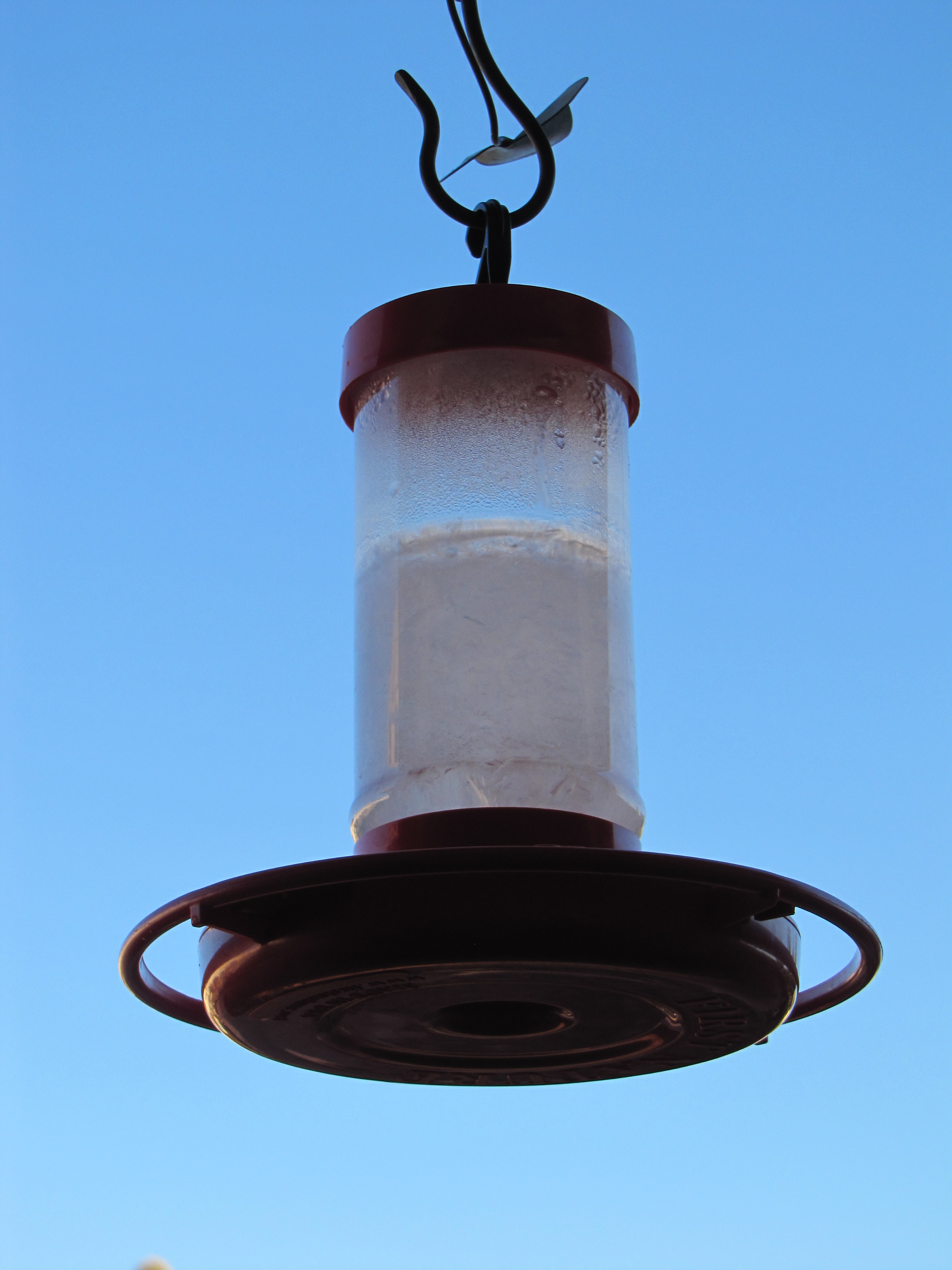
Hummingbird feeders must be thawed in freezing weather (photo Bob Bowers)

Hummingbird feeders must be thawed in freezing weather (photo Bob Bowers)

Just a few years ago it was thought that putting hummingbird feeders out in the winter would encourage birds to hang around past the time they might normally migrate south.  This concern has been proven false for quite some time now, but unfortunately some folks still believe feeders should be taken down in the winter.  Here in SaddleBrooke, not only do some of our hummingbirds leave late for Mexico or arrive abnormally early in the spring, two of our species spend every winter here, often joined by a third.  Our Costa’s, with his purple gorget, is a year-round resident, and Anna’s Hummingbirds (the male’s gorget is ruby red) actually migrate into southeastern Arizona from late summer through early spring, nesting here during some of our coldest weather.  The third hummingbird that is seen here occasionally in the winter, and has been documented year-round in some parts of Tucson, is the brilliant Broad-billed Hummingbird.

 With as many as three species of hummingbirds in SaddleBrooke during the winter, we certainly need to keep at least a few hummingbird feeders cleaned and filled regularly.  Even in some of the coldest winter states, such as Wisconsin, late or lost migrant hummingbirds have been documented in the middle of winter.  It’s doubly important to keep hummingbird feeders up throughout the year in SaddleBrooke.  Not only do we have a year-round hummingbird population, but sometimes winter in the Sonoran Desert can take a major turn for the worst, as it did last February.  On February 3rd this year, my outdoor thermometer dropped to 17 degrees by sunrise, and the next day’s low wasn’t much better, at 19 degrees.  Temperatures gradually returned to normal during the month, but on the morning of February 27th, we awoke to a major snowfall.  When temperatures drop well below freezing or if our plants and feeders are buried under an atypical snowfall, all of our birds suffer, especially hummingbirds.

 Although hummingbirds rely on insects and spiders for protein, up to 90% of their diet consists of flower nectar or the artificial equivalent, sugar water.  Considering that these lightweight wonders (our Costa’s Hummingbirds weigh about two and one-half grams, the same as a penny) routinely beat their wings 70 times per second, it’s little wonder that they thrive on high energy sugar fuel.  When freezing weather hits or snow covers flowers and feeders, hummingbirds are particularly vulnerable.  Without continual access to sugar water or nectar, hummingbirds are at high risk.  They can put themselves into a dormant, low metabolic state during freezing nights, slowly absorbing sugar stored in their crop, but if replacement sugar is not available in the morning, these birds are likely to die.  Consequently, we should all keep at least one feeder up year-round.  If an overnight freeze is predicted, bring your feeders in after dark and replace them at first light.  If daytime temperatures persist below freezing, keep a close eye on your feeders, and thaw them out if ice crystals form.  Feeders without metal parts are especially useful, since they can be thawed quickly in a microwave.

 Although hummingbirds are our most vulnerable birds, severe weather negatively impacts all of them.  Sunflower and thistle feeders should be kept clean and full throughout the winter, as well, and winter is also a great time to hang suet feeders.  Suet cages are inexpensive, and suet cakes are available at places like Walmart for less than two dollars.  Suet provides high calory fat that birds need during cold weather, and nuts, berries and even bugs impregnated into the cakes add protein and nutrients, as well.  Suet will also draw birds that may ignore seed feeders, including Cactus Wrens and Gila Woodpeckers.

 January is also a good time to consider attending one or more of the upcoming bird festivals scheduled for the new year.  Wings Over Wilcox is one of the better-known festivals, running from January 11-15, and featuring workshops and field trips, highlighting the presence of thousands of Sandhill Cranes in the nearby wetlands.  For those needing an excuse to visit San Diego, the local Audubon Society there hosts a birding festival in March, and the bird-rich Verde Valley’s Birding and Nature Festival will be April 26-29.  Two festivals take place during the height of migration, Southwest Wings in Sierra Vista August 1-4, and the second annual Tucson Bird and Wildlife Festival August 15-19.  Let me know if you would like contact  or other information for any of these.

 (This article originally appeared in the January, 2012 issue of the Saddlebag Notes newspaper, Tucson, Arizona.)
 

Posted in Birding Arizona | Tagged , | Leave a comment