Gardening and Landscaping for Bird Lovers


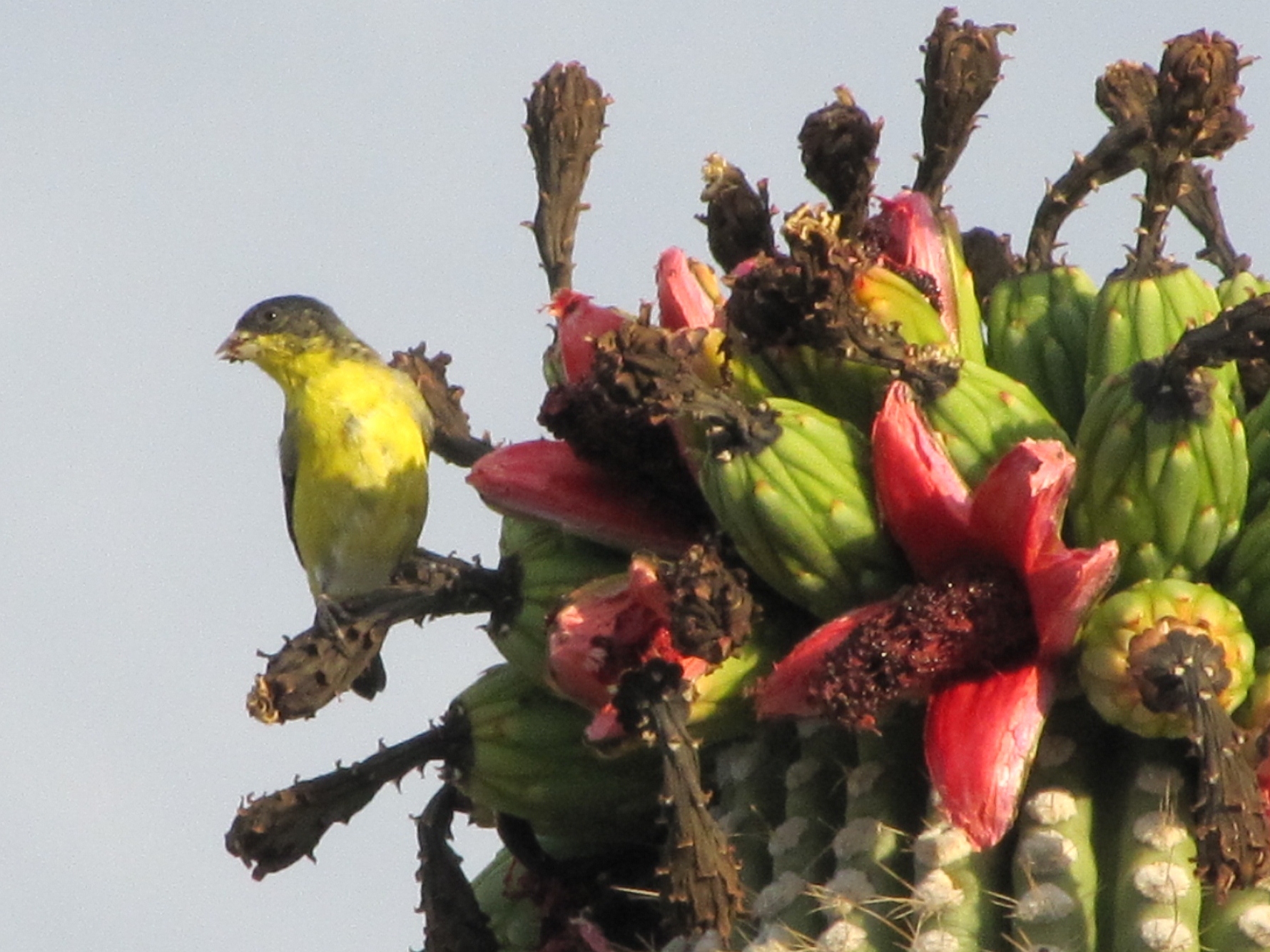
Lesser Goldfinch feeding on Saguaro fruit (photo Bob Bowers)

Lesser Goldfinch feeding on Saguaro fruit (photo Bob Bowers)

If you love to watch birds and want to see them in your yard, feeders are one way to attract them, but certainly not the only way.  How you landscape your yard, and what flowers, trees, cactus and shrubs you choose to plant are equally important to drawing birds.  Feeders supplement natural food sources, but keeping them clean and filled is a lot of work.  Landscaping your yard to attract birds is easier in the long run, and offers an added benefit: you’ll enjoy the yard as much as they do.

Birds aren’t all alike, but most seek several things in common.  These include places to perch and nest, cover, water and food.

Trees and Shrubs for Cover and Nesting

Anna's Hummingbird nesting in  Palo Verde (photo Bob Bowers)

Anna’s Hummingbird nesting in Palo Verde (photo Bob Bowers)

Perching, nesting and protection are provided by a proper selection of trees and shrubs.  Lush, thickly-foliaged trees and bushes should be a priority for bird lovers.  Clusters, rather than isolated plants and trees offer more protection to birds, as well as presenting a more aesthetically pleasing yard.  Native plants, such as velvet mesquite, desert willow, whitethorn acacia, palo verde, hackberry, saguaro, cholla and wolfberry are easily grown in our area, require less water than many exotics and will attract a large variety of birds.  Other plants that attract birds for nesting and cover include citrus, oak, Texas ranger, palm, fig and conifers.  Verdins nest in a variety of trees and bushes, but other birds prefer specific plants.  Cactus Wrens and Curve-billed Thrashers like cholla, while Hooded Orioles nest in palm trees.  Gila Woodpeckers and Gilded Flickers excavate nesting cavities in saguaro.  Although they normally don’t reuse their nests, many other birds do, including Elf Owl, Western Screech Owl, American Kestrel and Ash-throated Flycatcher.

Providing Water and Food for Birds

Water attracts birds, but providing it clean and fresh is problematic.  Pump-driven water features are easier than low volume bird baths, which are difficult to keep free of algae, bird droppings and other debris.  As attractive as they are to birds, the problems with maintaining them may outweigh their value.  Fortunately, there are many alternative sources of water for birds.

White-crowned Sparrow using Mexican Petunia as shelter (photo Bob Bowers)

White-crowned Sparrow using Mexican Petunia as shelter (photo Bob Bowers)

Natural food for birds is much easier to provide.  Many of the plants listed above provide food as well as shelter.  From a bird’s perspective, several items are important when choosing plants for your yard and garden.   Some feed on insects and other bugs, some on fruit, flowers, nectar, and seeds.  Some feed on all of the above.   Some even feed on the birds you attract to your yard, but that’s another story.  A special point should be made about seeds.  Plants that go to seed should not be pruned or cut back until the seeds are gone, since this is a primary food source for many birds.  Long after our basil was killed by cold weather, flocks of Lesser Goldfinches enjoyed the stalks of dried seeds.
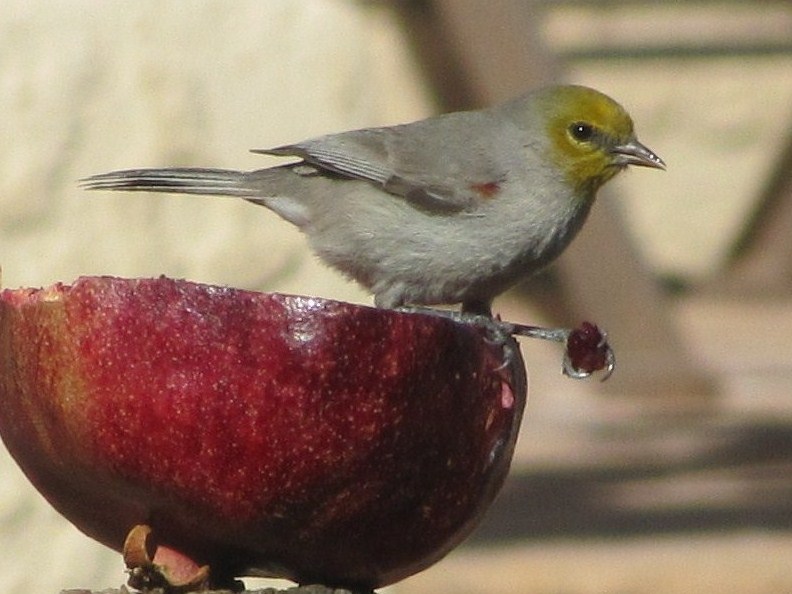
Verdins are attracted to pomegranate (photo Bob Bowers)

Verdins are attracted to pomegranate (photo Bob Bowers)

Since birds are always present, a garden that produces a variety of food year-round is ideal.  The Arizona Native Plant Society and Tucson Audubon Society published an excellent guide to bird-oriented plant selection, Desert Bird Gardening.  The booklet includes a table of 45 plants, showing which ones provide nectar, fruit, seeds and insects, as well as which seasons each flowers.  For example, prickly pear flowers in spring, agave in summer, desert marigold in spring and fall and wolfberry in winter and spring.  Baja fairy duster and chuparosa, which attract hummingbirds, Verdins and Cactus Wrens, are capable of blooming any time of the year.  Other plants in this list include thistle, brittle bush, sunflower, mimosa, penstemon, pyracantha, trumpet, sage, salvia and pomegranate,  one of my favorites.  The large red flowers are magnificent in spring, and as the fruit ripens near year’s end, nearly every bird in the yard goes nuts over it.  I’ve watched Verdins gorge on the nectar-filled arils while open-mouthed quail caught accidental discards below.  Impale a half pomegranate on a nail in the top of a wooden stake and watch a parade of birds:  thrashers, mockingbirds, cardinals, woodpeckers, sparrows and finches.  And what better Christmas decoration than a tree loaded with large rose-red ornaments of fruit?

(This article originally appeared in the February, 2013 issue of the Saddlebag Notes newspaper, Tucson, Arizona.)

Posted in Birding Arizona | Tagged , | Leave a comment

Wings Over Willcox and other Arizona Birding Festivals

Sandhill Cranes are the main attraction at Wings Over Willcox (photo Charlie Thiel)

Sandhill Cranes are the main attraction at Wings Over Willcox (photo Charlie Thiel)

Arizona is well known as one of the best places in the United States to look for birds, ranking in the top three according to an article published in USA Today.  The article quoted a U.S. Fish and Wildlife survey which showed more than a million people came to Arizona in 2006 to bird watch, spending nearly a billion dollars in the process.  That fiscal cliff-sized expenditure represented about 8% of total U.S. spending on birding that year, boosting state revenue, as well.  Many of those visitors come for one or more of the state’s annual birding festivals, which feature field trips, workshops, lectures and nationally-known speakers and leaders.  Among the many benefits of living in Arizona is the opportunity to attend these festivals without having to buy a plane ticket.

Pyrrhuloxia, a target bird at Arizona birding festivals (photo Bob Bowers)

Pyrrhuloxia, a target bird at Arizona birding festivals (photo Bob Bowers)

Give or take, there are ten festivals in the state worth attending, ranging from one-day informational booths and tours to multi-day festivals featuring 50 or more events.  Some are new arrivals, while a couple have been in place 20 years or more.  Information about ten of these follows.  If any of these interest you, it’s important to plan ahead.  Many popular field trips and events, especially those involving well-known experts, often sell out far in advance.  Note that all dates listed are for 2013.

Wings Over Willcox (January 16-20).  Registration for this hugely popular festival begins on September 1, and as I write this in early December, 23 of 53 events have sold out.  However, more than half of the events are still available, from birding tours to photography classes to wine-tasting tours.  Ken Kaufman is the keynote speaker.  Birdlife around Willcox is varied and productive, but the signature highlight of the festival is thousands of Sandhill Cranes that winter nearby.

Southwest Wings Birding Festival (July 31-August 3), Sierra Vista.  This will be the 21st annual SW Wings festival, which features hummingbird-rich canyon sites, Elegant Trogons and a wide range of nearby habitat.

Tucson Bird and Wildlife Festival (August 14-18).  Only in its third year, this event, sponsored by the Tucson Audubon Society, features many well-known birders and is especially convenient to SaddleBrooke.

Verde Valley Birding and Nature Festival (April 25-28), Cottonwood.  Centered in Dead Horse Ranch State Park, this popular festival is in its 13th year.  The late April timing coincides with peaking spring migration.

Yuma Birding and Nature Festival (April 18-20).  Note the dates and programs are tentative, and that last year’s festival was canceled due to budget issues.

Sedona Hummingbird Festival (August 2-4).  In its second year and timed to coincide with peak hummingbird activity, this festival features presentations by hummingbird experts in science, gardening, photography and more.

Tres Rios Nature and Earth Festival (March 9-10), Goodyear.  This festival takes place in Estrella Mountain Regional Park, where the Salt and Agua Fria Rivers join the Gila River.  If water means good birding, what could be better than a three-river confluence?

Great Blue Heron carp fishing at Gilbert Water Ranch (photo Bob Bowers)

Great Blue Heron carp fishing at Gilbert Water Ranch (photo Bob Bowers)

Three other one to two-day events are worth considering:  The Nina Mason Pullian Rio Salado Audubon Center’s Migration Celebration (April 13-14), Phoenix; the San Pedro Spring Festival at Sierra Vista (May 4) and the Feathered Friends Festival (March 23), Gilbert Water Ranch.

Registration and event fees range from free to expensive, but one can often pick and choose only those events of interest.  Early registration for the multi-day festivals is critical to insure participation in popular events.  Detailed information can be obtained by searching the Internet using the festival name.  If you are interested in birds and birding, attending a festival is a great way to expand your expertise and have fun in the process.  And if you live in Arizona, you can get to any of these without an airport body scan.

(This article originally appeared in the January, 2013 issue of the Saddlebag Notes newspaper, Tucson, Arizona.)

Posted in Uncategorized | 1 Comment

The Audubon Society’s Christmas Bird Count

The White-crowned Sparrow a winter migrant found on many Arizona CBCs (photo Bob Bowers)

The White-crowned Sparrow, a winter migrant found on many Arizona CBCs (photo Bob Bowers)

This year will mark the 113th consecutive year that the annual ‘Christmas’ Bird Count takes place.  As you might imagine, the count has changed a lot in 113 years.  Although the first count happened on Christmas Day in 1900, and it’s still called the Christmas Bird Count (CBC), it now takes place over a 23-day period from December 14 through January 5.  The first count was organized by Frank Chapman, an ornithologist at the American Museum of Natural History.  27 people volunteered to count birds in 25 locations from California to Ontario, and they documented a total of 90 species.  By contrast, last year’s record CBC involved 63,227 observers in 2,248 ‘count circles’ across the United States, Canada, Mexico, Central America, South America, the Caribbean, the Northern Mariana Islands and Guam.  These volunteer ‘citizen scientists’ tallied nearly 65 million birds and 2,298 species, almost a fourth of the world’s total species.  This year’s upcoming count may well establish new records, and will add a wealth of data to the pool drawn upon by researchers, scientists and decision makers.  CBC results are collected, summarized and published annually by the National Audubon Society.  The data have proven invaluable in monitoring the health of bird populations, and have led to habitat preservation and other conservation measures.

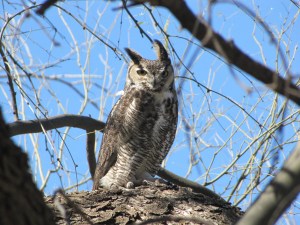
North America's most widespread owl, the Great Horned

North America’s most widespread owl, the Great Horned (photo Bob Bowers)

Frank Chapman undoubtedly would be impressed with the evolution of his idea, but he was motivated by circumstances that no longer exist in the U.S.  As the 19th century drew to a close, birds were unprotected and, in some cases, threatened with extinction.  Birds were killed for their feathers, for their meat and often just for sport.  Incredible as it seems today, there was an annual event at the time designed to kill large numbers of birds for the ‘fun’ of it.  Called ‘the Side Hunt’, this was a competition where participants chose sides to see which team could shoot and kill the most birds.  Appalled by this, Chapman decided to provide an alternative, where participants would identify and count birds rather than kill them, and this first Christmas Bird Count took hold and eventually replaced the Side Hunt.  Five years after the first CBC, Chapman was also instrumental in founding the National Audubon Society, which adopted and expanded the Christmas Bird Count.

You don’t have to belong to Audubon to participate, nor do you need to be an ornithologist or researcher.  You don’t even have to be an expert birder, since each counting team is led by a qualified and experienced ‘compiler’.  The compiler, or team leader, establishes the count date within the 23-day window, organizes the team into smaller groups to cover the 15-mile diameter counting circle, and compiles and submits the results.  Volunteers are enthusiastically welcomed.

The Northern Flicker, another low-elevation winter bird in Arizona (photo Bob Bowers)

The Northern Flicker, another low-elevation winter bird in Arizona (photo Bob Bowers)

This year there are 35 counts scheduled for Arizona, in a variety of habitats including Buenos Aires NWR, Avra Valley, Nogales, Santa Catalina Mountains, St. David, Patagonia, Ramsey Canyon, Gila River, Madera Canyon and Dudleyville.  Many of the leaders are well-known Arizona birders with years of experience in their designated count circles.  The complete list of count circles, the count date and the compiler’s name, telephone number and email address can be found at the Tucson Audubon Society web site, www.tucsonaudubon.org.  Help is needed on most of these counts, so if you find one that interests you, contact the compiler for more information.  This is a great way to spend a fun day, meet others with similar interests, learn a lot about birds and make a positive contribution to the knowledge and conservation of birds everywhere.  Beginning this year, it’s also free.

(This article originally appeared in the December, 2012 issue of the Saddlebag Notes newspaper, Tucson, Arizona.)

Posted in Birding Arizona, Birding the Americas | Tagged | Leave a comment

November is Turkey Month, and Wild Turkeys are Thankful

A Wild Turkey Displays in Arizona’s Madera Canyon (photo Bob Bowers)

Unlike their domesticated cousins, Wild Turkeys worry little about the approach of Thanksgiving. However, this wasn’t always the case. In fact, loss of habitat and unregulated hunting nearly wiped out all of U.S. Wild Turkeys by the mid 1930s.

There are two species of wild turkeys, the Wild Turkey found throughout the United States and the Ocellated Turkey, endemic to Mexico’s Yucatan. The Wild Turkey consists of five sub-species, which for the most part are found in specific geographic areas: the eastern U.S., one in Florida, one in Kansas, Oklahoma and Texas (the Rio Grande sub-species), one in the western mountain states (Merriam’s) and the rarest (Gould’s) found only in Mexico and some sky islands in Arizona and New Mexico. Although the Wild Turkey has successfully recovered from near-extinction, the bulk of today’s populations are found in the Eastern, Rio Grande and Merriam’s sub-species.

Here in Arizona, we have two native sub-species of Wild Turkey, the more common Merriam’s and the rare Gould’s. Most of Arizona’s Merriam’s turkeys are found in ponderosa pine forests north of the Gila River. Near SaddleBrooke, you might find turkeys on Mt. Lemmon, Ramsey or Madera Canyon. With a total U.S. Population estimated at less than 1,000 birds, Arizona Game and Fish Department is continuing efforts to expand existing populations by capturing and relocating selected birds.

When over-hunting of birds nearly extirpated turkeys in the 1930s, state wildlife agencies across the country tried desperately to restore them to former levels. Initially, this was attempted by releasing pen-raised birds, but survival rates of these near-domesticated turkeys were too low. It took twenty years before success was finally achieved, through the capture of wild birds in one area and their release in a different, non-populated area. In Arizona, miners subsisted on Gould’s turkeys, and by the time Arizona implemented regulated hunting of turkeys in 1929, not a single Gould’s remained in the state. Ironically, the biggest boost to the Wild Turkey’s recovery came in 1973, with the founding of the National Wild Turkey Foundation, established primarily to protect the future of turkey hunting. The NWTF is a nonprofit conservation and hunting organization, and its efforts, together with that of other state and conservation organizations has proven enormously successful. The number of Wild Turkeys that had recovered to about 1 million birds by 1973 is now estimated by the NWTF at more than 7 million. So this Thanksgiving the Wild Turkey also has reasons to be thankful. About 7 million, in fact.

A Close Look at a Wild Turkey’s Beard (photo Bob Bowers)

Although hunting in Arizona is permitted for both native species, it is strongly restrictive and tightly controlled. During a limited season in April and May, hunters are limited to one ‘bearded gobbler’ and permits are available only through a lottery. The license and tag fees are $229. When you add the cost of a shotgun, ammunition, camouflaged undies and a guide, the frozen bird at Basha’s looks like a bargain.

(This article originally appeared in the November, 2011 issue of the Saddlebag Notes newspaper, Tucson, Arizona.)
Posted in Birding Arizona | Tagged , , | Leave a comment

House Sparrows and House Finches, our Most Common Birds

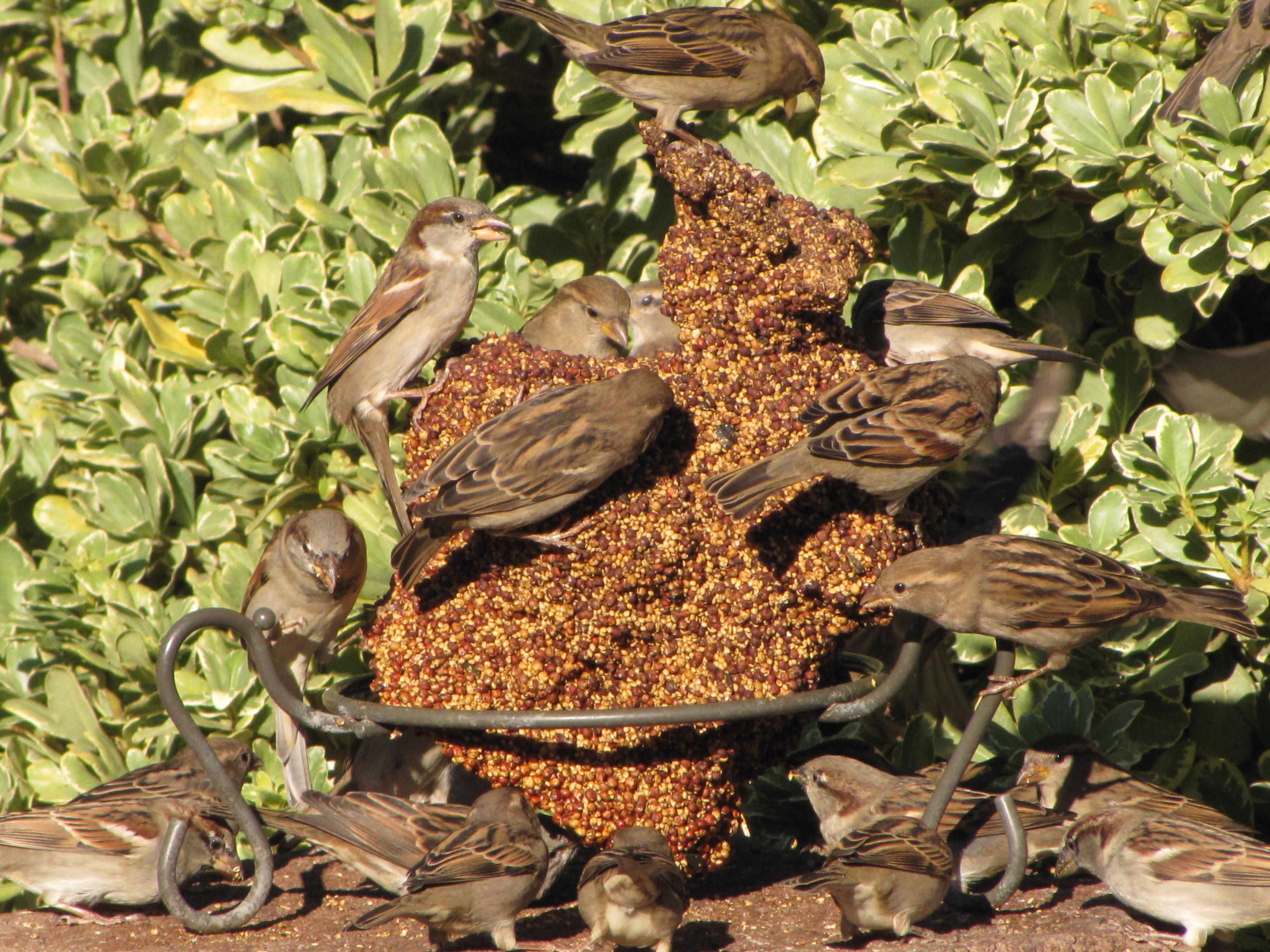
House Sparrows Monopolizing a Seed Block

After I wrote about one of my favorite birds last May, the Black-throated Sparrow, I received several reports of yards ‘full of’ these special birds.  The Black-throated Sparrow is, in fact, seen in most SaddleBrooke yards, but most of the reported sightings probably were House Sparrows, our most common bird.  Adult male House Sparrows can be confused with Black-throated Sparrows, since they also have a black throat, but otherwise the two birds are easily distinguished.  House Sparrows are common to the point of being a nuisance, and tend to hang out in flocks of a dozen or more birds.  They try to monopolize seed feeders, and nest in natural and man-made cavities around your house and yard.  By contrast, Black-throated Sparrows are usually seen alone or in much smaller groups of 2-4 birds, and they nest near the ground, typically in cactus.

Other than Throat Color, there is Little in Common between this Black-throated Sparrow and a House Sparrow

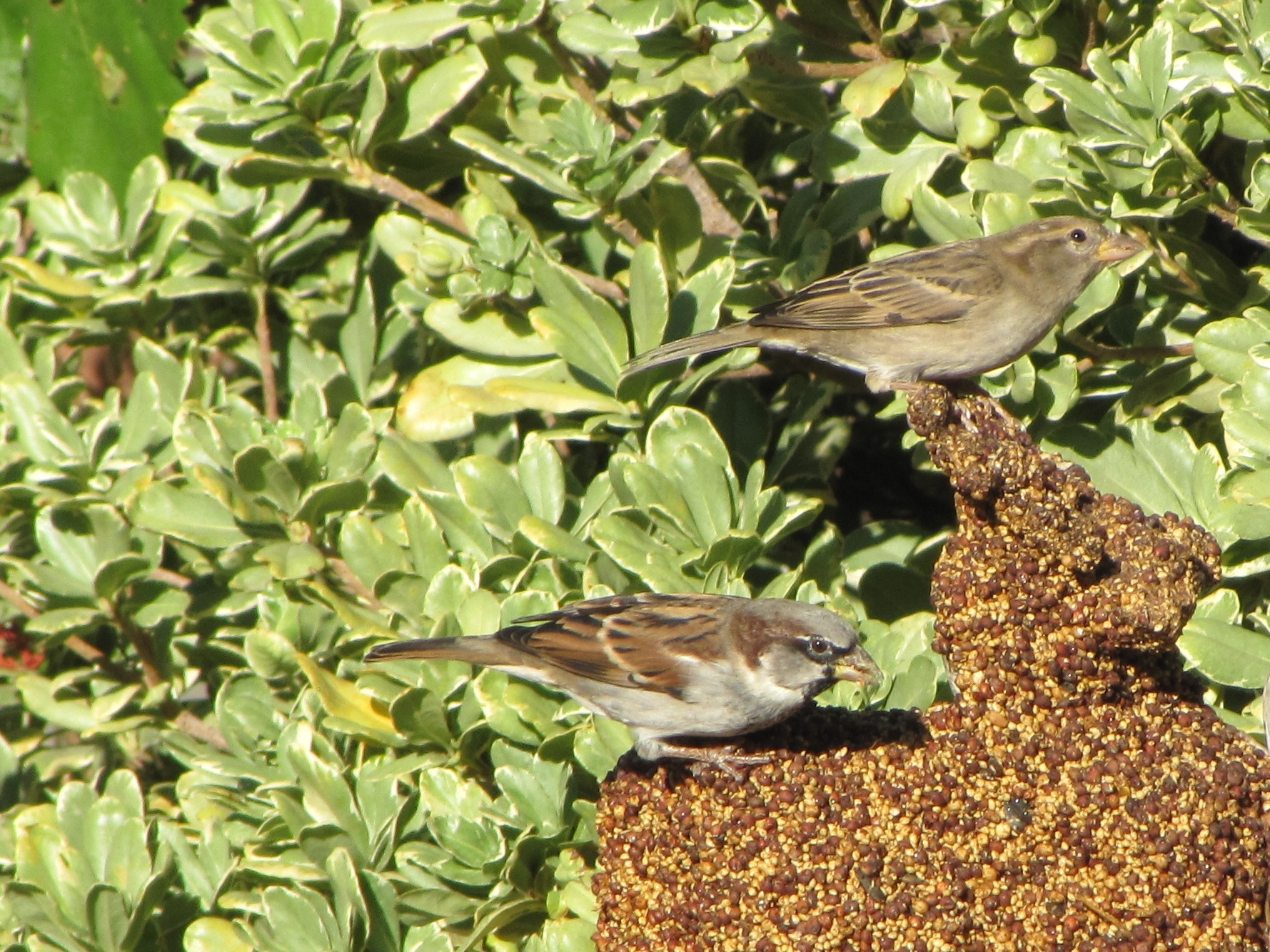
The easiest way to differentiate the two birds is by color.  Black-throated Sparrows are mostly colorless, patterned in shades of black, gray and white, while male House Sparrows are richly colored across their backs in boldly patterned reddish brown.  Female House Sparrows are dingy brown with a pale supercilium/eyebrow, and they are found in large numbers with the males.  In contrast, male and female Black-throated Sparrows are identically marked, and bold white stripes border the top and bottom of the black stripe that runs through their eye.  The range of Black-throated Sparrows is limited to western U.S. and Mexican deserts, while House Sparrows are found throughout the lower 48 states, Mexico and most provinces of Canada.

Female House Sparrow (above) and Male House Sparrow (below)

This widespread distribution of House Sparrows is all the more remarkable considering that this bird was not present in the U.S. in 1849.  In the fall of 1850, 16 birds were imported by the Brooklyn Institute, protected through the winter and then released the next spring.  When these birds did not ‘thrive’, the institute purchased and imported more from England (the House Sparrow originally was called the English Sparrow, although it originated in the Middle East.)  This second batch of birds was released in 1852 and 1853, and survived and thrived far beyond anyone’s expectations.  For reasons that aren’t exactly clear, especially knowing the bird as we do today, more sparrows were obtained in Europe, imported and released in 10 other states, including a whopping thousand birds in Pennsylvania in 1869.  From these states, multiplying sparrows were captured and transported to other locations.  Coupled with this artificial distribution, the sparrows themselves broadened their range aggressively, up to 150 miles per day.  This natural range expansion accounts for Arizona’s House Sparrows, which first showed up in Tucson in 1903.  Other countries made similar importations, and today the House Sparrow is the most widely distributed wild bird in the world.

Since House Finches are equally widespread in the U.S., and nearly as ubiquitous as House Sparrows, one might suspect they were imported as well, but that’s not the case.  Prior to 1945, House Finches were considered a western bird, ranging from British Columbia to southern Mexico and from California to mid-Texas.  In 1940, they were introduced to New York, which for unknown reasons seemed determined to import birds.  Those eastern House Finches also expanded their range, which now covers the lower 48 states.

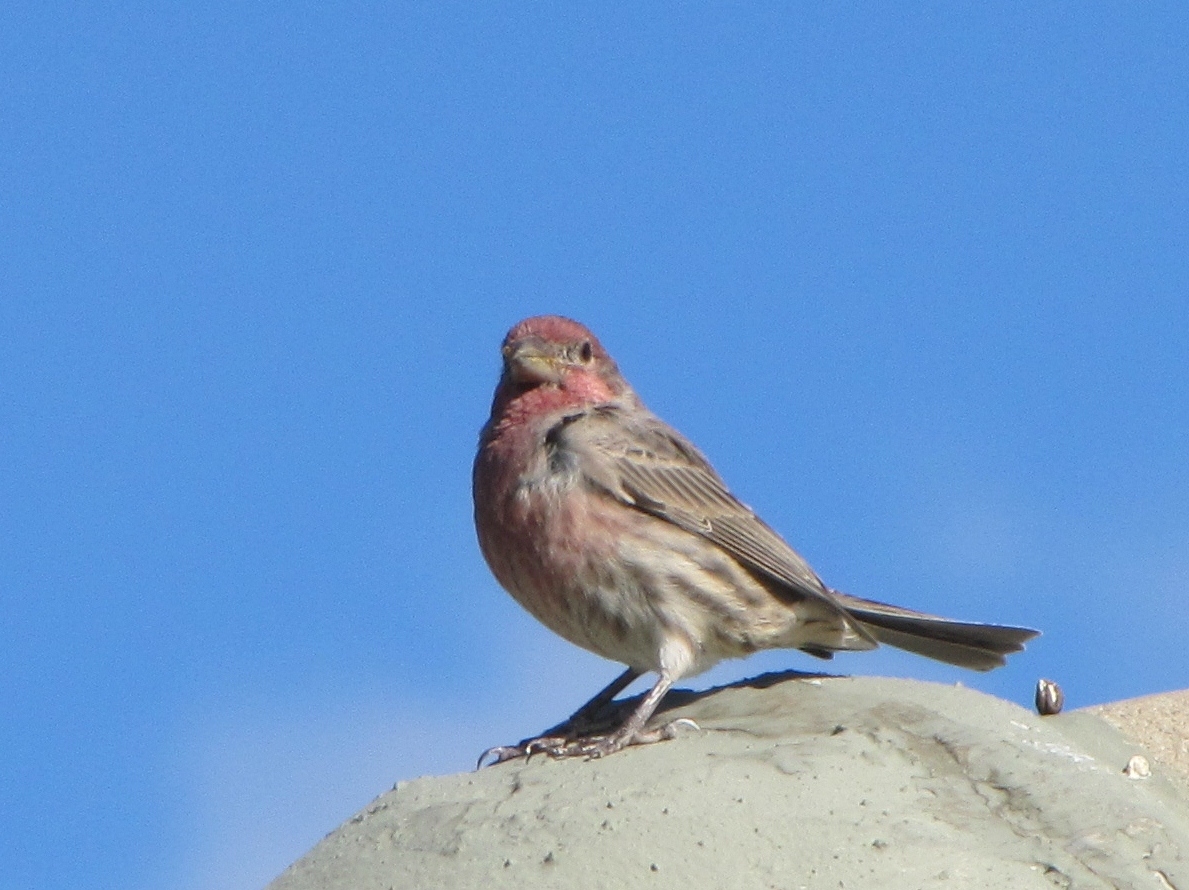
The Male House Finch’s Color is Influenced by Diet

Male House Finches are colorful birds, with a bright red forehead, throat, breast and rump.  Their feather color is diet dependent, and House Finches in Hawaii, for example, are more orange and yellow than red.  Since the finch is a seed and insect eater, this has nothing to do with pineapple.  In fact, we occasionally see yellow-colored House Finches here, known as ‘yellow variants’, birds that likely are missing something important in their diet.  Be thankful we don’t change color for the same reason.

As is the case with many birds, the female House Finch is colorless.  ‘Drab and dingy’ apply to female House Finches as well as to female House Sparrows.  Don’t feel sorry for the females, though.  This is nature’s way of protecting them from predators, and is especially important during nesting.  The guys can swagger around with their eye-catching color, but there are times when drawing attention is a bad idea.

(This article originally appeared in the November, 2012 Saddlebag Notes newspaper, Tucson, Arizona.  Text and photographs copyright Bob Bowers.)

Posted in Birding Arizona | Tagged , | Leave a comment

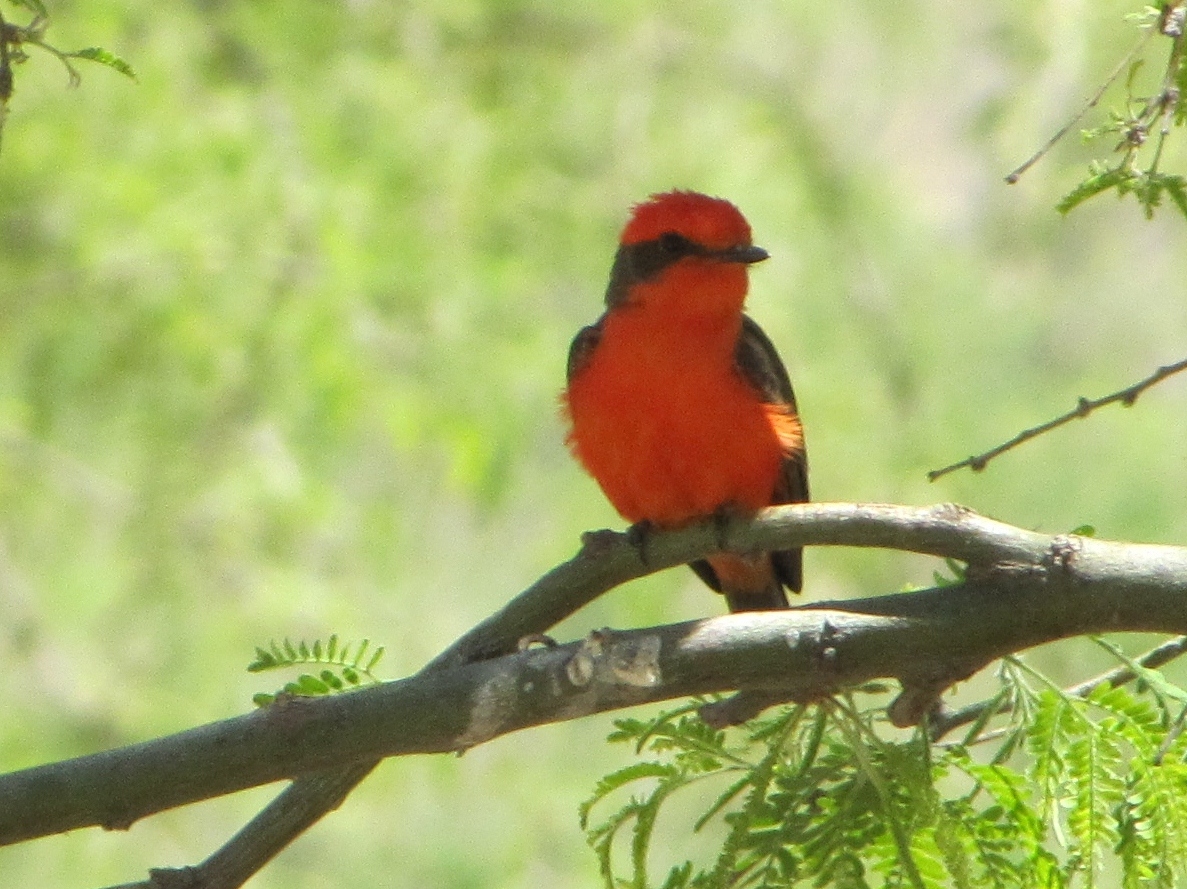
The Vermilion Flycatcher, a Ruby with Wings

Male Vermilion Flycatcher in Arizona (photo by Bob Bowers)

Of all the colorful birds in southeastern Arizona, the one certain to get your attention is the male Vermilion Flycatcher.  Perched on a low branch, his brilliant red crown and breast reflecting Arizona sunshine, he looks like a ruby with wings.  Paying little attention to observers, he sallies out, grabs an insect on the fly and returns to his perch.  Look carefully, and you’ll likely find his mate perched nearby, emulating this fly-catching.  Less striking, she’s still a beauty with a pale breast and salmon pink belly.  These birds love riparian areas, watercourses and washes, and in SaddleBrooke, you’ve probably seen them on a golf course.  Most U.S. Vermilion Flycatchers migrate from Mexico to nest here and in parts of Texas, New Mexico and California, returning south in the fall.  Fortunately for us, some winter here as well.

How Many Ways Can You Say Red?

 If this bird had been named the ‘Red Flycatcher’, maybe it wouldn’t seem so special.  ‘Vermilion’ suggests something more than red, and the dictionary agrees, adding ‘bright’ and ‘orange’.  The flycatcher’s scientific name is even more to the point, Pyrocephalus rubinus, which translates as ‘ruby fire head’.  Read Herbert Brandt’s five-pound, 61-year old classic, Arizona and Its Bird Life, and you will find poetic references to the Vermilion Flycatcher on 27 different pages.  Brandt waxed eloquently about the Firebird, as it was also known, describing it as brilliant, a jewel, crimson, blazing, fiery, rich ruby, colorful, a gem and a gorgeous flame.  I think he liked it.

A Ruby with Wings, the Vermilion Flycatcher (photo by Bob Bowers)

The Vermilion is the only species in its genus, Pyrocephalus, and is unique among other Tyrant flycatchers in a couple of ways.  While male and female flycatchers, such as Black Phoebe, Ash-throated Flycatcher and Western Kingbird look alike, Vermilion males and females are strikingly different.  Likewise, young phoebes, Ash-throats and kingbirds look much like their parents, but immature Vermilion males are mottled, not solid red and females have yellow bellies, not pink.  One feature common to young and adult Vermilions is a dark eye mask that aids in identifying immature birds.  Vermilion Flycatchers also dip their tails like phoebes, and the females can be confused with the similar looking, but larger (and more common to SaddleBrooke) Say’s Phoebe.  Vermilions belong to the large family of Tyrant Flycatchers, and while several tyrannids are known for elaborate courtship displays, the Vermilion’s is particularly stunning.  The male slowly flutters above the trees, more like a butterfly than a bird, displaying his brilliant red breast and crown, and then flutters back to his low perch.  I’ll never forget my first sighting of a male Vermilion, performing this elaborate display along the San Pedro River.  I thought I was seeing an exotic bright red butterfly.

Even Viewed from the Back, a Vermilion Flycatcher Stands Out (photo by Bob Bowers)

When one of our sons saw a Vermilion in SaddleBrooke, he recognized it as his favorite Peruvian bird.  Indeed they are found in Peru, where you can also find an unusual melanistic version that is completely black and brown.  More like a lump of coal than a ruby.  As a matter of fact, the Vermilion, relatively rare in the U.S., is widespread across Mexico, Central America and South America.  Perhaps most surprisingly, the winged ruby can also be seen in the Galapagos Islands.  All it takes is a six hundred mile flight from Ecuador and a five-figure dent in your IRA.  Or you can walk a SaddleBrooke golf course.

(This article originally appeared in the October, 2012 Saddlebag Notes newspaper, Tucson, Arizona.  Text and photographs copyright Bob Bowers.)

Posted in Birding Arizona | Tagged , , | Leave a comment

Fall Migration of Birds in Southeast Arizona

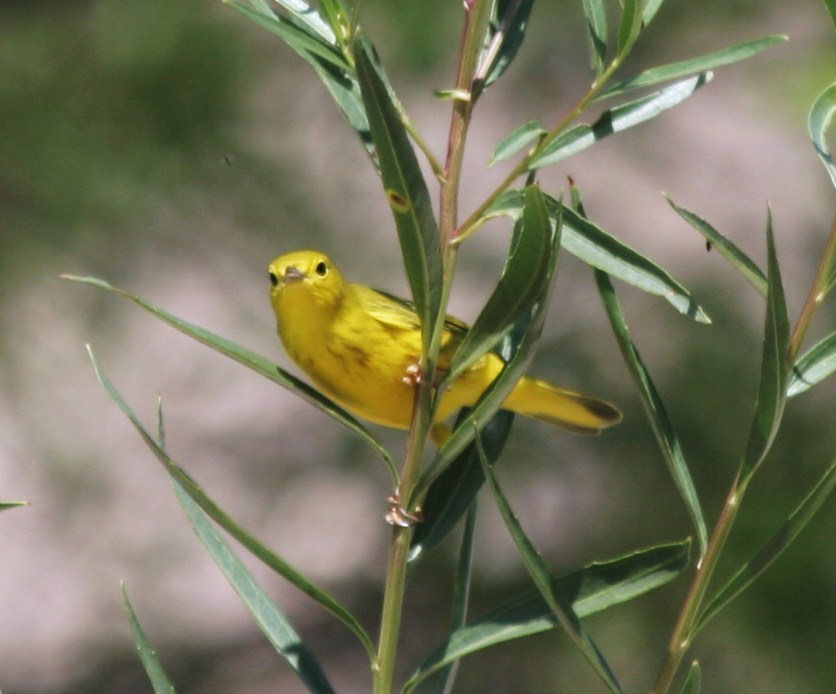
Migrating Yellow Warbler, Catalina State Park, September (photo Bob Bowers)

Home to some of the best watching in the country, southeast Arizona actually has four birding ‘seasons’.  Our resident birds, like Cactus Wrens, Curve-billed Thrashers and Northern Cardinals, live here year-round and give us a continuous ‘season’ of birding.  A second ‘season’ consists of birds that come here to breed, nest and fledge their young, arriving in spring from Mexico or further south and then returning to their winter grounds, usually by the end of September.  These locally nesting birds include Hooded Orioles and Black-chinned Hummingbirds, among others.  A third birding ‘season’ is the reverse of the second:  some species, like White-crowned Sparrows, winter here.  They arrive from their more northern nesting areas around the end of September, and then head back north in the spring.  Finally, a fourth and a fifth ‘season’ of birding consists of birds that pass through our area as they migrate between their northern nesting areas and their southern wintering grounds in Mexico or Central America.  The spring migration is short-lived, and birds like the Rufous Hummingbird and American Robin are rarely seen in SaddleBrooke in the spring, if at all.  Understandably, they are rushing north to their breeding grounds, and those who snooze, lose.  Fall migration, though, is a different story.  When bird families pass through on their way back south, they sometimes hang out for weeks, gorging on monsoon bugs and flowers.  These southbound migrants, combined with summer nesters and our year-round residents produce a perfect storm of birding in August and September, my two favorite birding months in Arizona.

The Birds of August and September

Hummingbird activity, which drops off in July and early August, picks up significantly around mid-August and remains strong through September.  Our year-round Costa’s practically own the feeders in July, but the competition heats up by August 15th.  Black-chinned Hummingbirds, who nest along nearby washes, return to home feeders to stock up for their trip to Mexico.  Migratory Anna’s join those that didn’t leave in the summer, and hang around to nest in winter and spring.  Rufous Hummingbirds, returning to Mexico from their summer breeding grounds in the Pacific Northwest, arrive in swarms and stay through September, joined by occasional Broad-billed and the more rarely seen Broad-tailed.  This is a good time to hang additional feeders and to try hand feeding hummers.

Male Summer Tanager, Peppersauce Campground, Arizona (photo Bob Bowers)

Brightly-colored Western Tanagers, Yellow Warblers,  Wilson’s Warblers, Nashville Warblers and MacGillivray’s Warblers sometimes stop briefly in SaddleBrooke, but can be seen reliably in Catalina State Park or Catalina Regional Park.  Slight increases in elevation bring more species into the mix.  Visit Peppersauce Canyon for Painted Redstarts, Black and White Warblers, Summer Tanagers and Hermit Warblers, and the higher elevations of Mt. Lemmon for a large variety of warblers, including Grace’s, Red-faced, Townsend’s, Black-throated Gray and Olive.

Familiarize yourself with these ‘opportunity’ birds and give more than the usual passing glance at backyard visitors.  Visit Peppersauce, Catalina Regional Park, Catalina State Park and Mt. Lemmon.  August and September might become your favorite birding months, too.

(This article originally appeared in the September, 2012 Saddlebag Notes newspaper, Tucson, Arizona.  Text and photographs copyright Bob Bowers.)

Posted in Birding Arizona | Tagged , | Leave a comment

The Sapsucker, a Hummingbird’s Best Friend?

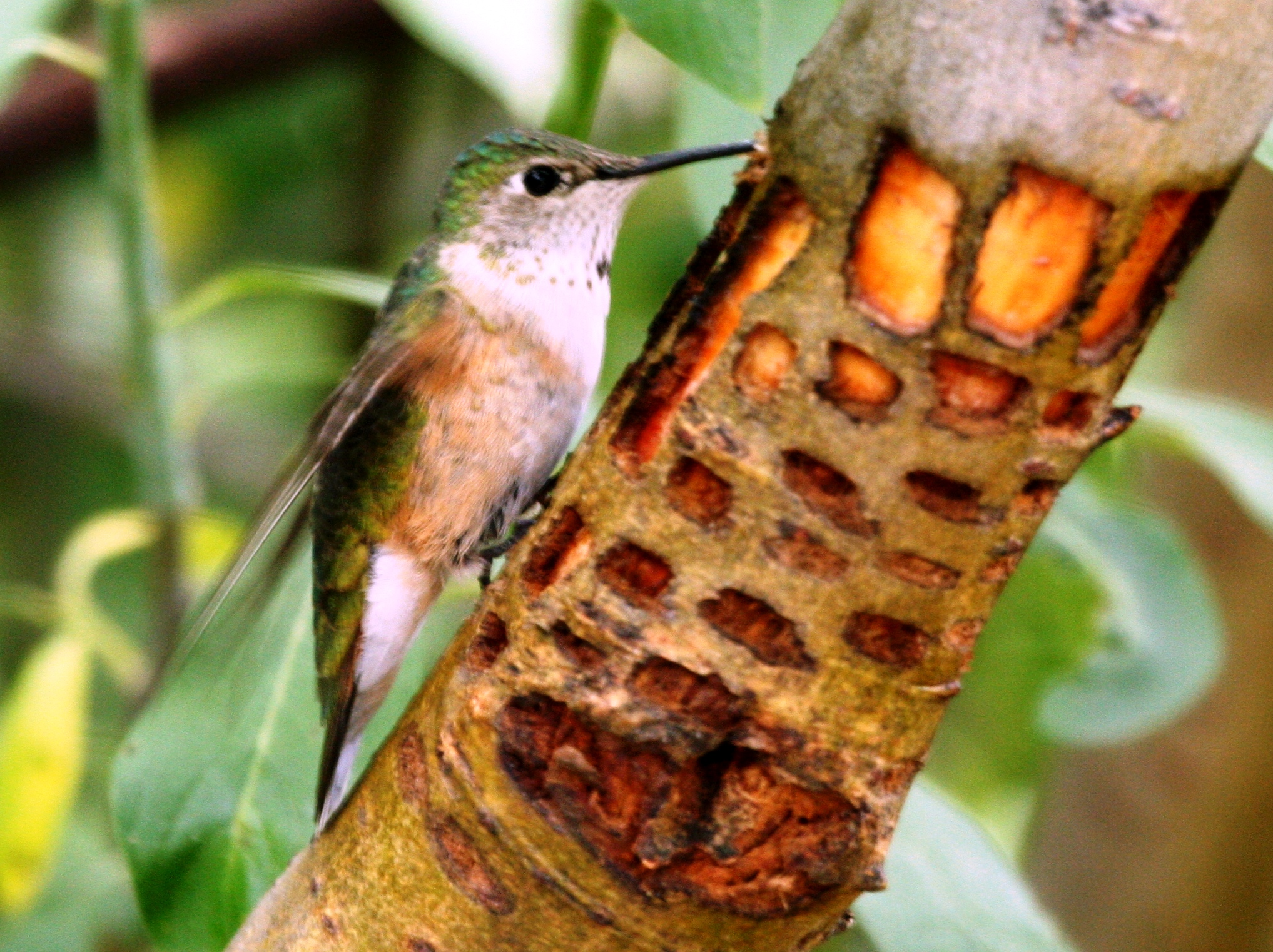
Immature Male Broad-tailed Hummingbird at Colorado Sapsucker Wells (Photo Bob Bowers)

If you think ‘woodpecker’ is a funny name for a bird, how would you like to be called a ‘sapsucker’?  Like Rodney Dangerfield, the Picidae family just gets no respect.  There are 22 members of this family in North America, and 4 of these are sapsuckers.  The two you’ll find in Summit County are the Williamson’s and the Red-naped, both of which nest here in the summer, and our hummingbirds are grateful for both of them.

Do Sapsuckers really Suck Sap?

To be accurate, sapsuckers should be called ‘saplickers’ or ‘saplappers’.  They can’t actually suck sap, but they do lap and lick, using their long, sticky, barbed and extensible tongue.  Other woodpeckers have a similar tongue, but they use it to retrieve insects from holes and crevices rather than to lap sap.  Trees transport nutrients from their leaves to their roots using bark tissue called phloem, and the phloem sap that moves through this vascular system is prized by sapsuckers.  Actually, lots of animals, including bats and other birds, like this sap, but if it weren’t for sapsuckers, they would not be able to access it, because exposed sap quickly congeals.  To the benefit of all of these sap cravers, sapsuckers have an anticoagulant in their saliva that prevents coagulation.

Juvenile Red-naped Sapsucker Drilling Wells, Chihuahua Gulch, Colorado (photo by Bob Bowers)

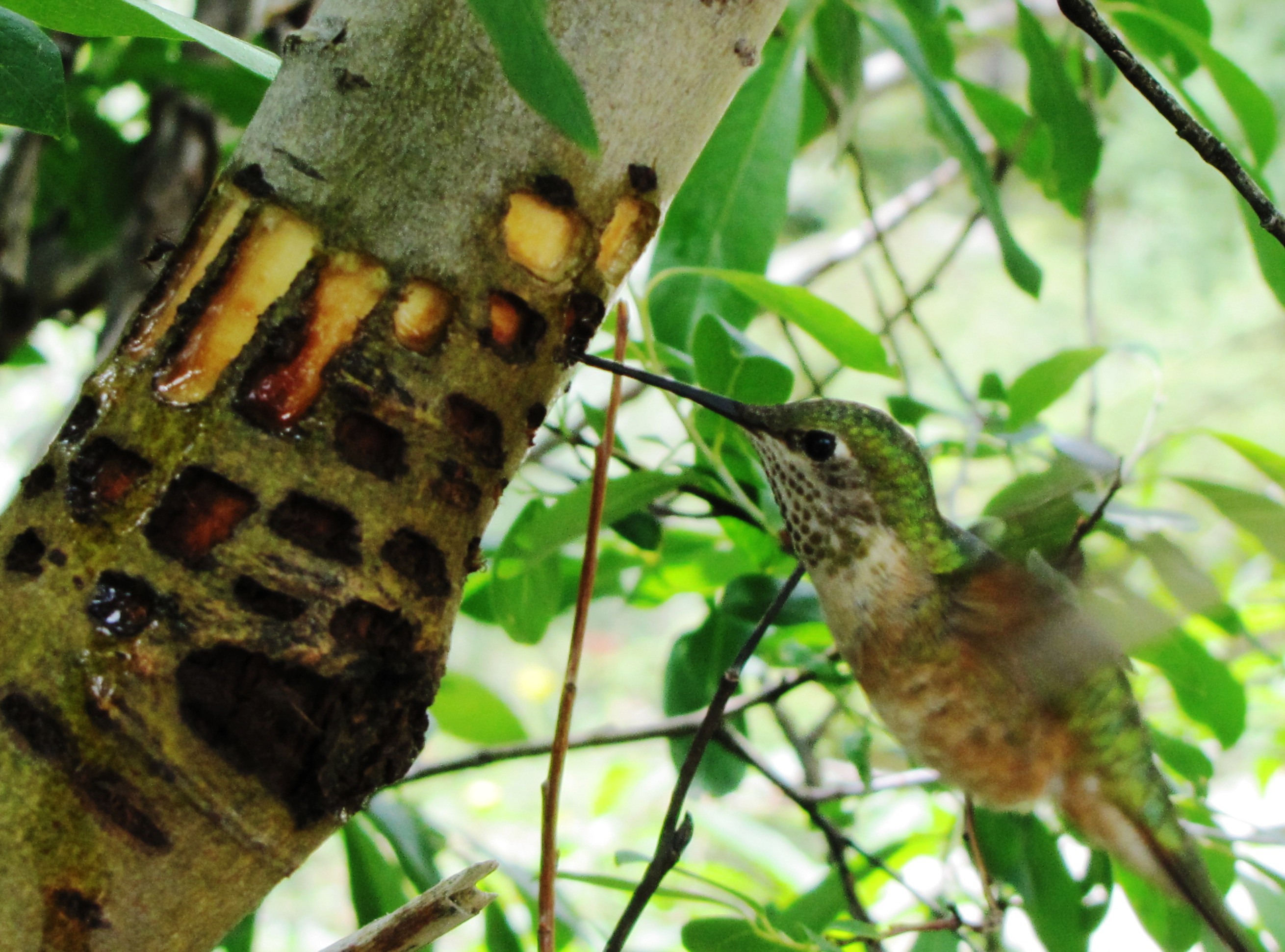
To get to the phloem sap, sapsuckers drill small, shallow holes in the tree’s bark.  These holes are square and in neat rows, looking more man-made than natural, and are an unmistakable sign of sapsuckers.  You will find them in all kinds of trees and shrubs, including aspen and willow.  For birders, searching for these sap wells is a great way to find hummingbirds in the wild.

How do Hummingbirds Benefit from Sapsucker Wells?

Fortuitously, phloem sap is nearly identical in sugar content to flower nectar, providing hummingbirds with a suitable alternative.  This is especially important to hummingbirds like our Broad-tailed, which often arrive on their mountain nesting grounds before many flowers are blooming.  Nectar represents as much as 90 percent of a hummingbird’s diet, but they also need protein.  The second important part of a hummingbird’s diet is insects, and these protein-rich bugs are also found at sapsucker wells, being drawn there by their own affinity for sweet sap.  In summer, these same wells attract migrating Rufous and Calliope Hummingbirds, passing through Summit County on their way south, back to their wintering grounds in Mexico.  Interestingly, this same pattern is repeated throughout the sapsucker’s range.  For example, the Red-naped Sapsuckers that nest in Colorado in the summer move to southeastern Arizona for the winter.  There, they drill sap wells in mesquite trees, drawing Anna’s and Costa’s Hummingbirds to the insect-laden, nutritious sap.

Colorado Broad-tailed Hummingbirds find Tree Sap Comparable to Nectar (photo by Bob Bowers)

Hummingbirds continue to expand their summer ranges northward, underscoring the importance of providing artificial feeders to supplement natural nectar sources.  To make your own food, boil one cup of granulated sugar in four cups of water and let cool.  Don’t add food coloring, but clean feeders weekly.  Weather can drastically impact the availability of both insects and flower nectar, and at these times hummingbird feeders can save birds from starving or freezing to death.  For this reason, you should put feeders out early in spring before sighting any hummingbirds, and leave them up at least a week or two after your last fall sighting.

In a way, sapsuckers are nature’s own insurance policy for hummingbirds, allowing them to push further north without total risk.  Call them sapsuckers, saplickers, saplappers or even Rodney Dangerfields.  Respected or not, they’re still a hummingbird’s best friend.


(This article originally appeared in The Summit Daily News, Frisco, Colorado, on August 4, 2012.  Text and photographs copyright Bob Bowers.)

Posted in Birding Colorado, Hummingbirds | Tagged , , | 1 Comment

The Incredible Hummingbird

Hummingbirds, like this Costa Rican Green Violet-ear, are found only in the Western Hemisphere (Bob Bowers)

It’s hard to imagine living in a place without hummingbirds, but most people in the world are not likely ever to see one. Better than three percent of the planet’s 10,000 bird species are hummingbirds, but they live only in the west. You won’t find hummingbirds in China, India, Australia, or Europe. Not in the Middle East, and not even in bird-rich Africa. Even Darwin’s laboratory of avian evolution, the Galapagos, is hummer-free. The world’s smallest birds, that we so enjoy and take for granted, are found from Canada through the Caribbean to the tip of South America, but nowhere else. Visitors from other parts of the world must be astonished when they first lay eyes on one.

Truth Stranger than Fiction

Picture Bob Newhart as Columbus describing a hummingbird to the King of Spain. An exceptionally long-billed bird smaller than any other, weighing little more than a penny, and capable of flying 2,800 miles during migration. A bird that can fly backward, as well as forward, that can hover and fly sideways, vertically and even upside down. A bird that can fan its wings 90 beats per second, and whose heart rate soars to 1,200 beats per minute at flight speeds of 60 miles per hour. Talk about leaping buildings in a single bound; this is truly ‘Superbird’.

Smallest and Most Acrobatic Bird in the World (pictured: Arizona Rufous Hummingbird, Bob Bowers)

Some 320 species of hummingbirds are found in the west. Most of these are found south of the Mexican border, with the greatest variety found in Ecuador. From Missouri to Virginia, most of the eastern U.S. knows only the Ruby-throated, but more than 20 species have been documented in the western states. We’re particularly fortunate living in Arizona, where 14 species were recorded on a single day in Miller Canyon, a U.S. record. SaddleBrooke’s hummer number isn’t too shabby, either; we saw six species in our back yard one day last August.

The Hummers of SaddleBrooke

It’s probable that one day we will spot a new hummingbird in SaddleBrooke, but to date the list is six: Costa’s, Anna’s, Black-chinned, Broad-billed, Rufous and Broad-tailed. Our Costa’s, the second smallest bird north of Mexico, is a full-time resident, and within the past year both Anna’s and Broad-billed Hummingbirds have been recorded in every month, so they may be moving in permanently, as well. The Black-chinned come north from Mexico in the spring to breed and nest nearby, returning south by the end of September. Rufous Hummingbirds pass through quickly in February, in a hurry to get to their nesting grounds in the Pacific Northwest, but they linger up to six weeks in late summer on their way back to Mexico.

Because we have resident and migratory hummingbirds in SaddleBrooke 12 months of the year, it is important that we keep our sugar water feeders filled whenever we are in town.

August and September Hummingbirds

Hummingbirds are present in SaddleBrooke year-round, but their numbers peak from about mid-August through the end of September. Non-resident Anna’s Hummingbirds return to establish winter breeding territories, joining our resident Costa’s (and possibly resident Anna’s). The Mexican migrants join in, hanging around long enough to build the body weight necessary to get them home. Broad-billed pass through in far fewer numbers, but our most tropical birds, with their red bills and iridescent indigo color are worth waiting for, as are the rare high-elevation Broad-tailed Hummingbirds.

No Binoculars Needed if You’re Brave Enough to Hand-feed Hummers (Prudy Bowers)

This frenetic period is a delight for hummingbird fanciers, and the perfect time to hang additional feeders, photograph birds and even feed them by hand. As I write this, I’m at 9,350 feet in Colorado, where there are three summer hummers: nesting Broad-tailed and southbound Rufous and Calliope Hummingbirds. They are as thick here in mid-July as they are in SaddleBrooke in mid-August, and the numbers this year bode well for what we will see at home next month. Even though our condo is on the third floor, hummingbirds surround our four feeders from dawn to dusk, and as the sun sets they are as thick as bees, stockpiling the sugar needed to get them through the chilly night. During these last few minutes of daylight, aggression abates and the feeders are crowded with birds finally willing to share this last nightcap.

By the time we arrive home in early August, many of these birds will follow, and the Colorado feeding frenzy will be replicated in SaddleBrooke. This will be your best chance of the year to get close to a hummer. Pull up a comfortable chair, brace your arm to keep it from tiring and hold the feeder in your hand. Try not to flinch as long needle-like bills whiz by and these miniature buzz bombs hover in front of your nose. You won’t find this in Africa.

(This article originally appeared in the August, 2012 Saddlebag Notes newspaper, Tucson, Arizona.  Text copyright July 13, 2012, Bob Bowers, Photographs copyright Bob and Prudy Bowers)

Posted in Birding the Americas | Tagged , | 1 Comment

Camp Robber: The Gray Jay

The Gray Jay, aka Camp Robber (photo by the author)

If you want to get to know the Gray Jay, plan a picnic in one of Summit County’s high forests.  Find a suitable spot, open your lunch bag, sit back and relax.  You won’t have to wait long, since they don’t call this bird the ‘Camp Robber’ for nothing.  In fact, if you’re willing to share, bold Gray Jays will perch on your hand to snatch most anything offered.  Little of this confiscated food is eaten on the spot, though.  The jay will grab a morsel and immediately fly back into the trees.  It’s not that they’re antisocial; these year-round residents squirrel away lots of groceries to get them through the mountain winter.

Enjoyed both by summer visitors and winter skiers, Gray Jays are found in Summit County throughout the year.  Turning their noses up at wimpy migrants, these birds are unmoved by snow and ice, living off their summer caches until spring and picnickers return.  Food to be stored is coated with the bird’s sticky saliva, and then hidden in bark crevices or stuck to high tree branches.  Displaying incredible memory, Gray Jays return to these innumerable hiding places throughout the bleak winter, surviving on the well-preserved food.  One of the jay’s cousins, and another year-round mountain resident, the Clark’s Nutcracker, similarly caches thousands of pine nuts and seeds.  Most of these seeds are buried, and although the nutcracker remembers the location of most of these, those that are forgotten are an important part of forest regeneration.

The Gray Jay and his Relatives

Gray Jays belong to the Corvids, a family that includes crows, ravens, other jays and magpies, as well as the Clark’s Nutcracker, a total of 20 species in North America.  Corvids are omnivorous, and although they forage for seeds and insects, Gray Jays also prey on other birds’ eggs and nestlings.  One was even seen nabbing an in-flight warbler.

Colorado Gray Jay looks for a handout from the author (photo by Prudy Bowers)

With their large round heads and small bills, Gray Jays look more like overgrown chickadees than other American jays, and in fact belong to a different Corvid group, the only American representative of Old World jays.  Lifelong monogamous partners, pairs of Gray Jays share much of family responsibility, and both continue to feed fledglings long after they have left the nest.  When first hatched, young are helpless and featherless, hence the familiar phrase, naked as a jay.  Unlike many other birds, Gray Jays nest just once each year, and they do it surprisingly early, in March or April, when snow is still deep.  This early start easily leaves time for another brood, but experts think the jays’ priority is warehousing food for the coming winter.

Gray Jays also differ from our other birds in a unique sibling rivalry.  After the typical three or four young leave the nest, they remain together initially as a family, but a month later, begin fighting until one dominant nestling has driven the others away.  The reasons for this behavior are unclear, but it must contribute toward overall survival of the species, rather than diminish it, as one might first think.  Even though young jays begin storing food soon out of the nest, their early efforts may be ineffective.  If so, they would need to supplement their own caches with parental stores, and eliminating competition would improve the chances of the remaining dominant bird.  This is supported by studies that show 80% of displaced nestlings die within the first year.

Originally called the Canada Jay (the scientific name is Perisoreus Canadensis), the Gray Jay was also known as ‘Whiskey Jack.’  This unusual name has nothing to do with liquor.  Instead, ‘Whiskey Jack’ is an Anglicized version of ‘wiskedjak’, a creature from Algonquian mythology known, appropriately, for his mischievous pranks.  So, all is not lost.  These camp robbers might steal your sandwich and chips, but they won’t touch your Jack Daniels.

(This article originally appeared in the Summit Daily News, Frisco, Colorado, on July 21, 2012.  Text and Photographs copyright Bob Bowers)

Posted in Birding Colorado | Tagged , | Leave a comment