Sharpie, the Cooper’s ‘Innocent’ Cousin

Even dining, a Cooper's looks mean

Killing Machine, the Cooper’s Hawk (photo Bob and Prudy Bowers)

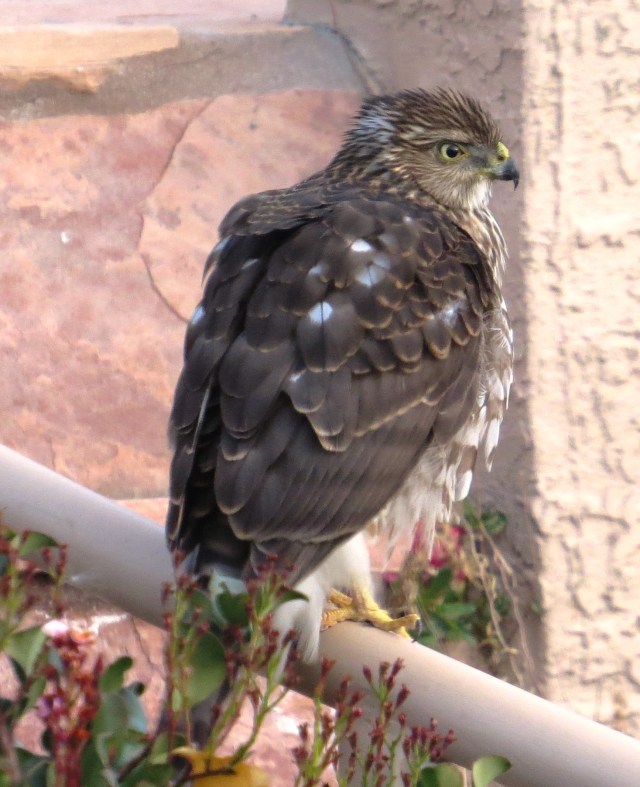
Wherever you find birds in the greater Tucson area, sooner or later you’ll find a Cooper’s Hawk, as well.  This is to be expected, since Cooper’s Hawks feed almost exclusively on other birds.  And, being resourceful, Cooper’s Hawks are commonly found in and around residential yards, especially those with bird feeders and quail blocks. These well-supplied yards rank high on Cooper’s Hawk TripAdvisor restaurant lists. If you’re like us and want to attract birds to your yard with seed feeders, understand that the quail and doves dining at your feeders are an entree themselves in the eyes of a Cooper’s Hawk.  And the next time a hawk is perched on your wall scanning the menu, take a good look at those eyes.

Evil-eyed Cooper's

Evil-eyed Cooper’s Hawk (photo Bob and Prudy Bowers)

Those large yellow eyes and black pupils telegraph the bird’s appetite and mind set as clearly as those of a novice poker player. An unmistakable evil burns there that screams death and destruction, and any fat bird still lounging around nearby is already a day late and a dollar short. The Cooper’s is a killing machine so effective it’s probably been researched by the Pentagon. And if you think the oversized Cooper’s, with nearly 3 feet of wingspan, would be luckless pursuing a dove through tree branches and around corners, you’re mistaken. This is a bird’s worst nightmare, doing zero to sixty in milliseconds, capable of turning on a dime and probably parking parallel.  If your yard goes from 200 birds to none in a flash, look around for a Cooper’s and a deadly eye laser.
Sweet-faced Sharpie

Sweet-faced Sharpie (photo Bob and Prudy Bowers)

This brings us to the Cooper’s cousin, the Sharp-shinned Hawk. Both belong to the genus Accipiter, both feed on birds and they both look so much alike it’s difficult to tell one from the other. Around here, Cooper’s are far more common than Sharpies, who are more likely to be seen at these elevations in winter. Sharpies are smaller than Cooper’s, both in length and wingspan, though these differences often are hard to distinguish. One relatively good diagnostic tool is their menu. While Cooper’s have an appetite for quail and doves, Sharp-shinned Hawks seem to prefer lighter fare like sparrows and finches. Maybe they’re just watching their weight. Years ago, birding mentor Rick Wright suggested you could distinguish Cooper’s Hawks from Sharp-shinned easily, simply by looking in their eyes, and I’ve been a believer ever since. That determined killer look so obvious in the eyes of a Cooper’s Hawk, is nowhere to be seen in the Sharpie’s eyes. To the contrary, and in spite of his identical intent, the Sharp-shinned Hawk looks docile and friendly, a buddy to share a beer with.

Welcome to Walmart

Welcome to Walmart (photo Bob and Prudy Bowers)

The Sharpie seems innocently sweet and innocuous with a quizzical ‘who, me?’ in his eye, and to underscore this casual friendliness you’ll find him perched in the open like a Walmart greeter. Of course, he’s motionless and frozen to his spot (sometimes on the ground next to a feeder), but he doesn’t look mean. I don’t think anyone has researched this, and I don’t know if one look is more successful than the other. I do know that my yard is just as empty of entrée birds when either an evil-eyed Cooper’s or an innocent-eyed Sharpie is hanging out. Birds seem fully capable of understanding what’s behind those eyes regardless. Too bad we can’t do the same with politicians.

The above article was originally published in the Saddlebag Notes Newspaper, January, 2016.

Posted in Birding Arizona | Tagged , , , | 1 Comment

Silky Flycatchers

Male Phainopepla

Male Phainopepla, Arizona’s Silky Flycatcher (photo Bob and Prudy Bowers)

With 10,000 species of birds in the world, it’s difficult to pick favorites, but I can’t resist a family with the name ‘Silky-flycatchers.’  Actually, the scientific name for this small family is Ptilogonatidae, but ‘Silky-flycatchers’ is easier to pronounce. There are only four species worldwide in the family, and they are all found in the Western Hemisphere.  Two are limited to Costa Rica and Panama, the Black-and-yellow Silky-flycatcher and the Long-tailed Silky-flycatcher.

The Gray Silky

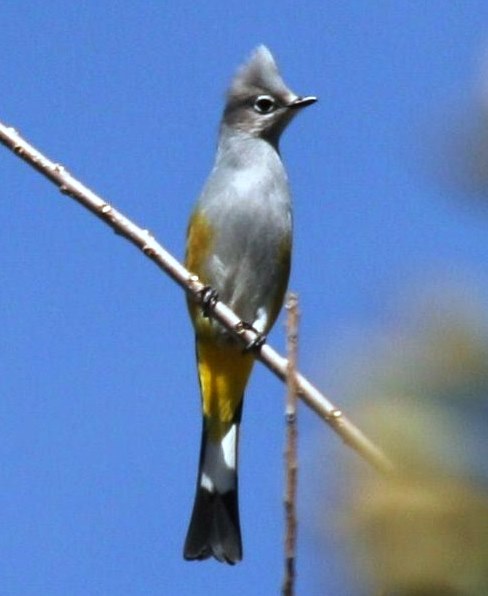
The Gray Silky, Copala, Mexico (photo Bob and Prudy Bowers)

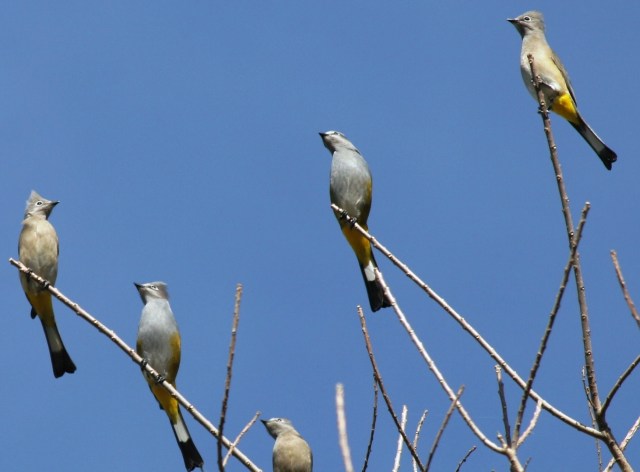
One of the other two, the Gray Silky, is predominately a Mexican resident, slipping into western Guatemala occasionally.  Gray Silkies are strikingly colorful, with a gray crest, pale eye ring, long slender tail with black-bordered white feathers underneath and bright yellow ventral feathers.  To find this bird, however, you need to travel to southern Sonora, the northernmost part of its range where it can be found in montane forest habitat.  We once discovered a flock of them perched and singing in the mountains east of Mazatlàn, on the highway to Durango.

Gray Silkies, Copala, Mexico (photo Bob Bowers)

A flock of singing Gray Silkies in Mexico (photo Bob and Prudy Bowers)

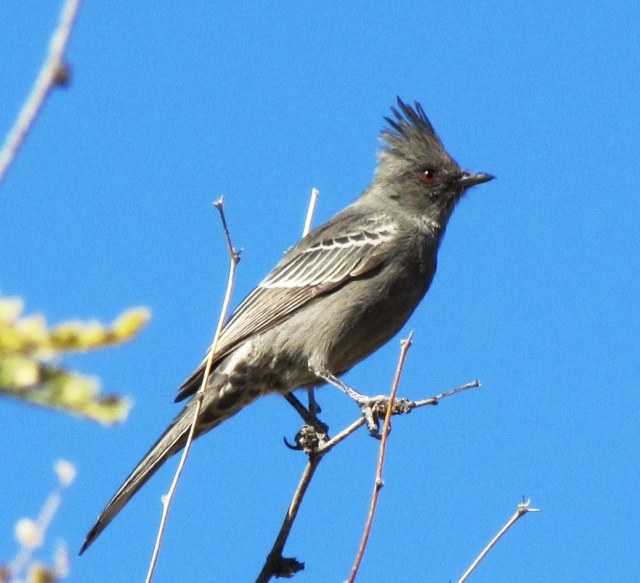
Fortunately for us, the fourth Silky-flycatcher makes its home in Arizona and the southwest as well as Mexico.  This is the Phainopepla, our familiar shiny black bird with a red eye and crest. The Phainopepla’s scientific name reflects the family’s silky connection. Phainopepla nitens is a combination of Greek and Latin, with Phainopepla from Greek for ‘shining robe’ and nitens from Latin for ‘shining.’  This redundant combination, ‘Shining shining robe’ insures you won’t forget this silky bird truly shines.  Like the other three silky flycatchers, Phainopeplas naturally catch flies, hawking insects from the highest perch they can find.  Also like the other three Silky-flycatchers, Phainopeplas eat mistletoe berries, and are so fond of them they build their nests in mistletoe host trees and aggressively defend their trees from interlopers.  Silky-flycatchers have a symbiotic relationship with mistletoe.  The birds eat the berries and then poop the seeds in a sticky matrix onto tree limbs where they germinate and grow the next round of mistletoe.  Desert mistletoe, incidentally, does not harm, let alone kill healthy trees, but its removal by well-meaning landscapers or gardeners is clearly not in the best interests of Phainopeplas, who can eat more than a thousand mistletoe berries each in a single day.  The berries also are the bird’s primary source of water.

Female Phainopepla

Female Phainopepla, Arizona (photo Bob and Prudy Bowers)

Phainopeplas don’t really migrate, but as summer heat builds and mistletoe berries disappear they will disperse from warmer lower elevation sites to cooler higher areas.  Interestingly, they breed in both areas, February through April in the lower elevations and May through July in the higher ones.  You can often hear Phainopeplas before you see them, as they make repetitive ‘hooweet’ calls from their high perch.  Less obvious and little known is the fact they can imitate twelve other birds, including Red-tailed Hawks and Northern Flickers.  If you like to photograph birds, Phainopeplas likely will be one of your favorites.  They aren’t shy, perch in clear sight and call attention to themselves.  A photographer’s dream.

The above article was originally published in the Saddlebag Notes Newspaper, December, 2015.

Posted in Birding Arizona | Tagged , , , , | Leave a comment

Birding Rocky Point, Arizona’s Beach

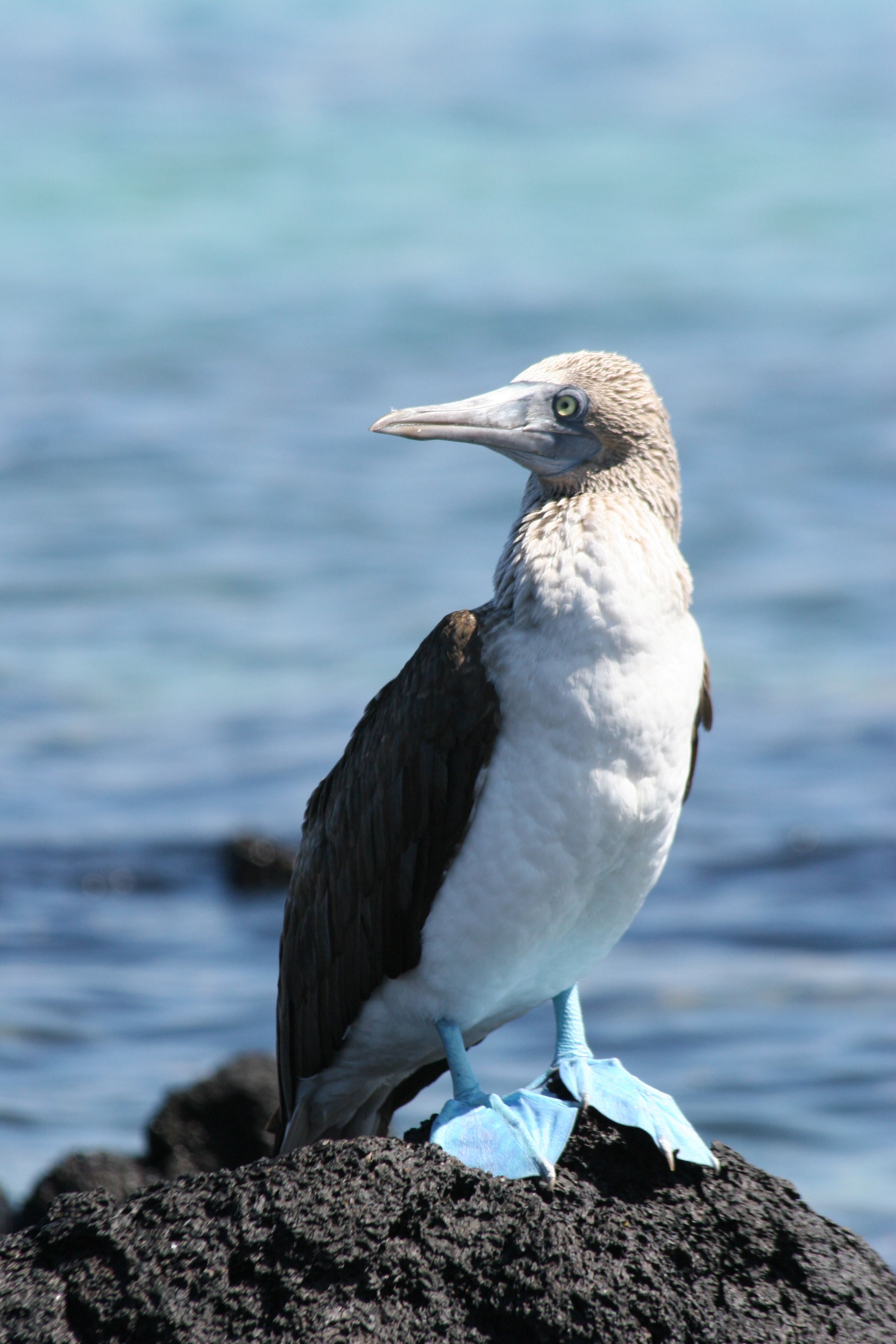
Blue-footed Booby (photo Bob and Prudy Bowers)

Blue-footed Booby (photo Bob and Prudy Bowers)

Arizona, landlocked and famous for deserts, saguaros and grand canyons, seems an unlikely place for ocean birding, but google ‘Arizona’s Beach’ and prepare to think differently.  Search engines recognize a beautiful stretch of ocean frontage around Puerto Penasco, Mexico, as ‘Arizona’s Beach’, and for good reason.  Just sixty miles south of Arizona’s Organ Pipe National Monument, Puerto Penasco, or Rocky Point, lies along the upper reaches of the Sea of Cortez, on a highway built to connect Baja California with mainland Mexico’s state of Sonora.  Once a sleepy fishing village, Rocky Point has evolved into a serious tourist destination with high-rise condos, gourmet restaurants, dive shops and golf resorts.  Almost equidistant from Phoenix and Tucson, Rocky Point easily qualifies as ‘Arizona’s beach.’  From Tucson’s I-19 intersection, it’s just 206 miles and less than 5 hours to Rocky Point’s Sam’s Club, and though you need Mexican car insurance, no tourist visas or automobile permit are required.

Yellow-footed Gulls are endemic to the Sea of Cortez

Yellow-footed Gulls are endemic to the Sea of Cortez (photo Bob and Prudy Bowers)

Even though birding goes unmentioned in most lists of Rocky Point attractions, the area’s open ocean, coves, bays, estuaries and wetlands are home to a large variety of resident and migratory birds.  Eleven area hotspots are listed in eBird, with a total of 258 species, many of which are unknown or rarely seen in Arizona.  This includes one Sea of Cortez endemic, the Yellow-footed Gull, American Oystercatcher, Surfbird, no fewer than eight terns, Sanderling, Red Tropicbird, five plovers, two storm-petrels, Black-vented Shearwater and both Brown and Blue-footed Boobies among many others.  We toured these hotspots in mid-July, and although birding is far better from fall to spring, we found 57 species in two days of casual birding.

Rocky Point Osprey with dinner (photo Bob and Prudy Bowers)

Rocky Point Osprey with dinner (photo Bob and Prudy Bowers)

Of the 11 hotspots, some are easier to access and some are more productive than others.  The largest list of species (240) shows for Puerto Penasco Ciudad (city), although this was probably the initial hotspot and likely included other sites now defined separately.  Two of the other sites are west and north of the city, Cholla Bay and Playa Pelicano, while six of the hotspots are part of the city:  Playa Bonita between Sandy Beach and the port, the port itself, the malecon, the settlement ponds, Las Conchas and CEDO.  Two other sites are estuaries east of the city, Morua and La Pinta.  The town, port and malecon are reached by continuing on Highway 8 from Arizona, which becomes Avenue Benito Juarez and ends at the waterfront.  The Cholla Bay site is a protected estuary just north of the bay community west of town, and Playa Pelicano has been absorbed by the Laguna del Mar resort, which lies north of town and west of highway 3.  The resort is under development, but at least for now is accessible to birders, and birding both here and at Cholla Bay  is excellent.  Another great site is the ‘Estanque de Aguas’ or sewage settlement ponds, which can be reached by taking Calle Sonora east of Benito Juarez until it ends in a residential area, parking there and walking the treed levees that separate the large ponds.  The two estuaries east of town are not easily accessed, though you can reach Morua via Playa Encanto and La Pinta from the dirt road entry to the Mayan Palace resort.  Tell the Mayan Palace gate keeper you want to go to the resort’s restaurant, and park your car at a bridge over the estuary in order to walk and bird at least part of the large wetlands.

Arizona monsoon enhances Rocky Point sunset (photo Bob and Prudy Bowers)

Arizona monsoon enhances Rocky Point sunset (photo Bob and Prudy Bowers)

Las Conchas is a gated oceanfront residential area that is almost impossible to bird unless you are staying there, and there are many short-term rental homes available, which is the option we chose in July.  But CEDO, the center for desert and ocean studies, is also accessible through the Las Conchas gate, so you can tell the gate keeper you are visiting CEDO, park at the center and walk down to the beach that runs adjacent to Las Conchas.  One morning, sitting on our ocean-view deck and enjoying a cup of coffee, we realized we were seeing flocks of Blue-footed Boobies flying east to west, in what seemed non-ending groups.  We started counting, and the flocks, which ranged from a dozen birds to fifty, streamed by for two hours, at about 50 birds per minute.  In other words, we sipped our coffee and watched 6,000 Blue-footed Boobies fly by our house.  And this was during the slow-birding summer.  I can’t wait to go back this winter.

The above article was originally published in the Tucson Audubon Society’s quarterly magazine, The Vermilion Flycatcher, on October 1, 2015.


Posted in Birding Mexico, Uncategorized | Tagged , , , , | Leave a comment

The Canada del Oro Wash; a Natural Aviary

Great Horned Owl family on the Canada del Oro Wash (photo by Bob and Prudy Bowers)

Great Horned Owl family on the Canada del Oro Wash (photo by Bob and Prudy Bowers)

One of metropolitan Tucson’s major washes, the Cañada del Oro ‘flows’ some 80 miles south and west from the slopes of Mt. Lemmon,  past SaddleBrooke and Catalina and through Oro Valley until it finally joins the Santa Cruz River west of Interstate 10.  Typically dry, the wash can run swift and heavy with monsoon rain in late summer or calm and brook-like after light spring showers.  These semi-annual soakings promote lush growth, and even when dry as dust the wash offers shade, shelter and insects to area birds.  A wide variety of trees, from hackberry to ash grow along the wash, providing a green ribbon oasis for resident and migratory birds.

Birds are common throughout the wash, but in the more remote areas north of Oro Valley their numbers rise dramatically.  If you followed the Cañada del Oro Wash (CDO) north from where it joins the Sutherland Wash in Catalina State Park, you would travel through more than 10 miles of bird rich state and regional park land before reaching SaddleBrooke.

Cooper's Hawk at Catalina Regional Park (photo Bob and Prudy Bowers)

Cooper’s Hawk at Catalina Regional Park (photo Bob and Prudy Bowers)

Separated from the more popular state park by less than a half mile, Pima County’s less-known Catalina Regional Park lies along the east side of Lago del Oro just south of Miraval.  The park was established after heavy monsoon floods following the 2003 Aspen Fire devastated homes along the wash, and it consists of a narrow two-mile stretch of mesquite bosque bordering both sides of the wash. It’s undeveloped, fenced and off-limits to motorized vehicles, but trails are open to horses and hikers.  A willow and cottonwood oasis with a spring-fed pond is located at the south end near the Pima Pistol Club, and a blind gives birders a hiding place to observe birds.  The pond is a magnet for resident and migratory birds, and nesting birds include Bell’s Vireo, Vermilion and Ash-throated Flycatchers, Gila and Ladder-backed Woodpeckers, Bewick’s Wren, Lucy’s Warbler, four species of hummingbird, Cooper’s Hawk and Great Horned Owl.   The pond area, from Golder Ranch Road south, is an eBird ‘hotspot’ with more than 100 reported bird species.  The sandy wash can be walked easily, giving birders visual access to both tree-lined sides.

Mistletoe addict, the Phainopepla (photo Bob and Prudy Bowers)

Mistletoe addict, the Phainopepla (photo Bob and Prudy Bowers)

Desert mistletoe is common among the park’s mesquite trees, making it a dependable place to find Phainopeplas.  The Phainopepla is one of only four species of silky flycatcher, and the only one found in the U.S.  This sleek, crested black bird (females are gray) with a red eye, as might be expected feeds on flies, but also has a symbiotic relationship with mistletoe.  Phainopeplas are dependent upon mistletoe berries, gobbling them like moviegoers after popcorn.  The undigested seeds are then passed in a sticky matrix that clings to the host mesquite’s branches, fostering a new growth of mistletoe, and of course, more berries.  The next time you’re munching popcorn at the movies, try to think of something else.

Brown-crested Flycatcher, CDO Wash adjacent to SaddleBrooke (photo Bob and Prudy Bowers)

Brown-crested Flycatcher, CDO Wash adjacent to SaddleBrooke (photo Bob and Prudy Bowers)

North of the regional park, the most beautiful, birdy and remote stretches of the CDO wash lie right next to SaddleBrooke, providing what could be one of the premier reasons to live here.  Alongside SaddleBrooke, the wash flows through state trust land, separated from the community by a barbed wire fence.  Fenced or not, anyone with an inexpensive, easily-obtained state trust land pass is allowed to walk on and enjoy these rich Arizona assets.  State trust lands, including those next to SaddleBrooke, often are leased for cattle grazing, and these are fenced to keep cattle from wandering into places they don’t belong, like neighborhoods and golf courses.  However, the fences are there to keep cattle in, not people out, so gates are provided for access.  Not so, unfortunately, for SaddleBrooke residents who want to walk their dog, take a nearby hike or find a special bird.  Our access to this amazing resource is precluded by a total absence of gates.  Even old retired people are resourceful, though, and if you walk the two-mile stretch of fence from Unit 21 past the Preserve, you’ll find attempts to breach, crawl under or otherwise bypass the nasty barbed wire.  Some of these are next to 20-foot drops into the wash, and all of them represent a sharply barbed hazard to anyone trying to access the wash.  Fencing contractors are employed to reseal openings, but this fence mending is costly and just triggers a new round of hazardous breaches, which in turn leave openings for cattle.  However, a simple solution exists:  Install five gates, one every half mile or so along the stretch, with a signed reminder to close and latch the gates.  Safe and easy access to the wash will enhance the community’s reputation and benefit all of our residents.

The above article was originally published in the Saddlebag Notes Newspaper for October, 2015.

Posted in Birding Arizona | Tagged , , | Leave a comment

Restless Aerialists–Summit County Swallows

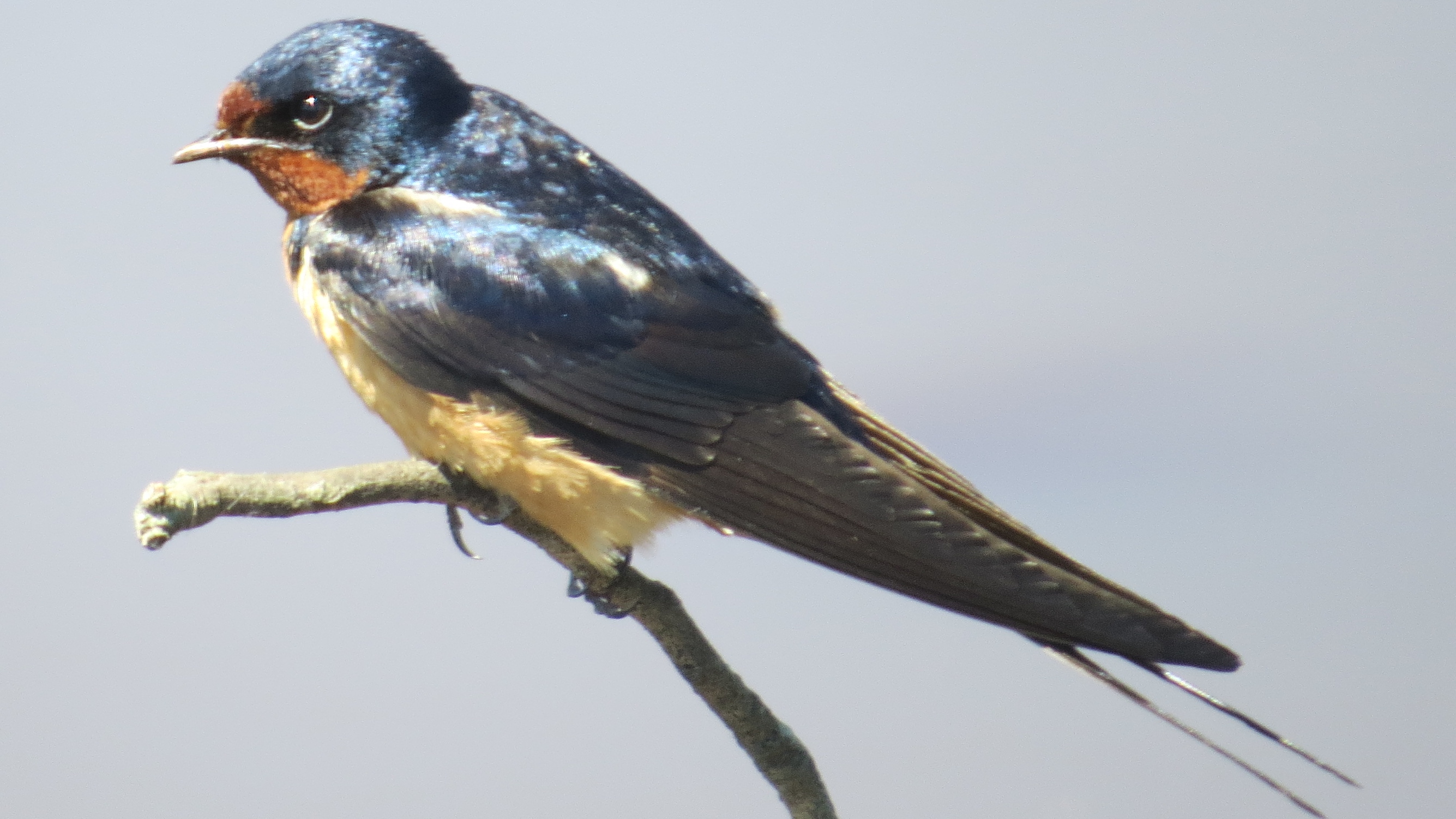
Elegant Barn Swallow

Elegant Barn Swallow (photo Bob and Prudy Bowers)

Summit County, Colorado isn’t Capistrano, but summer visitors here in the rarified air of our high mountains might identify with that song about birds and spring on the California coast.  The song’s lyrics lament a lover’s departure the day migrating Cliff Swallows left San Juan Capistrano, and long for her promised return with the swallows the following spring. First recorded by the Ink Spots, the song was a hit and the swallows returned on schedule, but it isn’t clear if the lover came back. Maybe the song was written by a jilted birder. Regardless, you don’t have to migrate to Capistrano to see Cliff Swallows; we’ve got plenty right here in Summit County. In fact, we’ve got plenty of four other swallow species, too.

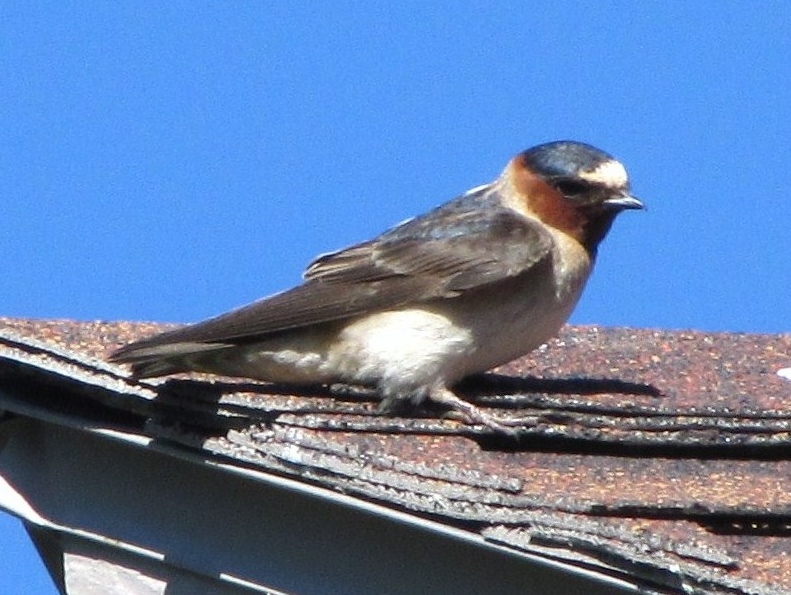
Cliff Swallow on condo roof in Keystone, Colorado (photo Bob and Prudy Bowers)

Cliff Swallow on condo roof in Keystone, Colorado (photo Bob and Prudy Bowers)

North of the Mexican border, there are nine species of swallows, and five of these are common summertime breeders in Summit County. In addition to Capistrano’s Cliff Swallows, we can find Northern Rough-winged, Barn, Violet-green and Tree Swallows with little effort. However, identifying swallows is a bit more difficult than finding them, since they have an annoying habit of zipping through space like acrobatic, high-speed dogfighters, seemingly with no need to take a break or pose for curious birders. Once in a while, they will line up on power lines or perch in plain sight, but you’re more likely to find them exploding through the air like avian fireworks. Even so, there are ways we can tell them apart.

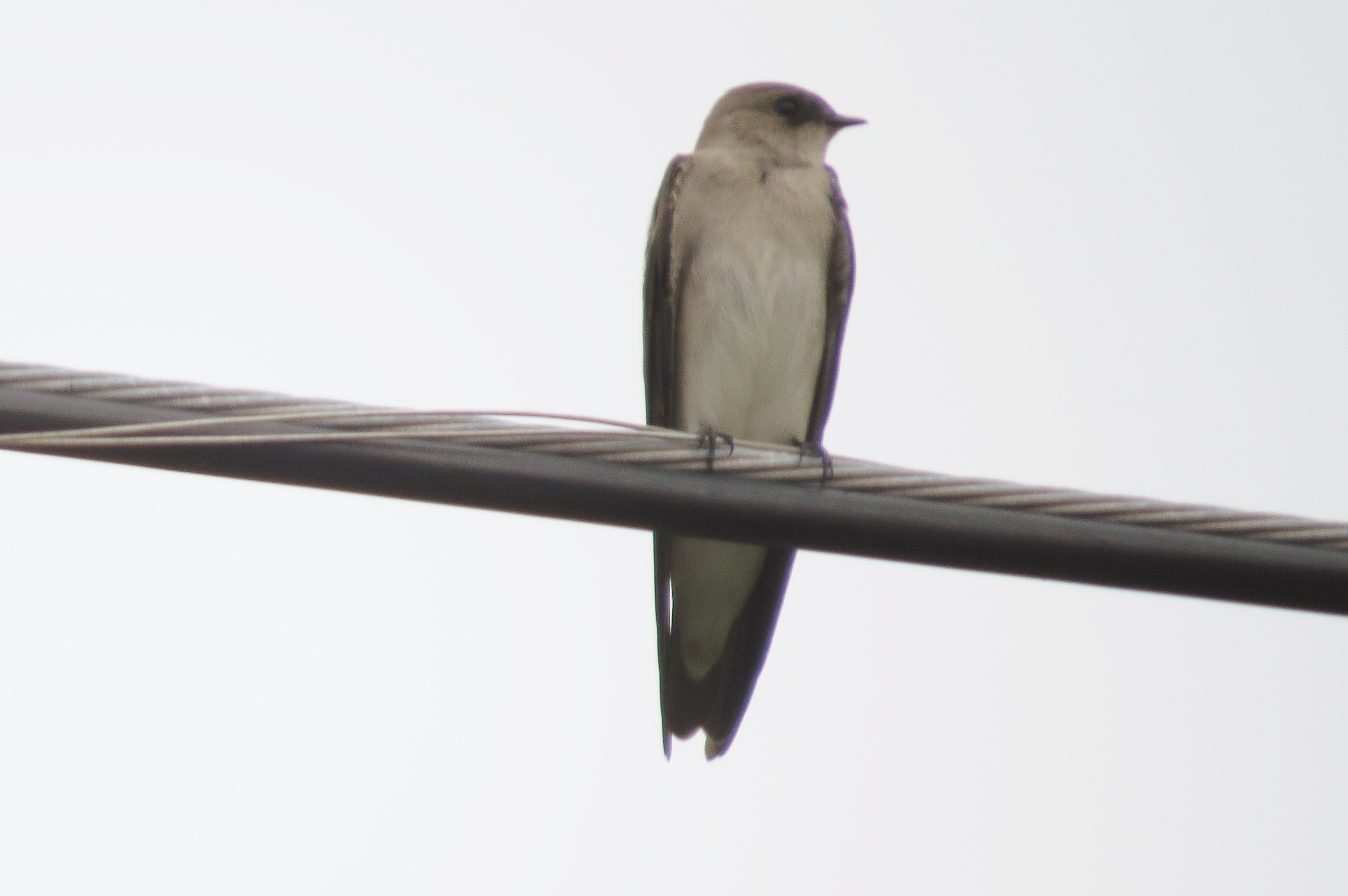
Drab Northern Rough-winged Swallow (photo Bob and Prudy Bowers)

Drab Northern Rough-winged Swallow (photo Bob and Prudy Bowers)

Northern Rough-wings may be the easiest to differentiate, but not because they are striking or colorful. To the contrary, if you’re watching a flock of colorless, drab and buffy birds with white bellies dart about, this is the likely species. Rough-winged Swallows also are more common in early summer, and nest in holes in dirt or sandbanks. The two species most difficult to tell apart are the Violet-green and Tree Swallows, birds that are similarly plumaged, sound alike and nest singly in cavities or birdhouses. From below, they look identical, and from above the emerald green backs of Violet-green males are often difficult to tell from the blue-green backs of Tree Swallow males. Both also flash white rump sides from above, though those of the Violet-green are more pronounced. With luck, you’ll find a perched male facing you. If so, look at the face. If there is white on the cheek and above the eye, it’s a Violet-green, otherwise you’ve found a Tree Swallow. Identification gets easier with Barn Swallows, elegantly long-winged birds with deeply forked tails, brilliant blue backs and rich orange faces and throats. As the name suggests, Barn Swallows like to nest in barns, as well as under building eaves or highway overpasses. Their nests are neat half cups, made from mud pellets they ferry to the eaves. There aren’t as many barns as condominiums in the ski country, but Barn Swallows have adapted well to the many condos that populate Summit County. Under the eaves of these buildings, you’ll find neat rows of Barn Swallow nest-cups.

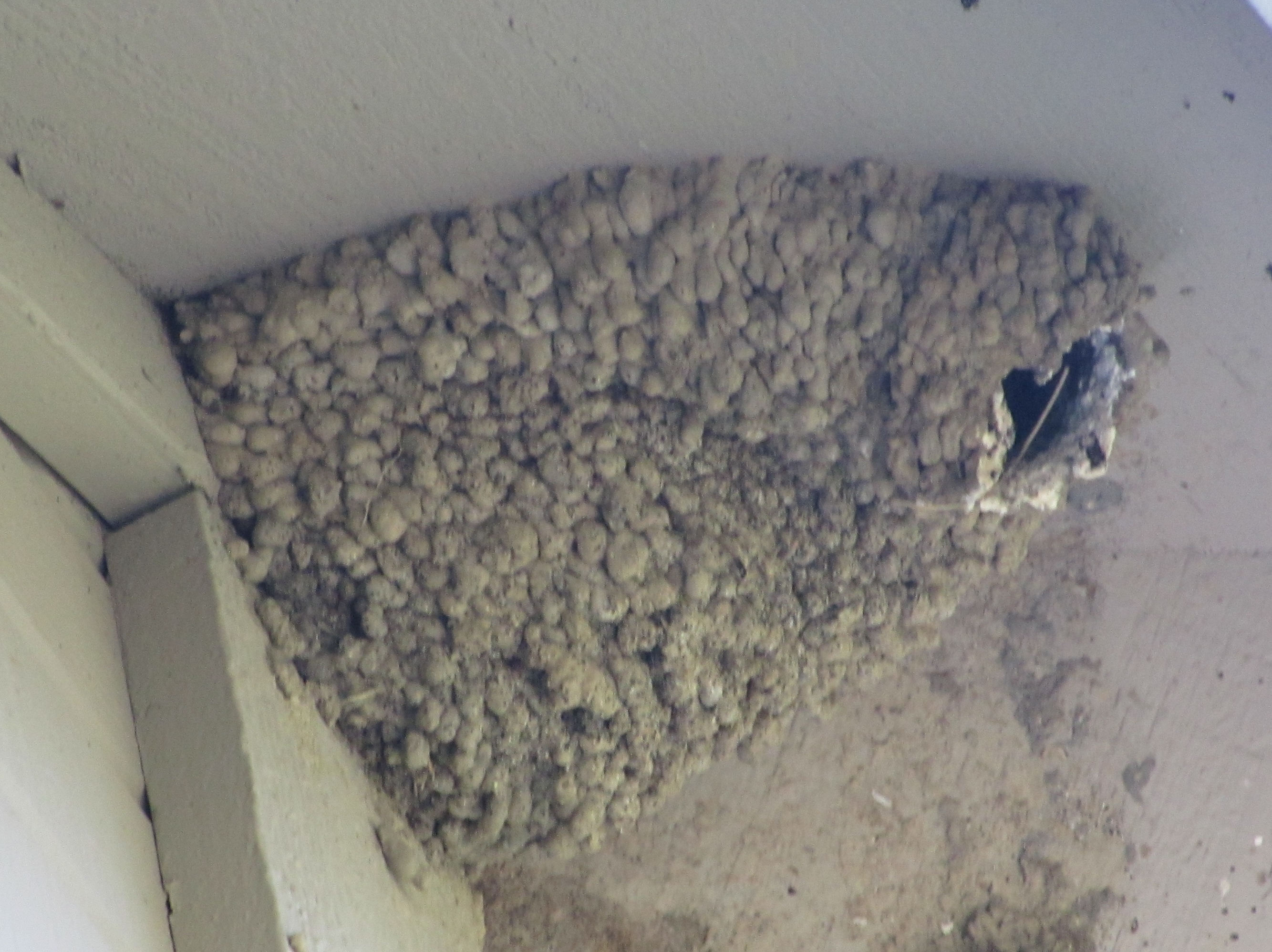
Jug nest made by Cliff Swallows, Keystone, Colorado (photo Bob and Prudy Bowers)

Jug nest made by Cliff Swallows, Keystone, Colorado (photo Bob and Prudy Bowers)

If condos look like barns to Barn Swallows, they must look like cliffs to Cliff Swallows. These swallows are fairly easy to identify, as well, with dark crowns, white foreheads, orange necks and short square tails. Cliff Swallows also build nests from mud pellets, but instead of little half cups, they construct larger jug-like structures in a colony of nests. Unafraid of heights, they build these precarious-looking nests under the highest eaves available. Leaning out from my third story condominium deck in Keystone, I watch the construction of these nests at the top of my building high above the Snake River, and wonder what goes through the mind of a fledgling when he peeks out at his first flight challenge. Vertigo is obviously not found in a Cliff Swallow’s genes.

Watching swallows tirelessly sweep creeks and shorelines for insects may be dizzying, but it’s also mesmerizing and relaxing, whether or not you can identify the birds. And if your summer sweetheart disappears with the birds this fall, remember that at least the birds will be back next spring.

(This post was originally published in The Summit Daily News, Frisco, Colorado, July 11, 2015)

Posted in Birding Colorado | Tagged , , , | Leave a comment

Is it Safe to Go Birding in Mexico?

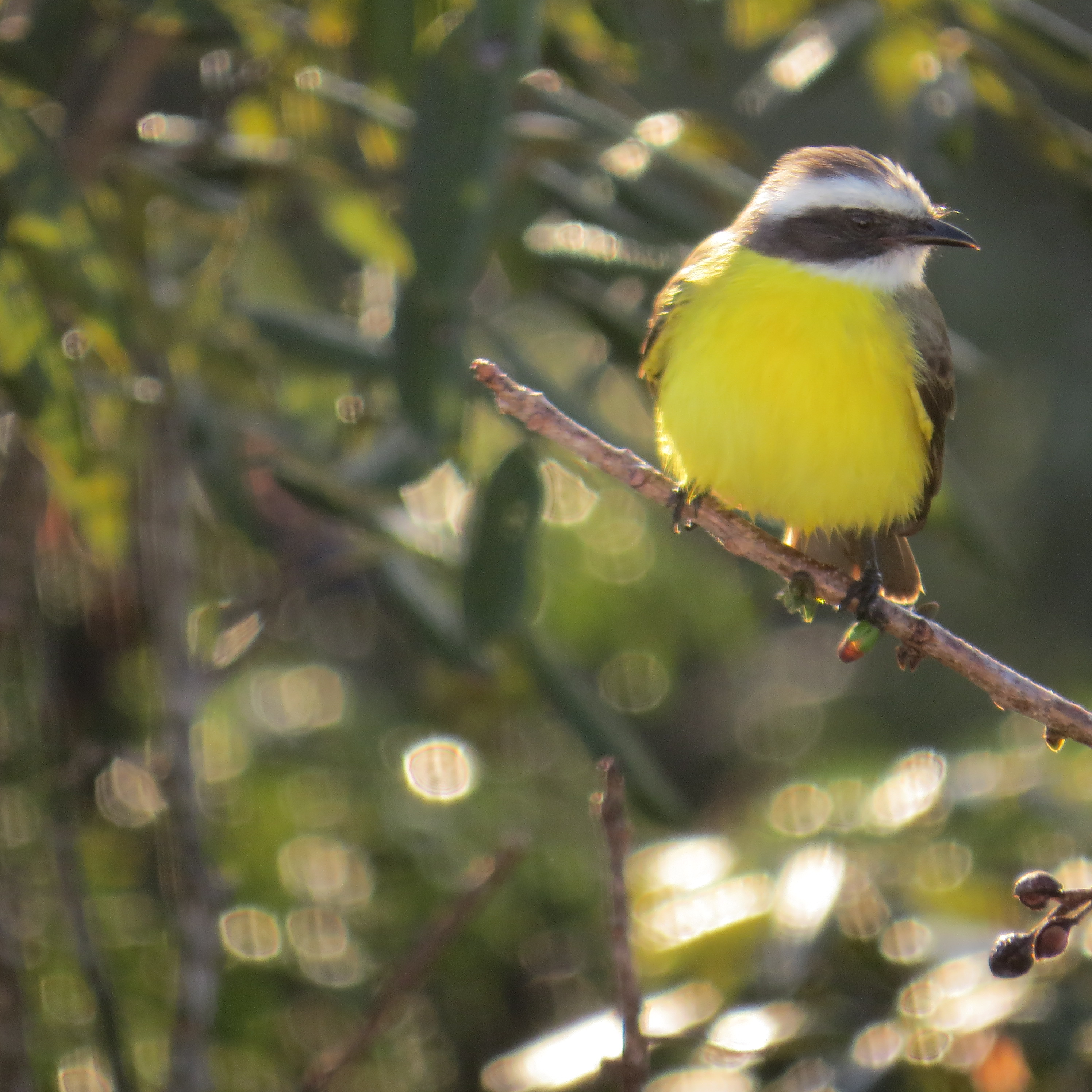
Social Flycatcher, Piste, Mexico (photo Prudy Bowers)

Social Flycatcher, Piste, Mexico (photo Prudy Bowers)

Beginning sixty some years ago with a high school Spanish class in a broken down bus from Kansas City, I have traveled to Mexico far too many times to count.  One reason we retired in Arizona was its proximity to Mexico, and since living here, we have crossed the border dozens of times, flying to remote Mexican cities and driving our own or rental cars almost everywhere in that fascinating country.  One reason, of course, is the birding.  More than a thousand birds can be found in Mexico, including many tropical and exotic species not found anywhere else in the world.  We have never found ourselves in danger, never worried about our well-being and never felt at risk, even when driving some of the worst roads imaginable in some of the most far flung places rare birds often prefer.  In spite of this, most of our friends are worried about travel to Mexico and few of them would ever join us on one of our trips.  The reason is simple:  almost continuous media reports on violence south of the border.

Citreoline Trogon, La Bajada, Mexico (photo Bob Bowers)

Citreoline Trogon, La Bajada, Mexico (photo Bob Bowers)

However, in spite of flamboyant homicides and the press’s proclivity to sensationalize them, the risk to tourists and birders is more perception than reality.  When the facts are examined, a tourist is less likely to be murdered in Mexico than in the U.S., and the risk in many U.S. cities is far higher than that in Mexico.

Gray Silkies, Copala, Mexico (photo Bob Bowers)

Gray Silkies, Copala, Mexico (photo Bob Bowers)

To consider the relative safety of traveling, birding and being in one place or another, a little research is worthwhile.  To a prospective tourist, two considerations are paramount:  personal risk and the relative rate of homicide.  For all its negative publicity, Mexico actually scores well on both counts.  Consider that Mexico is as big as Western Europe—Great Britain, France, Germany, Spain and Italy combined.  There are 2,457 municipalities in Mexico, and most violence occurs in less than 10 percent of them, while more than 1,500 municipalities are violence-free.  Thirteen of the Thirty-one states in Mexico have no travel advisories whatsoever posted by the U.S. State Department, and all but four states have only partial travel advisories.  Much of the State Department’s advisories can be summed up as follows:  stay out of high risk areas, avoid driving at night, avoid casinos, other gambling and adult establishments and stay away from drugs and drug dealers.  Obviously, this advice could apply to the U.S. as well.  Mexican homicides are largely drug-related.  When Calderon became president in December, 2006, he initiated a war on drug cartels, which led to battles between police, the military and the cartels, and subsequent turf wars between cartels for lucrative distribution routes initiated most of the worst violence.  According to Mexican statistics, 90% of drug war-related homicides are criminals, 6% are military and police and 4% innocent bystanders.

Xantus's Hummingbird, Baja California (photo Bob Bowers)

Xantus’s Hummingbird, Baja California (photo Bob Bowers)

It’s important to note that foreign tourists, including birders, have never been targeted throughout this escalating violence.  If you have ever been in the opposite situation, you will appreciate the significance of this.  In 1994, we traveled to Cambodia while there was a bounty on U.S. citizens, and in 1996 we spent 3 weeks in Egypt while radicals tried to bring down the secular government by killing tourists.  Of course, an innocent bystander can always be caught in crossfire, but it’s a lot different when someone is actually trying to kill you.  This is not to say no U.S. citizens are ever killed in Mexico, but when you look at the numbers it’s clear how little risk actually exists for American tourists.  Since 2006, more than 140,000 murders have taken place in Mexico.  In the past three years, about 70,000 people have been murdered, more than 20,000 annually, but during that same three years only 265 of those were Americans.  The 81 killed last year represent a rate of only 1.35 per 100,000 tourists, far below the U.S. homicide average of 4.8 and only a fraction of the overall Mexico rate of 18.8.  You’re actually 4 times safer in Mexico than in Arizona, where the rate in 2012 was 5.5.

Streak-backed Oriole, Alamos, Mexico (photo Bob Bowers)

Streak-backed Oriole, Alamos, Mexico (photo Bob Bowers)

Mexico’s murders are publicized out of proportion, as well, due no doubt to our shared border and the fact that half of all U.S. citizens living abroad live in Mexico.  The homicide rate in Mexico is actually lower than much of Latin America.  The homicide rate per 100,000 habitants in Honduras is four times the rate in Mexico, and 13 western countries and territories exceed Mexico’s rate, including such tourist destinations as Belize, Jamaica, Guatemala, Trinidad and Tobago, the Bahamas and Puerto Rico.  Worldwide, there are other popular destinations with higher homicide rates, including South Africa at 31.0.

In 2008, we drove more than 5,000 miles birding Mexico from Tucson to Oaxaca along the central mountains and returning along the coast.  We’ve birded the length of Baja California three times, and this past January we rented a car in Cancun and birded more than 2,000 miles of the Yucatan peninsula including the states of Chiapas and Tabasco.  Other than a little car trouble, we have never experienced an unpleasant incident.  We have found the country warm and inviting, the people friendly and helpful and the birding magnificent.  Nevertheless, there are places we avoid based on feedback, travel advisories and our own research, and not, incidentally, just in Mexico.  Researching material for this article, I read dozens of articles and reports, and reviewed State Department advisories as well as statistical data available from the U.S., the United Nations Office on Drugs and Crime (UNODC), the Mexican Statistics Agency (INEGI) and Mexico’s National Security System (SNSP).  There is no shortage of factual information about safety in Mexico, and anyone contemplating a trip should take advantage of this wealth of data and opinion.  Who knows, you might decide to join the six million Americans who visit Mexico annually.  The birding alone is worth it.

(This article originally appeared in the January, 2015 issue of the Saddlebag Notes newspaper, Tucson, Arizona.)

Posted in Birding Mexico | Tagged , | Leave a comment

The Copper Canyon: Scenery Trumps Birding

Urique, far below Cerro Gallego in Mexico's Copper Canyon (photo Bob Bowers)

Urique, far below Cerro Gallego in Mexico’s Copper Canyon (photo Bob Bowers)

One of the joys of birding is that it takes you to lots of beautiful places.  I used to fish a lot, and when I got skunked on Oregon’s Deschutes River, the majesty of that wide river cascading over lava sheets made up for a fishless day.  Similarly, birding isn’t always outstanding, but the scenery can compensate.  Sometimes, the scenery overpowers the birding altogether, and Mexico’s Copper Canyon is a perfect example.  We just returned from our first trip there, and it far exceeded our expectations.

Zorro, Posada del Hidalgo in El Fuerte, Mexico (Photo Bob Bowers)

Zorro, Posada del Hidalgo in El Fuerte, Mexico (Photo Bob Bowers)

This Disneyland E-ticket adventure begins just 580 miles from SaddleBrooke, in the colonial town of El Fuerte, on the Fuerte River in Sinaloa.  We stayed at the Posada del Hidalgo, a garden hotel with bougainvillea and swarming Broad-billed Hummingbirds.  The hotel claims to be the birthplace of Don Diego de la Vega, better known as Zorro, and a sculpted masked man centers the atrium, bullwhip swirling and saber thrusting.  A costumed proxy entertains the happy hour crowd, but he isn’t Antonio Banderas.

Chepe, the Copper Canyon train  (photo Bob Bowers)

Chepe, the Copper Canyon train (photo Bob Bowers)

After breakfast, you board Chepe, the daily train that runs between Los Mochis on the Sea of Cortez and Chihuahua, 406 miles to the east, crossing the heart of the Copper Canyon along the way.    Each passenger car has comfortable seating for 64, with large, clean windows, and a dining car provides booths for 24, with even larger windows.  This Mexican train suggests Butch Cassidy and the Sundance Kid, but armed guards ride along to discourage budding modern day bandidos.  The guards spend most of the trip in the dining car, drinking coffee and eating doughnuts, which might (or might not) diminish passenger anxiety.  Seats are assigned as you board, and passengers are free to roam the cars, as well as hang out in the jostling, noisy space between cars.  No windows block your view here, but a waist-high door that sometimes unnervingly swings open is the only barrier between you and the ground that speeds by below.  No one polices the passengers, and no signs deter you from sticking your head, let along your hand, out the windowless area between cars, where tree branches and cut bank rocks often come within inches.

Blooming Amapa trees, Mexico's Copper Canyon  (photo Prudy Bowers)

Blooming Amapa trees, Mexico’s Copper Canyon (photo Prudy Bowers)

The train traverses tropical deciduous forest before entering the canyon, where it follows the Temoris River and climbs through towering rock walls and hillsides painted with pink blossoms of amapa trees.  It had rained the day before our trip, and the river was boiling down the canyon, while dozens of waterfalls cascaded down the walls.  After four hours (and just 75 miles) of this sensory overload, we disembarked at Bahuichivo, 5,250 feet above sea level and a 30-minute bus ride from the Mision Hotel in Cerocahui.  A welcoming lunch was followed by a tour of the delightful Tarahumara girls boarding school and a tasting of the local Cabernet Sauvignon.  Next morning, we spent the four hours before the next train arrived on a van trip to Cerro Gallego, a stunning, sweeping overlook of Urique, the deepest of the three copper canyons.

The skywalk at Cerro Gallego, Copper Canyon  (photo Bob Bowers)

The skywalk at Cerro Gallego, Copper Canyon (photo Bob Bowers)

A Mexican version of Arizona’s Hualapai Indian Grand Canyon Skywalk invites the braver travelers to walk 20 feet out onto a glass and steel grate-floored projection that puts 6,100 feet of empty space between you and the canyon floor.  If your heart is still beating after this, you board the train for a short 27-mile, increasingly scenic ride to the next overnight stop at Posada Barrancas, 7,310 feet above sea level.  A couple of nice hotels here are perched on the canyon rim, and, like others we stayed at, they have hummingbird feeders.  The train continues east from here 183 miles to Chihuahua, but since most of the canyon was behind us, we returned the next day on the westbound train to El Fuerte, where we had left our car.

Blue-throated Hummingbird, Posada Barrancas, Mexico  (Photo Bob Bowers)

Blue-throated Hummingbird, Posada Barrancas, Mexico (Photo Bob Bowers)

Before boarding the mid-day train, however, we took another 3-hour morning tour, this time to the canyon’s adventure park, featuring a 35 minute round trip cable car ride high above the chasm.  A zip line also crosses the gorge, and we took a video of a young couple from Puebla, Mexico, taking their first ever zip line ride on parallel cables.  It took them two and a half minutes to reach the end, at speeds up to 80 miles per hour and more than a thousand feet above the ground.  They looked older when they got back.  Oh, by the way, I forgot to mention we also saw a lot of great birds.

(This article originally appeared in the April, 2015 issue of the Saddlebag Notes newspaper, Tucson, Arizona.)

Posted in Birding Mexico | Tagged , , , , , , , | Leave a comment

Birding the Land of the Maya

Social Flycatcher, Salil Ruins, Yucatan (photo Bob Bowers)

Social Flycatcher, Salil Ruins, Yucatan (photo Bob Bowers)

A year ago, Prudy and I flew to Cancun, rented a car, and drove 2,000 miles around the Yucatan Peninsula, looking for and photographing Mayan ruins and birds.  Apparently we had a good time, because we just did it again.  Well, we didn’t repeat it exactly.  This time we skipped a few of last year’s destinations, like Xcalak, Xpuhil and Yaxchilan, replacing them with new spots, like Cozumel, San Cristobal and, keeping our ‘X’ string alive, Isla Holbox.  Those ‘X’ words, incidentally, have Mayan roots and are pronounced ‘esh’ if initial, like ‘Eshcalak’ and ‘sh’ if not, like ‘Isla Holbosh.’  This might come in handy if you travel to the Yucatan, and traveling to the Yucatan is something we would certainly recommend.  There are plenty of good reasons to visit Mexico’s uniquely shaped peninsula:  beautiful weather and beaches, some of the best diving and snorkeling anywhere, wonderful food and a lot of gentle and friendly people.  And of course, there are those ruins and birds.  For those still hesitant to travel to Mexico, you should also know that our own State Department has no travel advisories in place for any of the three peninsula states, or for that matter, the two adjacent states, Tabasco and Chiapas.

Yucatan Jay (photo Prudy Bowers)

Yucatan Jay (photo Prudy Bowers)

We’ve been traveling to the Yucatan almost as long as Cancun has existed as a developed tourist destination.  With today’s level of popularity, it’s hard to believe that Cancun had only three residents just 45 years ago.  Now there are more than 600,000 residents and three million annual visitors.  We started visiting Cozumel long ago for the underwater life, but this year marked the first time we came to bird instead of to dive.  Birding has some similarity to diving:  you immerse yourself in a selected habitat, enjoy the beauty of the moment, and look for (and try to identify) colorful creatures.  At the same time, birding has some advantages over diving:  the equipment and guides are cheaper, and if your equipment fails, you can still breathe.  On this latest trip, our equipment worked like a charm, and the birds we saw were as brilliant and fascinating as the Caribbean fish.  Cozumel is Mexico’s biggest island, about 30 miles long and 10 miles wide.  Considering that this relatively small island lies just 12 miles offshore, it is surprising that some of the mainland’s nearby birds are absent from Cozumel, while the island has 3 endemic species not found on the mainland, or anywhere else for that matter.  We enjoyed many of the 260 plus species found on Cozumel, including one of the endemics, the Cozumel Emerald, a striking green (of course) hummingbird with a long forked tail.  The toughest bird for us to identify would have been easy for many of you, a female American Redstart.  These winter visitors from North America were abundant on Cozumel, and, looking different from (and not associating with) the far fewer males, they were our mystery birds for more than a day.

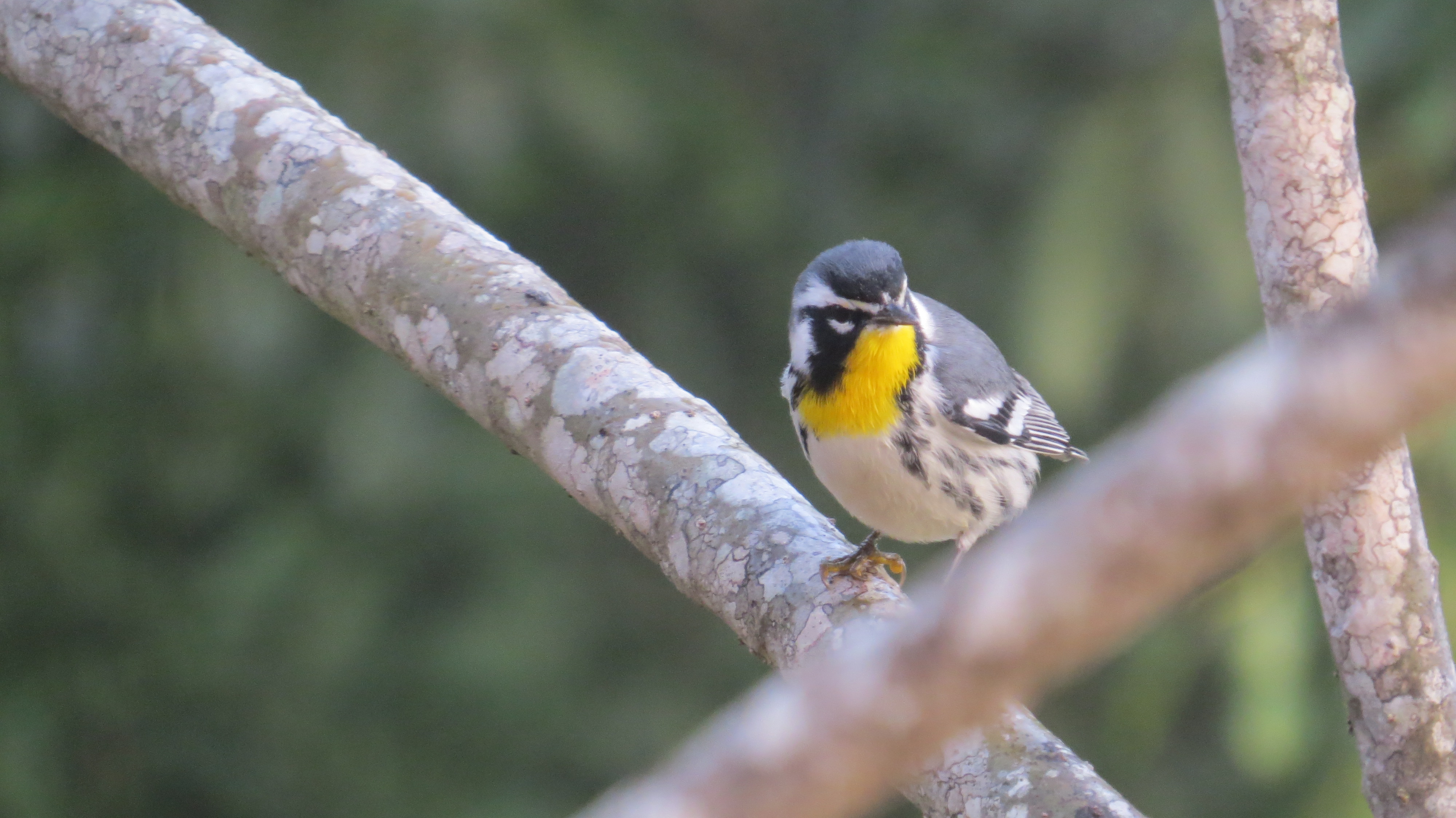
Yellow-throated Warbler, Uxmal, Mexico (photo Bob Bowers)

Yellow-throated Warbler, Uxmal, Mexico (photo Bob Bowers)

Another new-as-far-as-birding place for us was Uxmal (pronounced ‘ushmal’, remember?).  The hacienda there was such a beautiful and comfortable place, and the birding so spectacular, that we extended our initial stay, and then returned for another night a week later.  Our upper, corner room came with a balcony that overlooked open, treed habitat, and a leafless plumeria tree you could reach out and touch.  Among the hundred birds we saw in that area, we especially enjoyed a curious Yellow-throated Warbler (another eastern U.S. migrant), that paused enough to give us a photo op.  A couple of White-fronted Parrots were also regular morning visitors that had us reaching for the camera.

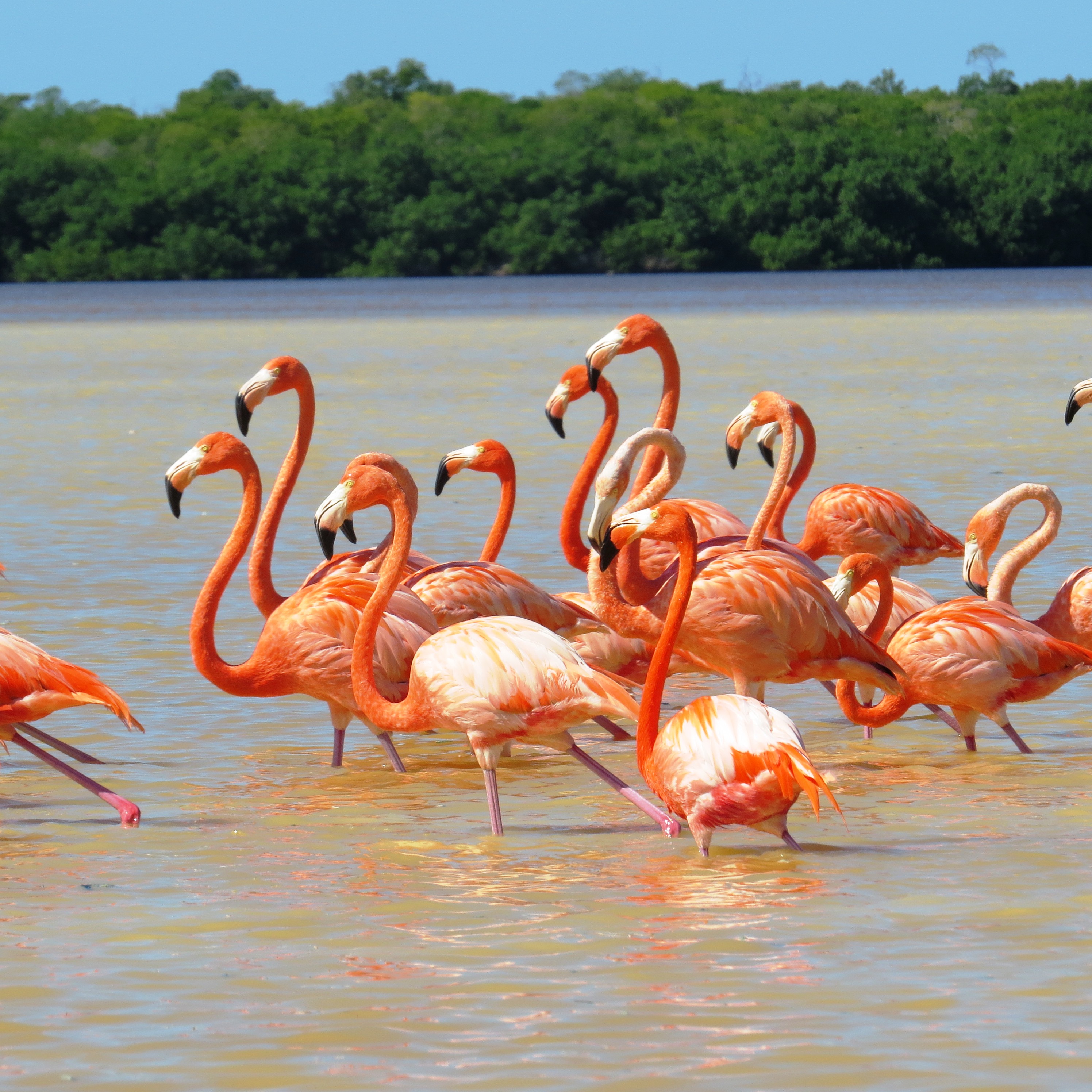
American Flamingos, Celestun, Mexico (photo Bob Bowers)

American Flamingos, Celestun, Mexico (photo Bob Bowers)

We found it impossible to skip Celestun, even though we had been there 12 months ago.  There is something magical and magnetic when 10,000 neon orange American Flamingos squawk a cappella and swish-feed in knee-deep water, wading as if they were skating.  You have to see it to believe it.

(This article originally appeared in the March, 2015 issue of the Saddlebag Notes newspaper, Tucson, Arizona.)

Posted in Birding Mexico | Tagged , , , , | Leave a comment

When Your Best Friend is a Sapsucker

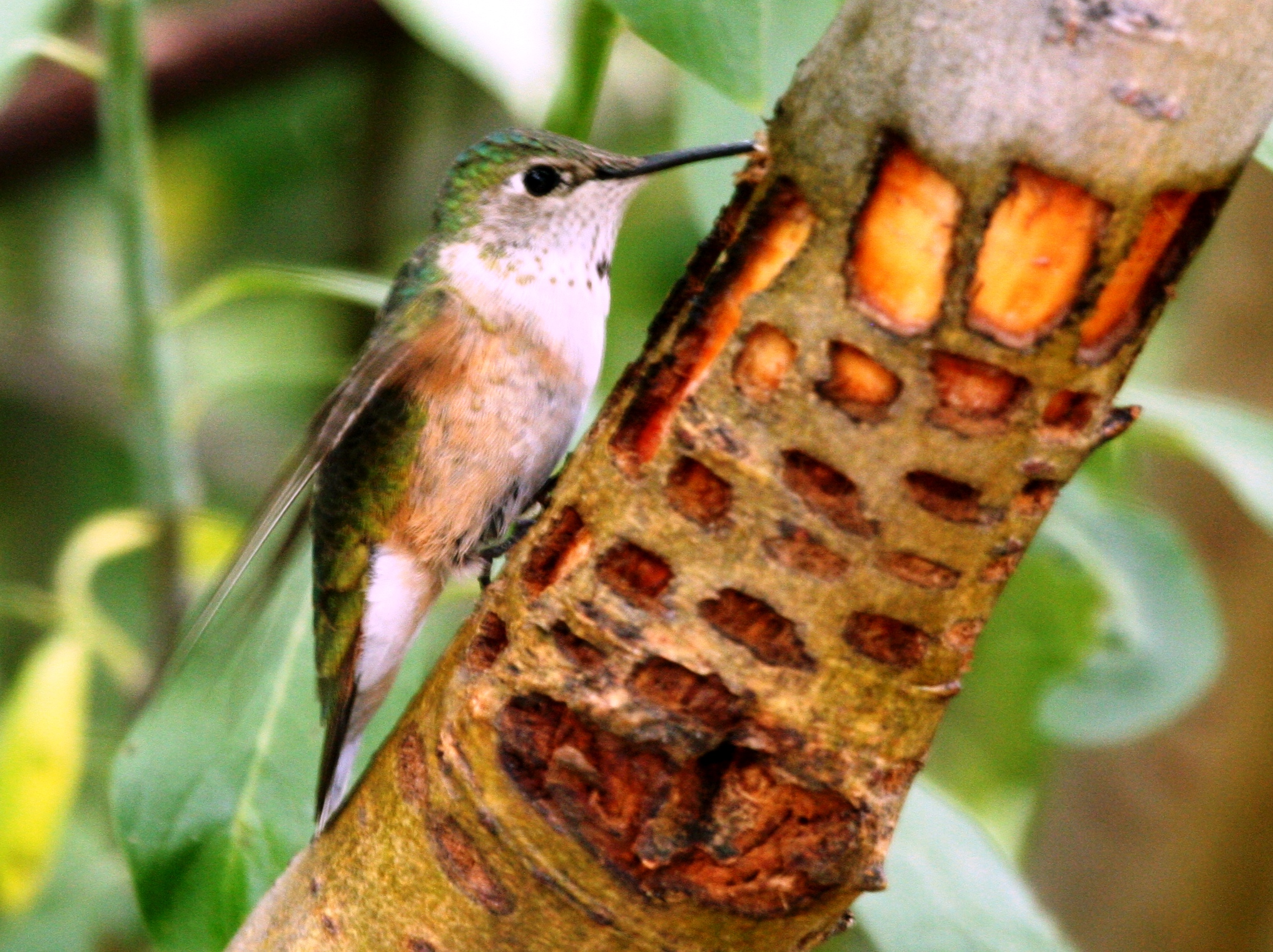
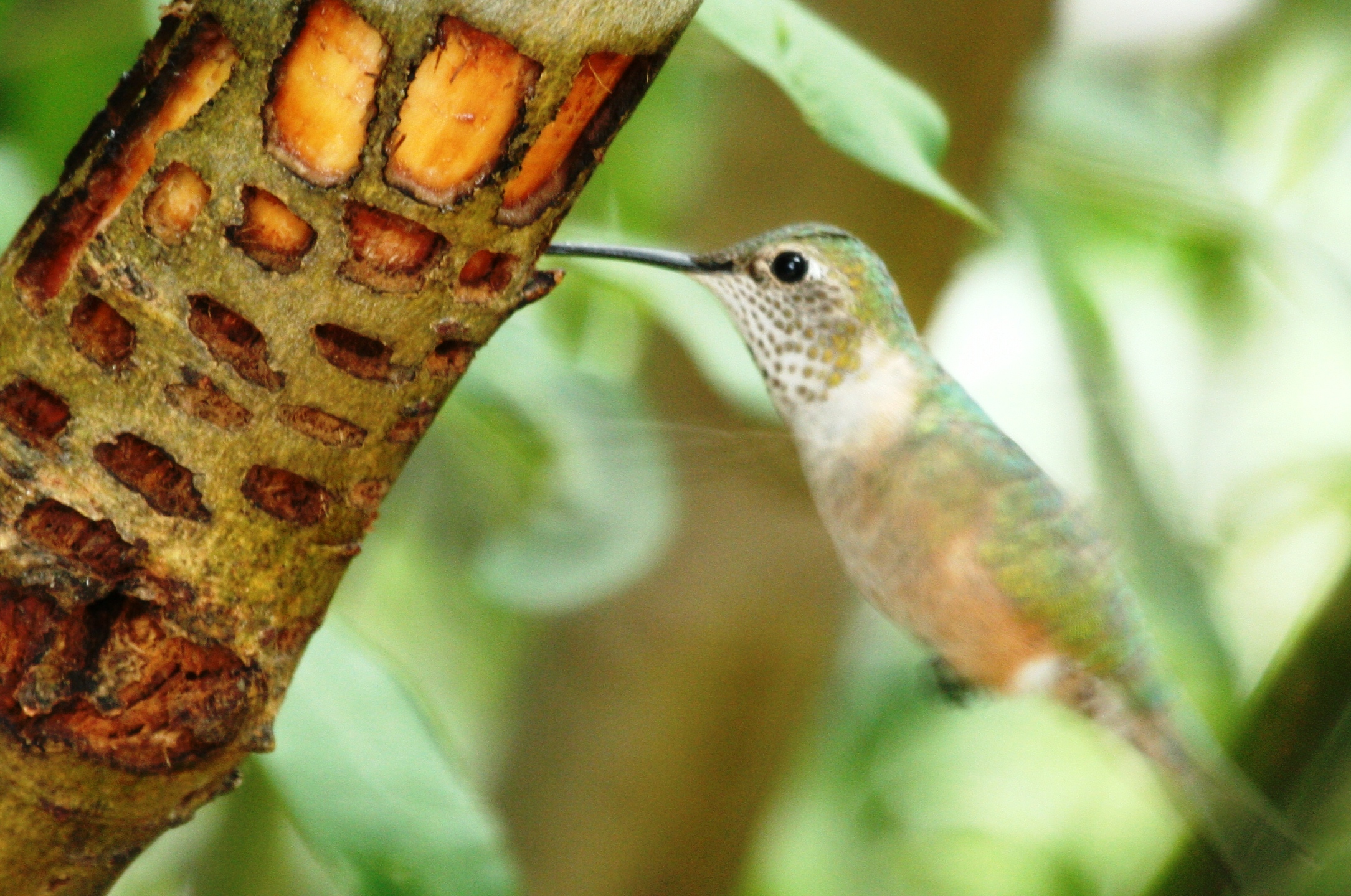
Broad-tailed Hummingbird at sapsucker wells (photo Bob Bowers)

Broad-tailed Hummingbird at sapsucker wells (photo Bob Bowers)

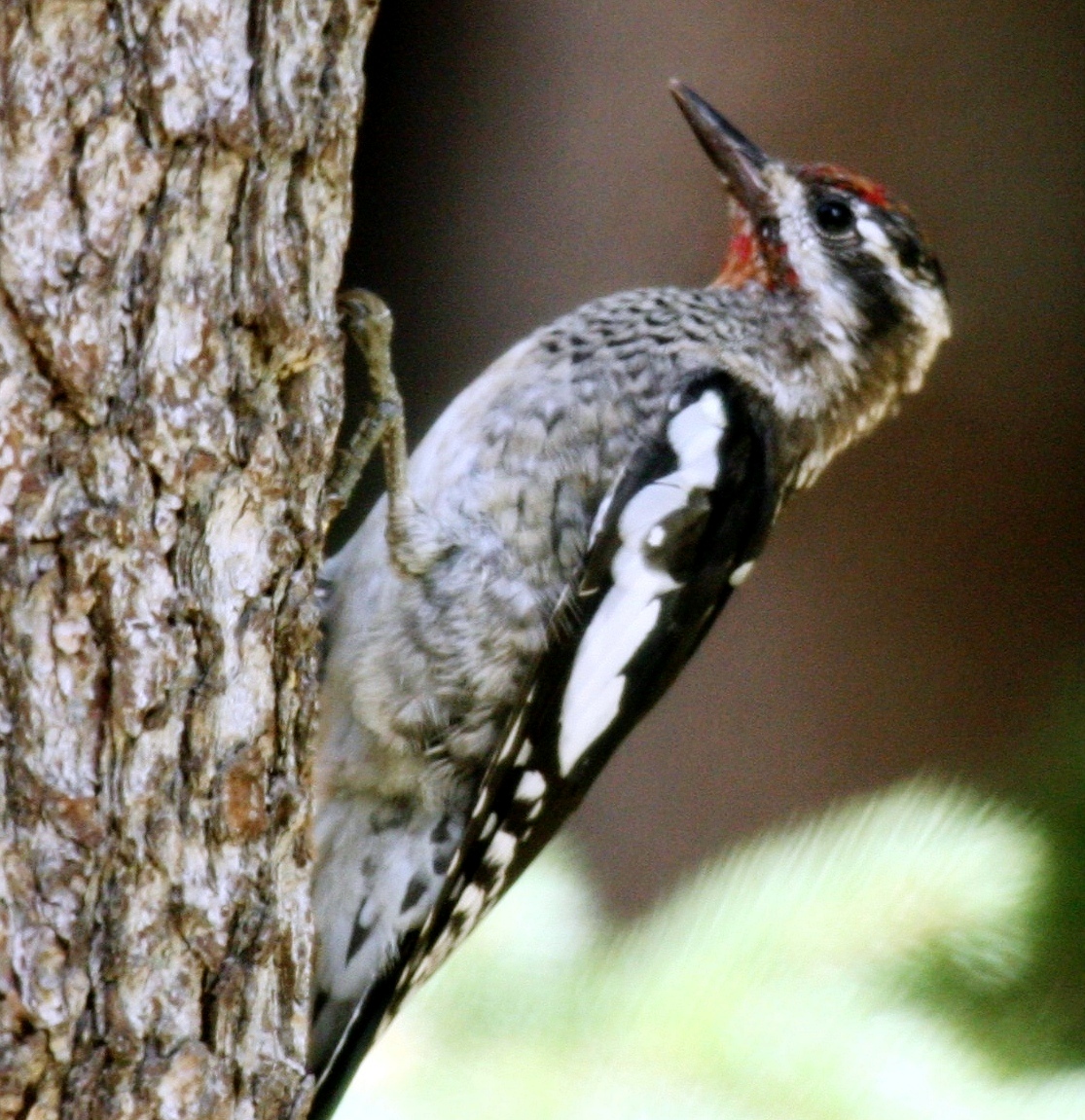
One of the few bird groups with a name sillier than woodpecker is the sapsucker.  To make matters worse, the poor sapsuckers are actually part of the woodpecker family, Picidae.  In North America, there are 22 species of birds in this family, 4 of which are sapsuckers, all in the genus Sphyrapicus.  Around southeastern Arizona, we occasionally get a stray Red-breasted Sapsucker, a west coast bird, rare Yellow-bellied Sapsuckers or Williamson’s Sapsucker (more common in the high country), but our most common sapsucker is the Red-naped, a bird that can be found fairly regularly from October until April, when it moves back to higher ground for the summer.

Red-naped Sapsucker (photo Bob Bowers)

Red-naped Sapsucker (photo Bob Bowers)

Like other woodpeckers, sapsuckers have chisel-like bills and stiff tails that help prop them upright while they cling to tree trunks and hammer away.  Sapsuckers also have an affinity for tree sap. Sapsuckers would more appropriately be named ‘saplappers’, since they don’t actually suck sap, but lick and lap it up as it oozes out of the holes they pound into trees.  They have an extensible tongue that is long, sticky and barbed, like other woodpeckers, which allows them to penetrate and retrieve insects from crevices.  Unlike other woodpeckers, the sapsucker also uses this tongue to lap up nutrient and sugar-rich phloem tree sap.  Phloem is plant tissue that transports nutrients from the photosynthetic part of the plant (leaves) to the plant’s roots.  The vascular phloem system is found in the tree’s bark, allowing sapsuckers to reach it easily by drilling small shallow holes with their bill.  These holes are unique and easily recognizable as horizontal rows of small squares. Normally, the phloem exposed by a drilled hole would quickly congeal and seal, but the holes sapsuckers dig (called wells) allow the rich sap to remain fluid.  This is most likely the result of an anticoagulant deposited by the sapsucker as he drills.  This liquid sap attracts insects, as well, adding protein to the sugar-rich sapsucker wells.  Other creatures are then drawn to the sapsucker wells, including bats, porcupines, warblers, Verdins and hummingbirds, one of the primary beneficiaries of the sapsucker’s labor.

Broad-tailed Hummingbird at sap wells in Colorado high country (photo Bob Bowers)

Broad-tailed Hummingbird at sap wells in Colorado high country (photo Bob Bowers)

Hummingbirds rely on nectar for as much as 90 percent of their diet, and sapsucker wells are especially important to migratory hummingbirds that nest in the north, often arriving before adequate nectar-producing flowers have bloomed.  In addition, insects drawn to the wells help satisfy the protein needs of the hummers.  Even in southern states, sapsucker wells drilled by migrating sapsuckers provide an important food source for hummingbirds that winter over.  Here in southeastern Arizona, the Red-naped Sapsucker wells are sometimes a critical winter food source for Anna’s, Costa’s and Broad-billed Hummingbirds that live here year-round. For birders, looking for sapsuckers or their neat rows of holes is often an easy way to find hummingbirds.  Hummingbirds feed on these wells as aggressively as they do on home sugar water feeders, rewarding patient birders with good opportunities to observe and photograph them.  Sapsuckers inadvertently provide food for hummingbirds equal to the sugar water feeders we hang.  From the hummingbird’s point of view, sapsuckers may well be their best friends.  In spite of that silly name.

(This article originally appeared in the February, 2015 issue of the Saddlebag Notes newspaper, Tucson, Arizona.)

Posted in Birding the Americas | Tagged , , , , | Leave a comment

The Twelve Days (and Six Birds) of Christmas

Gray Partridges (Photo David Mitchell, Creative Commons)

Gray Partridges (Photo David Mitchell, Creative Commons)

In spite of my obsession with birds, my true love never gave me a partridge in a pear tree, let alone any of the five other birds mentioned in ‘The Twelve Days of Christmas’, a carol published in England 214 years ago.  Even a non-birder should find it interesting that half of the gifts immortalized in that old song are birds.  If you share my curiosity, read on. 

The solitary bird in the song is likely a Gray Partridge, which along with the Chukar is one of just two partridges we see in the U.S.  Partridges are related to several familiar birds, including wild turkeys, grouse, ptarmigans, pheasants, prairie chickens, and until fairly recently, our own Gambel’s Quail.  Interestingly, the French word for partridge is perdrix, pronounced ‘per dree’, suggesting that the pear tree of the song could actually be a typo.  If the original version had been, ‘A partridge, une perdrix’, it might accidentally have been transcribed as ‘A partridge in a pear tree.’ 

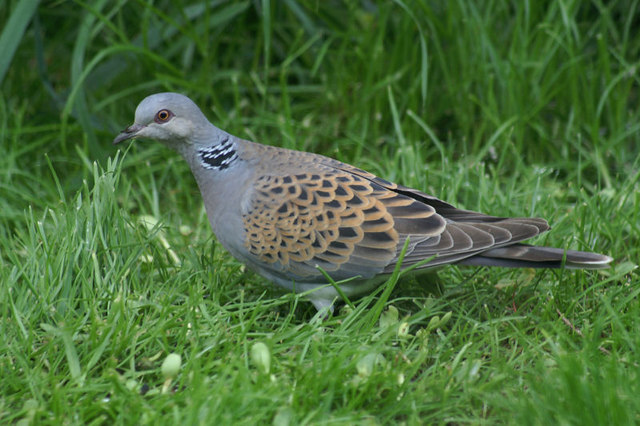
Turtle Dove (Photo courtesy Mike Pennington)

Turtle Dove (Photo courtesy Mike Pennington)

The song’s turtle dove is the European Turtle Dove, a bird that looks a lot like our Mourning Dove.  The Turtle Dove migrates to southern Africa each winter, and there might be times when you wish ours would.  Unlike our dove, the Turtle Dove population has dropped by nearly two-thirds, in part due to the other hemisphere’s pathetic practice of shooting migratory birds for fun.  More cheerfully, the three French hens in the song would have been a welcomed gift, since French chickens (Faverolles) are gentle, good pets that lay lots of eggs. They’re also good to eat, which might rule out the family pet idea. 

I used to think the fourth gift was ‘Four calling birds’, but when researching this article, I discovered it was ‘Four colly birds’.  Live and learn.  It turns out that a colly bird is really a blackbird, specifically the Common Blackbird.  This European bird actually is a thrush like our American Robin, and not a true blackbird at all.  Maybe that’s why they called it a colly bird.  This bird is also somewhat of a celebrity.  It was considered sacred in classical Greek folklore, and it’s the subject of ‘Sing a Song of Sixpence.’  If you remember that poem, four and twenty blackbirds were baked in a pie, a dainty dish they set before the king.  In medieval times, they actually put live birds under a pie crust just before serving, which could explain how the birds were able to sing when the pie was opened.  The poem ends with a blackbird snipping off the nose of the king’s innocent maid, proving there was little justice back then.  In spite of this, the Common Blackbird is now the national bird of Sweden. 

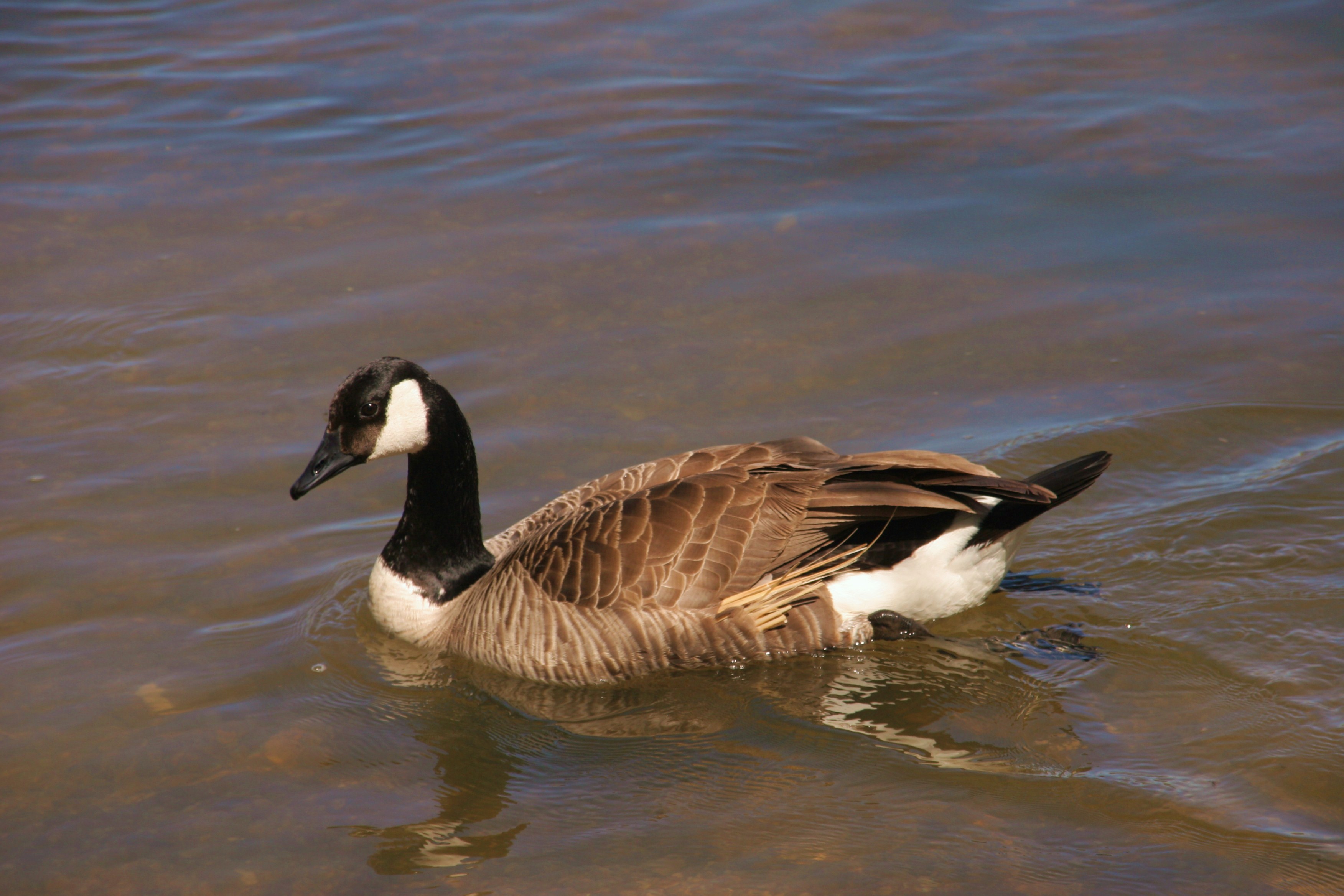
Canada Goose (Photo Bob Bowers)

Canada Goose (Photo Bob Bowers)

The final two birds of the song are action figures, possibly because ‘six geese-a-laying’ and ‘seven swans-a-swimming’ was a transition from perching birds to leaping lords.  In any event, these birds are more familiar to Americans.  We once lived on a river in Oregon, and didn’t have to travel far to see Tundra Swans.  Our Canada Geese fit the song well, too, laying each spring and raising dozens of goslings in our backyard.  Here in SaddleBrooke, you get a backyard full of quail instead of geese.  Sort of like geese, quail lay lots of eggs, raise dozens of chicks and run around eating your flowers.  Unlike quail, Canada Geese stand three feet tall, have a wingspan of five feet and perpetually pump out fertilizer.  When you hear ‘The Twelve Days of Christmas’ this year, be thankful you’re in Arizona.


(This article originally appeared in the December, 2014 issue of the Saddlebag Notes newspaper, Tucson, Arizona.)


Posted in Birding the Americas | Tagged , , | 1 Comment